

[비즈한국] On July 16, the Lee Jae-myung administration’s party-government consultative council officially announced the 'Basic Plan for the Establishment of the Armed Forces Academy (tentative name) in Gyeryongdae.' The plan envisions merging the Army, Navy, and Air Force academies into a single campus in Gyeryongdae, Yuseong-gu, Daejeon, where cadets would receive their four-year education together. Defense Minister Ahn Gyu-baek delivered a message about breaking down the silos between each branch, stating, "Jointness is not something that should just be strengthened, but something that must become part of our constitution."
The problem is that public opinion opposing the merger is significant. According to a report by Monthly Chosun, 91.3% of the 1,791 military cadets nationwide opposed the merger. An NBS public opinion poll also showed that 55% of the public were against it. The opposition from the alumni associations of each military academy is also intense.
The Defense Ministry's objective of strengthening jointness within the military is legitimate and difficult to dispute. However, those opposed to the merger point out that even the U.S. military, which is considered the most proficient at conducting joint operations, operates separate academies: West Point for the Army, Annapolis for the Navy, and Colorado Springs for the Air Force. The United Kingdom, which has a smaller military force than South Korea, also operates separate institutions: the Royal Military Academy Sandhurst for the Army, Britannia Royal Naval College for the Navy, and Royal Air Force College Cranwell for the Air Force.
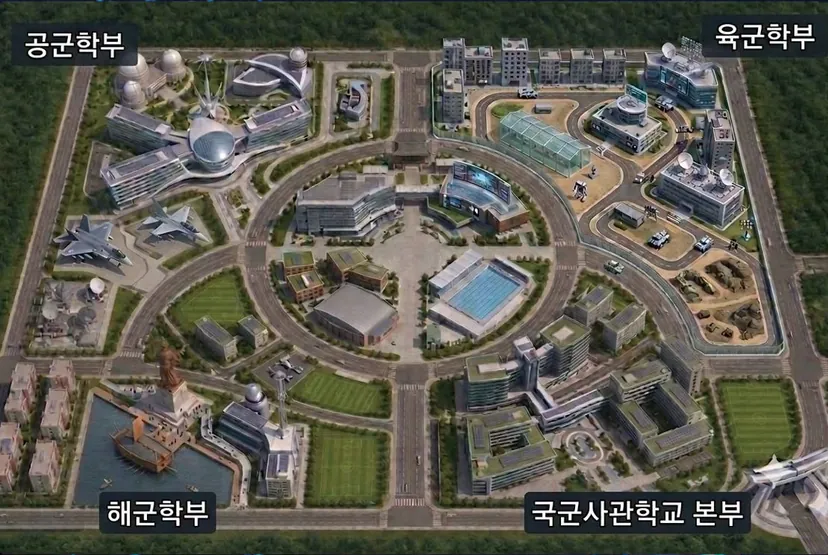
Two Paths of Argument Against Integration
It is difficult to find clear evidence or instances where the current curriculum of separate military academies hinders the military's jointness. Because of this, those opposing the merger argue that since jointness can be strengthened even while operating separate academies, the government has 'other motives' for pushing for integration at a huge cost. The logic is that the government is shaking up military education institutions for political purposes.
The political purpose mentioned here ultimately targets the December 3 insurrection. The claim is that the government is pushing for a retaliatory merger because the key soldiers who led the insurrection were all graduates of the Korea Military Academy (KMA). This perception also forms the backdrop for the opposition movement led primarily by the opposition party.
However, there are points where it is difficult to readily agree with the criticism of 'political motives.' Although the meme circulating on the internet that "The Korea Military Academy has attacked the capital city of Seoul more than any foreign enemy" is a satirical expression, it is difficult to see it as completely disconnected from historical facts. The fact that the majority of commanders who ordered illegal military operations and troop deployments from the May 16 coup to the December 12 coup and the December 3 insurrection were KMA graduates is something our military must reflect on painfully. Yet, those opposing the merger are not providing sufficient explanations regarding this issue.
Why Caution is Still Needed
Nevertheless, the integration of military academies should be reviewed very carefully, and the currently proposed method of integration also needs to be re-examined. Because the government is prioritizing 'strengthening jointness' while failing to explicitly mention 'eradicating the remnants of insurrection,' it is difficult to increase the military's combat effectiveness through integration while simultaneously rectifying the issue of a 'military that threatens democracy' in the current political climate.
First, considering the nature of the December 3 insurrection, it is difficult to prevent a recurrence through a merger of academies alone. The core driving force in the process of former President Yoon Suk-yeol judging, deciding, and executing the insurrection was not the system of the military academy itself, but the 'Korean-style senior-junior cartel.'
Former Defense Minister Kim Yong-hyun, a key suspect in the insurrection, leveraged his KMA connections to favor officers from Choong-am High School and the KMA, often referred to as the 'Choong-am faction.' They, in turn, used these personal networks to appoint key commanders and mobilize troops. Even if the academies are merged, situations could easily recur where graduates of the integrated academy receive personnel benefits based on high school ties and cooperate with politicians' illegal troop mobilization through those relationships.
Second, looking at past examples, there is a possibility that an integrated military academy could deepen the 'Army-centric phenomenon.' The National Sovereignty Government is the sixth administration in South Korean history to pursue a military academy merger. Integration plans were discussed during the administrations of Syngman Rhee, Chang Myon, Park Chung-hee, Roh Tae-woo, and Lee Myung-bak. Except for the Chang Myon government, which cited budget cuts as the reason, all other governments presented 'creating a sense of unity' and 'strengthening joint operations' as their reasons for the push. Each time, concerns followed that the Navy and Air Force could effectively be absorbed into an Army-centered system.
The backdrop for the U.S. military demonstrating strong jointness while operating separate Army, Navy, and Air Force academies is the competitive structure between each branch. To gain an advantage in organizational competition, each branch intensely researches new ways of warfare, and budgets and operational leadership are allocated based on their performance. The U.S. Army researches the Marine Corps' amphibious operation know-how, and the Air Force analyzes the Army's attack helicopter and drone operation methods to competitively seek more effective ways to fight.
The success or failure of this competition is determined through evaluations by civilian bureaucrats, the Department of Defense, and members of the Senate and House of Representatives. In contrast, it has been pointed out that the South Korean Ministry of National Defense and political circles lack the capacity to objectively evaluate which branch is developing its combat power more effectively. As a result, the incentive for each branch to compete for improved combat power has weakened, and a structure where jointness naturally declines has solidified.
Third, it is difficult to cultivate soldiers who support democracy through simple curriculum reorganization. As recently revealed in the so-called 'Baejae High School incident,' many students are emerging who deny democracy or align themselves with extreme claims. One cannot conclude that there will be no students among those admitted to military academies who disparage specific regions or deny the basic principles of democracy. There have been cases in Germany and various other countries where significant internal strife occurred due to the activities of far-right forces within the military.
What is More Urgent Than Integration
For these reasons, a more urgent task than merging military academies is ensuring that cadets accurately understand the 'duty of political neutrality of the military.' It is necessary to provide specific education on what constitutes an unjust order and why a soldier should refuse it. Beyond cultivating soldiers who obey orders, we must raise officers capable of making judgments based on the principles of the Constitution and democracy.
It is also necessary to establish institutional mechanisms to prevent reserve officers who have graduated from the academy from engaging in extreme political activities using the school's name, exerting undue influence on the military and the school, or intervening in various corruption cases. If we only reform the education of active-duty officers while leaving the political influence of the reserve network intact, fundamental change cannot be expected.
In the same vein, those who oppose the merger of military academies must also clearly state their opposition to the December 3 insurrection, which violated the Constitution. It is necessary to specify this in the principles of their opposition activities so that the opposition is not misinterpreted as advocacy or condoning of the insurrection.
Simply insisting on maintaining the status quo of the military academies is also insufficient. To ensure that events like the December 3 insurrection are not repeated, concrete alternatives must be presented to block personnel cartels, strengthen education on refusing unjust orders, and limit the political intervention of reserve forces. Only then can they effectively put the brakes on the government's pursuit of integration and secure a persuasive justification for maintaining separate military academies.
![[Military Tales] LIG's 'Secret Weapon' Anti-Drone Missile: Could it Shoot Down a North Korean Version of the Shahed?](https://s.bizhankook.com/attachments_webp_no_wm/2026/07/134404_no_wm_67d0cb50.webp)
![[Defense Story] Why Canada Submarine Bid Failure Proves Need for New Presidential Secretary for Defense Industry](https://s.bizhankook.com/attachments_webp_no_wm/2026/07/134454_no_wm_eee848e4.webp)
![[Military Story] [Exclusive] Indonesia Completes Final Payment of KF-21 Adjusted Contribution](https://s.bizhankook.com/attachments/2026/07/e8e440c2ed1c_17a7336a.jpg)
![[Mil-Duck Telling] The Root Cause of the 'Rubber Mallet Incident' That Caused Cracks in LAH-1 Engines](https://s.bizhankook.com/attachments/2026/07/50b076aac26a_6fa9356d.jpg)
![[Military Talk] Hanwha Unveils 'Drone-Blocking Command Armored Vehicle' N-MCV for the First Time](https://s.bizhankook.com/attachments/2026/07/096f15b33ac1_a76e4ddb.jpg)