

[비즈한국] South Korea lost the Canadian CPSP (Canadian Patrol Submarine Project) bid to Germany. Our loss to Germany was not a defeat in technical capability, but a failure in the "package design" competition at the state level. This incident serves as retrospective proof of the necessity to establish a permanent control tower through the creation of a Presidential Secretary for Defense Industry.
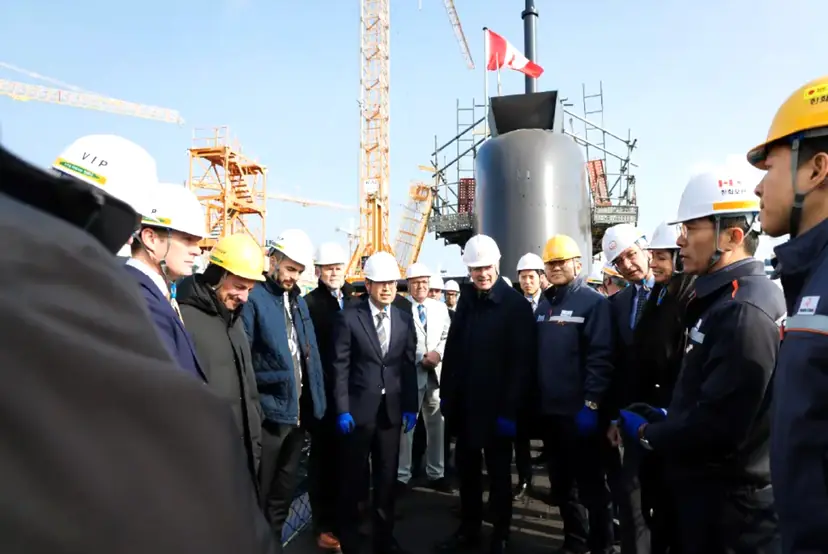
With the Canadian government selecting the German TKMS-Norway consortium as the preferred bidder for the CPSP, a project worth up to 60 billion Canadian dollars, the "Team Korea" of Hanwha Ocean and HD Hyundai Heavy Industries was pushed out in the final stage. Domestic and international experts generally agreed that the KSS-III Batch-II offered by South Korea is a proven, large-scale attack platform currently in operational service, holding a clear technological advantage over Germany's unproven, new 212CD model.
Nevertheless, the evaluation structure designed by Canada's Department of National Defence was weighted toward 50% sustainment, 20% platform performance, 15% financial stability, and 15% economic benefits, making it a game where victory could not be secured through technical superiority alone. In short, this elimination was not a "defeat in technical competition," but a "defeat in diplomatic and economic package competition." It serves as a sober reminder that as a non-NATO member, South Korea remains a challenger and a "guest" in the traditional defense industry and military diplomacy arena.
Furthermore, Germany treated this project not as a commercial bidding war, but as a strategic state-to-state matter. Defense Minister Boris Pistorius personally attended the Canadian defense exhibition, stating, "Choosing the 212CD signifies a consistent pursuit of the Atlantic route," effectively tying the entire bilateral relationship to the defense industry decision. They even presented official government modeling figures, such as an 86 billion CAD contribution to GDP and the creation of 650,000 job-years.
In addition, they proposed an alliance structure with Norway, presenting a vision that would integrate Canada into the existing NATO alliance infrastructure, and quickly solidified trust by detailing maintenance agreements with local Canadian firms and fostering cooperation with universities and businesses. With two NATO allies joining forces to pull out all the stops in their sales pitch, even the momentum of the "advancing K-Defense" was insufficient to overcome them.
In particular, while South Korea deployed a total effort with Presidential Chief of Staff Kang Hoon-sik visiting Canada three times as a special envoy, the initial messaging was focused on corporate performance promotion, such as "40 trillion won in production inducement" and "300 partner companies, 20,000 jobs." While the individual visits by the Minister of Trade, Industry and Energy, the Defense Acquisition Program Administration Commissioner, and the Presidential Chief of Staff at different times matched the level of a total war in terms of physical effort, it was a fragmented structure where ministries intervened sequentially, compared to Germany’s consistent strategic messaging via the single channel of its Defense Minister.
The most fundamental limitation was a structural factor that no amount of visits by special envoys could overcome in the short term: the NATO alliance network. Germany’s 212CD is a multinational, proven platform jointly developed and ordered with Norway, meaning Canada’s choice would signify joining a collective operation and maintenance system among existing NATO members. While South Korea had to build a new bilateral partnership from scratch, the German-Norwegian coalition presented a vision of adding Canada to an already verified alliance infrastructure, creating an inherent asymmetry.
Now, we must review our failure in the Canadian submarine bid and embark on new challenges to strengthen the competitiveness of our defense industry. The most powerful lesson this incident gives us is that a "government-level defense industry export control tower" must be helmed by an expert, enabling government agencies and companies to act as one team in defense exports.
To this end, I propose that the Lee Jae-myung administration establish an "Office of the Secretary for Defense Industry" under the Presidential Office as soon as possible. This was already considered for adoption by the Lee Jae-myung National Sovereignty Government election camp and the State Affairs Planning Committee.
Specifically, I suggest that the office under the Defense Secretary be composed of personnel in charge of strategic planning, regional defense sales, and inter-ministerial communication and coordination. This team would regularly coordinate cooperation among the ministries of defense, foreign affairs, industry, and science, and would be responsible for pre-planning defense sales during summits and state visits. This structure corresponds exactly to how Germany designed its long-term package by mobilizing the Chancellor’s Office, the Ministry of Economic Affairs, and the Ministry of Defense; France also operates a specialized organization for defense exports under its Presidential Office.
Furthermore, if the Office of the Secretary for Defense Industry is established, it should be followed by the annualization of the Defense Export Promotion Conference presided over by the President and the institutionalization of a pan-government collaboration system led by the Minister of National Defense. These measures, combined with financial and institutional support such as the conclusion of the RDP-A with the U.S. and the expansion of tax credits for defense R&D, are necessary to ensure we stop repeating a structure where "we win on performance but lose on the package."
While the Canadian CPSP is over, the current government's policy of becoming one of the top four global defense exporters must never be abandoned. If we operate a permanent control tower that precisely analyzes the evaluation structure and alliance terrain of counterpart nations from the moment project announcements are made in upcoming large-scale bids in Poland, Saudi Arabia, and Indonesia, this elimination will rather become a blessing in disguise—a decisive turning point for the transformation of the K-Defense system.
![[Military Commentary] Can Merging Military Academies Alone Prevent a Repeat of 'Insurrection'?](https://s.bizhankook.com/attachments_webp_no_wm/2026/07/134815_no_wm_d0a713af.webp)
![[Military Tales] LIG's 'Secret Weapon' Anti-Drone Missile: Could it Shoot Down a North Korean Version of the Shahed?](https://s.bizhankook.com/attachments_webp_no_wm/2026/07/134404_no_wm_67d0cb50.webp)
![[Defense Story] Why Canada Submarine Bid Failure Proves Need for New Presidential Secretary for Defense Industry](https://s.bizhankook.com/attachments_webp_no_wm/2026/07/134454_no_wm_eee848e4.webp)
![[Military Story] [Exclusive] Indonesia Completes Final Payment of KF-21 Adjusted Contribution](https://s.bizhankook.com/attachments/2026/07/e8e440c2ed1c_17a7336a.jpg)
![[Mil-Duck Telling] The Root Cause of the 'Rubber Mallet Incident' That Caused Cracks in LAH-1 Engines](https://s.bizhankook.com/attachments/2026/07/50b076aac26a_6fa9356d.jpg)
![[Military Talk] Hanwha Unveils 'Drone-Blocking Command Armored Vehicle' N-MCV for the First Time](https://s.bizhankook.com/attachments/2026/07/096f15b33ac1_a76e4ddb.jpg)