

[비즈한국] As the Ministry of National Defense recently announced its 'Drone-Counter Drone Development Policy' and declared investment in drone capabilities and counter-drone systems, LIG D&A has drawn attention by revealing detailed information about its anti-drone missile, which could be called a 'Shahed Killer.'
During the Defense Industry Development Exhibition (INLEX) held in Daejeon last June, LIG D&A revealed details about its self-developed anti-drone missile through a seminar titled 'Introduction to Counter-Drone Guided Weapon Systems and AI-Based Core Technologies.' According to the disclosed information, the anti-drone missile developed by LIG has a diameter of 140mm, a length of 1.8m, and a weight of approximately 38kg, making it very similar in shape and function to the 'long-range anti-tank guided weapon' that was displayed at defense exhibitions during the LIG Nex1 era.
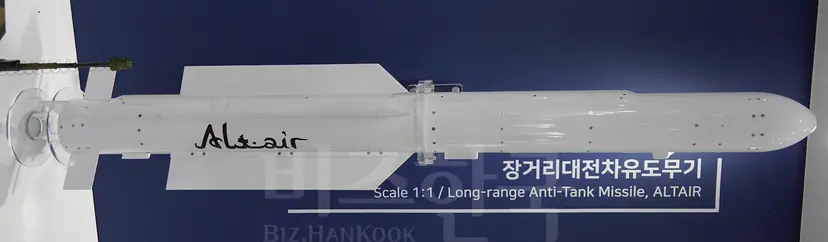
According to LIG's presentation, this missile is designed to be mounted on vehicles to intercept enemy drones. Once a drone detection radar identifies an enemy drone, the vehicle-mounted Electro-Optical Targeting System (EOTS) performs final identification before the missile is launched.
The launched missile is guided via a wireless data link to the vicinity of the enemy drone, after which an Imaging Infrared (IIR) seeker locates the target and destroys it. It is designed with a proximity fuse, ensuring the missile detonates automatically when it approaches near the target drone. Throughout this process, an LIG-developed fire control system automates the target detection and tracking procedures and has the capability to automatically assign guided missiles once the engagement target is confirmed.
The target for the anti-drone missile revealed by LIG is 'Group 2' unmanned aerial vehicles (UAVs). According to U.S. Department of Defense standards, military drones are categorized into five groups; Group 2 UAVs refer to aircraft that are under 2 meters in length and fly at speeds of less than 250 knots. The Qasef-1 drone of Yemen's Houthi rebels and Iran's Shahed-136 drone belong to this group. LIG stated that they developed this anti-drone missile based on scenarios where such drones would undertake long-range flights of hundreds of kilometers or more, similar to the 2019 Houthi attack on Saudi Arabian oil facilities or the recent instance of Iran sending Shahed drones to the UAE.
Furthermore, this missile is the first among LIG's missile lineup to apply extensive AI technology. This is because detecting small drones with an optical seeker requires enhancing the precision of infrared seeker algorithms using AI technology.
Development of this anti-drone missile is currently in the completion stage, and it is reported that it has already successfully intercepted drones during tests using inert warheads. However, the exact customers have not yet been disclosed. Notably, LIG D&A signed a strategic partnership in November 2025 at the IDEX 2025 international defense exhibition with an overseas partner to jointly develop and build a production line for a next-generation air defense system. Typically, such joint developments are negotiated behind closed doors and often promoted as the partner country's own domestic weapon system rather than Korean-made, so it is difficult to determine exactly where or how LIG's new anti-drone missile will be exported at this time.
However, I believe that LIG's anti-drone missile, which has been developed secretly for a long time, should not merely remain an export weapon, and that our military also needs to actively push for its adoption. There are three main reasons for this.
First, the threat of a North Korean version of the Shahed is becoming a reality. It is known that North Korea has received significant modern military drone technology from Russia following its troop deployment in the Ukraine war, and has unveiled long-range suicide drones presumed to be 'North Korean Lancet' and 'North Korean Shahed' drones on several occasions, including on August 24, 2024. Experts are concerned about the possibility that North Korea might not only export its locally produced Shahed-type drones to Russia but also use them to attack our territory directly in the event of an emergency.
Second, it could compensate for the weaknesses of the counter-drone systems currently being pursued by our military. While various new systems such as the 'Cheongwang' laser air defense weapon, hard-kill drones, and High-Power Microwave (HPM) weapons are being developed, there are few weapons capable of effectively countering Shahed-class drones that fly from long distances. For this reason, if an actual conflict occurs, there is a high possibility that expensive air defense missiles worth over a billion won per unit will be consumed unnecessarily. If LIG's anti-drone missile were to operate alongside the 'Cheonho' wheeled anti-aircraft gun and 'Cheongung' surface-to-air missiles already in service, a more effective defense against North Korean Shahed-type drones would be possible.
Lastly, if our military adopts it, it is expected that the missile could be mounted on Air Force tactical aircraft such as the KF-21, FA-50, and KA-1, in addition to the existing ground-launched versions. LIG's other export-oriented long-range air-to-surface missile, which has a similar size and performance to this anti-drone missile, is expected to be used as an air-to-surface weapon for exports like the B-250 light attack aircraft. If our fighter jets are equipped with LIG's anti-drone missile instead of expensive European air-to-air missiles, it would not only offer better cost-effectiveness but also allow for a larger payload compared to air-to-air missiles. This would enable our aircraft to intercept multiple targets with fewer sorties even if North Korea attempts a Russian-style 'massive drone attack.'
![[Military Commentary] Can Merging Military Academies Alone Prevent a Repeat of 'Insurrection'?](https://s.bizhankook.com/attachments_webp_no_wm/2026/07/134815_no_wm_d0a713af.webp)
![[Military Tales] LIG's 'Secret Weapon' Anti-Drone Missile: Could it Shoot Down a North Korean Version of the Shahed?](https://s.bizhankook.com/attachments_webp_no_wm/2026/07/134404_no_wm_67d0cb50.webp)
![[Defense Story] Why Canada Submarine Bid Failure Proves Need for New Presidential Secretary for Defense Industry](https://s.bizhankook.com/attachments_webp_no_wm/2026/07/134454_no_wm_eee848e4.webp)
![[Military Story] [Exclusive] Indonesia Completes Final Payment of KF-21 Adjusted Contribution](https://s.bizhankook.com/attachments/2026/07/e8e440c2ed1c_17a7336a.jpg)
![[Mil-Duck Telling] The Root Cause of the 'Rubber Mallet Incident' That Caused Cracks in LAH-1 Engines](https://s.bizhankook.com/attachments/2026/07/50b076aac26a_6fa9356d.jpg)
![[Military Talk] Hanwha Unveils 'Drone-Blocking Command Armored Vehicle' N-MCV for the First Time](https://s.bizhankook.com/attachments/2026/07/096f15b33ac1_a76e4ddb.jpg)