

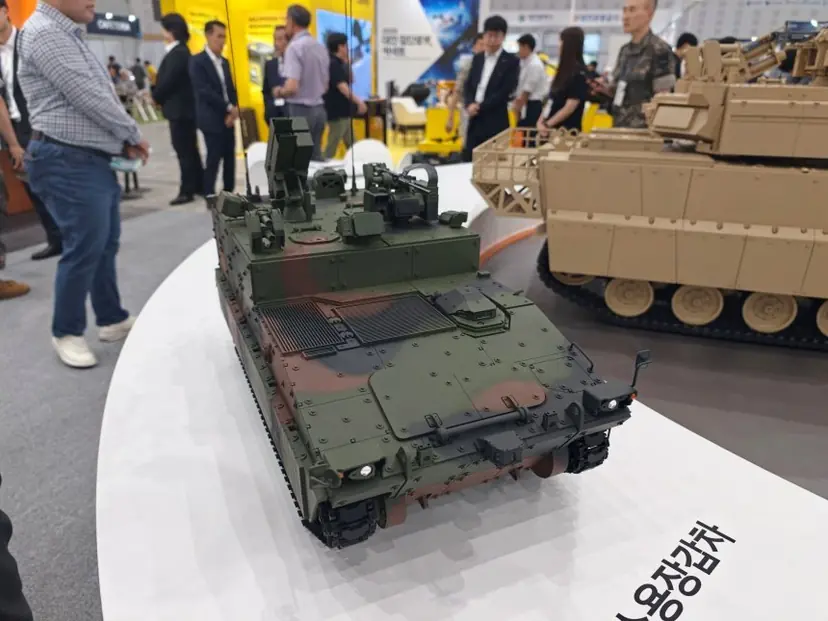
[비즈한국] Hanwha Aerospace unveiled the concept of its next-generation command vehicle, the N-MCV, for the first time at the Korea Defense Industry Exhibition (INLEX 2026), held at the DCC in Daejeon starting the 9th. By significantly modifying the existing K21, the vehicle not only functions as a mobile command post but also introduces a concept to defend against enemy drone attacks by integrating a triple-layer drone defense system—a protective concept applied to a command armored vehicle for the first time in the world.
Currently, South Korea operates command armored vehicles for its mechanized and artillery units. The artillery branch uses the K77, based on the K55 self-propelled howitzer, while the mechanized units use the K277, a modified version of the K200 armored vehicle. Both vehicles are not only aging but also lack the communication and computing infrastructure required for multi-domain operations, creating limitations in executing effective command in modern warfare.
Fortunately, a wheeled command post vehicle, which is a modified version of the K808 wheeled armored vehicle, has been developed and is currently being deployed. Unlike the past, it is equipped with advanced command and control equipment such as division/brigade-level ground tactical C4I systems and battalion-level or lower combat command systems, significantly improving command and control capabilities.
The problem is that mobile command posts are no longer safely protected in modern warfare. Conceptually, command posts are positioned with escort troops and assets to avoid enemy attacks, but with the technological advancement and proliferation of suicide drones, the threat to rear-area command posts is intensifying by the day.
The N-MCV (Next-Generation Mobile Command Vehicle), developed in-house by Hanwha Aerospace and debuted at the INLEX exhibition, is a next-generation command vehicle that overcomes these limitations. It primarily uses a heavily modified K21 armored chassis, removing the turret and adding supplemental armor. Up to this point, it is identical to the N-CEV, an engineering armored vehicle currently undergoing trials by the ROK Army.
The N-MCV further modifies the reinforced K21 chassis by increasing the height of the rear command compartment to secure space. This provides an unprecedentedly spacious internal command area, significantly enhancing convenience during command and control operations and tactical meetings.
Furthermore, the N-MCV emphasizes vehicle survivability, particularly its Counter-Unmanned Aircraft System (C-UAS) capability. To address this, the N-MCV features a three-stage drone defense system, which is an appropriately adapted version of the K-NIFV concept first revealed by Hanwha at last year's Seoul Air Show.
The first drone response system of the N-MCV is a small anti-drone missile. Optimized for intercepting drones, this missile is the Mark 1 air-defense missile from Estonian startup Frankenburg Technologies, which successfully passed interception tests last December. Its ultra-compact size makes it much smaller and lighter than standard air-defense missiles, weighing less than 2kg, yet it is capable of shooting down Shahed-class drones at an affordable price point of around $50,000. Hanwha Aerospace012450 signed an MOU for the joint development of a C-UAS system for next-generation command armored vehicles with Frankenburg on February 9 at WDS 2026 in Riyadh.
The second response system is an AI-based Remote Controlled Weapon Station (RCWS). While existing RCWS could only fire at ground targets via remote operation, the AI-based RCWS utilizes AI Automatic Target Recognition (ATR) technology to detect, lock onto, and shoot down enemy drones autonomously. It enables faster response times than human operators, allowing for more rapid countermeasures against surprise drone attacks.
The final defense system is the Active Protection System (APS). Currently being localized by Hanwha Aerospace and Hanwha Systems272210, this system detects incoming enemy missiles and drones using Active Electronically Scanned Array (AESA) radar and infrared sensors, then fires interceptor munitions to neutralize them. While current similar overseas systems can only counter enemy missiles, the APS under development by Hanwha is being designed to counter both drones and missiles. However, considering weight constraints, a lightweight version is expected to be installed rather than the system intended for Next-Generation Infantry Fighting Vehicles (NIFV).
The N-MCV is designed to enable battalion-level command, carrying two crew members and six command personnel. It is equipped with various satellite communication devices, radios, and conference equipment to support a next-generation military command system integrated with AI. Its introduction is expected to significantly boost the command capabilities of the Army's mechanized units as they transition into AI-powered, manned-unmanned teaming (MUM-T) forces under the 'Army TIGER 4.0' initiative.
![[Military Tales] LIG's 'Secret Weapon' Anti-Drone Missile: Could it Shoot Down a North Korean Version of the Shahed?](https://s.bizhankook.com/attachments_webp_no_wm/2026/07/134404_no_wm_67d0cb50.webp)
![[Defense Story] Why Canada Submarine Bid Failure Proves Need for New Presidential Secretary for Defense Industry](https://s.bizhankook.com/attachments_webp_no_wm/2026/07/134454_no_wm_eee848e4.webp)
![[Military Story] [Exclusive] Indonesia Completes Final Payment of KF-21 Adjusted Contribution](https://s.bizhankook.com/attachments/2026/07/e8e440c2ed1c_17a7336a.jpg)
![[Mil-Duck Telling] The Root Cause of the 'Rubber Mallet Incident' That Caused Cracks in LAH-1 Engines](https://s.bizhankook.com/attachments/2026/07/50b076aac26a_6fa9356d.jpg)
![[Military Talk] Hanwha Unveils 'Drone-Blocking Command Armored Vehicle' N-MCV for the First Time](https://s.bizhankook.com/attachments/2026/07/096f15b33ac1_a76e4ddb.jpg)
![[Military Talk] The Blueprint for a Crewed Spacecraft Using South Korea's Independent Technology Has Emerged](https://s.bizhankook.com/attachments_thumb/2026/06/98717_thumb_a7e83bdd.webp)