

[비즈한국] Bizhankook is serializing a strategy report written by the Yonsei University Business Innovation Track (BIT) over approximately 10 installments. Through reports analyzing the problems of companies at a turning point from the perspective of Gen Z, we aim to provide insights into innovation.
With the advent of the Electric Vehicle (EV) era, the battery industry was spotlighted as a future growth sector. Until 2023, EV battery sales surged based on eco-friendly policies and technological innovation, showing rapid growth. However, an unexpected turning point arrived. Due to the “chasm,” growth in Europe and North America slowed in the first half of 2024. In particular, the sluggish performance of Hyundai Motor005380 in the domestic market was notable. As growth slowed and automotive OEMs faltered, battery manufacturers' stock prices naturally plummeted as well. Samsung SDI006400 was no exception to this downturn.
From a long-term perspective, the transition to electric vehicles is indispensable, so the EV battery market is still expected to grow. So, how are other companies dealing with the chasm, and what is the situation for Samsung SDI? In this article, we will analyze the rapidly changing battery market environment and propose strategies for Samsung SDI to secure market influence in the mid-to-long term.
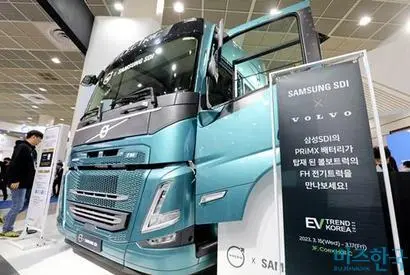
The Reality of the EV Chasm
The stagnation in EV sales was particularly noticeable in the first quarter of 2024. Consumers delayed EV purchases, and automakers cut back on investments as inventory piled up. Battery manufacturers saw their stock prices plummet, and an austerity trend spread across the industry.
The background of the growth slowdown in the EV market lies in the concept of the “chasm.” A “chasm” refers to a phenomenon where market growth temporarily stalls because the public hesitates to adopt a new technology until it is sufficiently verified and the ecosystem is mature. In the EV market, it became apparent that while early adopters accepted initial inconveniences out of interest in environmental values and technological innovation, the general public expects the same level of economic viability, convenience, and stability as internal combustion engine vehicles. The reduction in government subsidies also had a significant impact.
Ultimately, the root cause of the EV chasm can be structured into “economic bottlenecks” and “technological bottlenecks” that fail to meet the requirements of the mass market. The complex interaction of these two factors has slowed the pace of market diffusion.
Recently, with increased interest in the environment, technological advancements, and intensified price competition among OEMs, the economic bottleneck has partially eased. However, the technological bottleneck remains, and overcoming infrastructure and technical limitations is necessary to alleviate it. As the issue regarding the expansion of charging infrastructure has been partially resolved, the game changer for the market going forward will be battery technology that can “simultaneously innovate the performance and cost of electric vehicles.” The importance of R&D on new technologies will likely be emphasized accordingly.
The Battery Market Split Between NCM and LFP
In addition to demand-side uncertainty, the shift in the technological paradigm is acting as another axis reshaping the market. Let us first talk about the structure and technical characteristics of EV batteries, which are the foundation of technological innovation.
An EV battery is composed of a hierarchical system, with the battery cell as the most basic unit. The cell is where the basic charging and discharging reactions occur, and it consists of four key materials: cathode, anode, separator, and electrolyte.
Among these, the most important is the cathode material. The cathode is a core material that forms the positive electrode of the battery and determines the battery's capacity and output. Battery performance and characteristics vary fundamentally depending on the type of cathode material, and the market is currently divided mainly between two types.
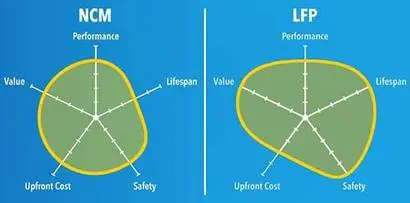
The first is the ternary lithium-ion battery, known as NCM. By using a cathode material that mixes nickel, cobalt, and manganese, it boasts high energy density and excellent output. However, it has the disadvantages of high cost, relatively short lifespan, and fire risk. Domestic companies like Samsung SDI, LG Energy Solution373220, and SK On mainly produce these, and they are mostly equipped in premium electric vehicles.
The second is the lithium iron phosphate battery, known as LFP. LFP batteries, which adopt a cathode material using lithium, phosphorus, and iron, have the advantages of high stability, long lifespan, and low cost. Conversely, they have disadvantages such as low energy density, heavy weight, performance degradation in winter, and low output. Chinese companies like CATL and BYD lead the production of LFP batteries, and they are mainly used in mass-market electric vehicles and ESS (Energy Storage Systems).
Chinese companies producing LFP batteries are trying to solve energy density and performance issues through R&D. They have also established ESS fields and recycling ecosystems by introducing additional processes. How to respond to these moves by Chinese companies will also be an important factor for survival in the future battery market.
All-Solid-State Batteries Combining Both Advantages
The all-solid-state battery is a next-generation technology that replaces liquid electrolytes with solid electrolytes. It is differentiated by its ability to implement the high energy density of existing NCM batteries and the stability and lifespan of LFP batteries in a single system. Going beyond simple performance improvements, it can simultaneously alleviate the technical and psychological bottlenecks that are key constraints in the EV market, such as range anxiety, fire risk, and high maintenance costs. In particular, the solid electrolyte-based structure fundamentally lowers the possibility of thermal runaway to resolve safety concerns, and high energy density satisfies consumer demands by increasing the driving range per charge. A long lifespan reduces battery replacement costs.
As such, all-solid-state batteries are evaluated as a technical solution that can structurally resolve the current EV chasm. While it is in a stage that requires further development and cost reduction for commercialization, the “killer specs” provided by all-solid-state batteries are strategically significant in that they simultaneously enhance mass market acceptance and lead a market paradigm shift. The company that secures this technology early and captures the market first is highly likely to gain an advantage in the post-chasm EV market and lead the technical standards of the battery ecosystem.
Samsung SDI's Current Status
So, how is Samsung SDI responding to the rapidly changing battery market due to the chasm and new technologies?
Looking at Samsung SDI’s revenue structure, as of 2024, the Energy Solution business accounts for 95% of the total portfolio, and the Electronic Materials business accounts for 5%. Energy Solution is again divided into three core businesses. The first is the EV battery market, a market worth approximately 193 billion USD, where Samsung SDI’s global market share is about 3.3%. It has supplied batteries from high-performance EVs to mass-market EVs, but faces risks from client demand slowdowns and inventory adjustments due to the transition to LFP batteries.
The second is the ESS battery business, a market worth approximately 14 billion USD, with a global market share of about 4.9%. With AI development and increasing demand for data centers, the market is expected to grow by an annual average of 12% to 14%, and there is an opportunity area in the expansion of renewable energy.
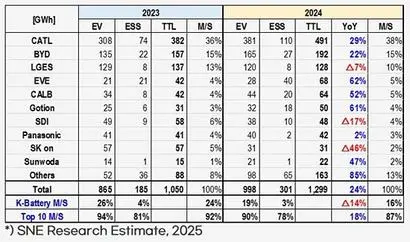
The third is the small lithium-ion battery business, a market worth approximately 65 billion USD, where it holds a 26.8% global market share, ranking first. These batteries are used in smartphones, wearable IT devices, and power tools, and expansion into applications such as small mobility is expected. However, there are issues in terms of margins due to unit price pressure and intensified competition.
Samsung SDI’s revenue model is a B2B business that provides batteries to automotive OEMs or IT device manufacturers and receives payment. Therefore, the product demand of the client company determines Samsung SDI’s revenue. This means it is directly affected by the client’s market situation, which is why it is inevitably vulnerable to external environmental changes such as the EV chasm.
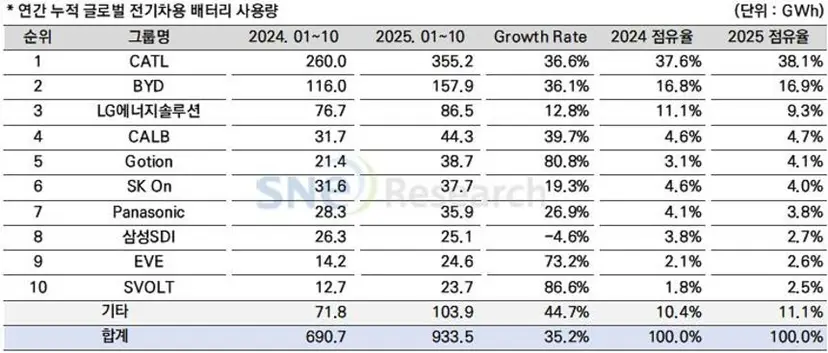
So far, Samsung SDI’s stock price has shown a continuous downward trend. This is the result of a combination of external environmental factors and internal business factors. First, looking at external environmental factors, the slowdown in EV demand due to the EV chasm led to sluggish EV sales by major clients, which was a direct hit. The reduction in U.S. EV subsidies led to a decrease in North American market revenue, and instability in subsidy policies, tariffs, and regulations in various countries increased uncertainty in overseas markets. Additionally, price competition intensified as Chinese companies such as CATL and BYD expanded their market share with low-cost LFP batteries.
Recently, Samsung SDI has partially resolved the issue of lost revenue streams due to the chasm by strengthening its ESS sector. However, a strategy is needed to survive in the EV battery market, which can be considered one of the essences of Samsung SDI.
As for internal business factors, there has been a slowdown in performance across all business divisions, with growth slowing in EV, ESS, and small batteries. Furthermore, the recently approved 2 trillion won capital increase raised concerns about the dilution of existing shareholder stakes. However, a bigger problem is that it has been slower than its competitors to respond to these external environmental changes.
Competitors' Responses
CATL, the leader in the battery market, is currently strengthening its regional supply chain by establishing joint ventures in North America and Europe. Although the Trump 2.0 administration’s tariff and regulatory policies were expected to put a brake on Chinese companies, they have not produced meaningful results. In this situation, CATL is seeking technological diversification and differentiation by maintaining its LFP technology leadership while commercializing next-generation technologies such as sodium-ion batteries, which have further advanced the field. Not stopping there, the company is even planning to expand its portfolio by extending its business to the entire battery ecosystem, including ESS.
LG Energy Solution, one of the representative players in the battery market, recently acquired the joint venture in the U.S. that it had established with General Motors (GM) entirely. With this, it has secured three standalone plants and five joint venture plants in the U.S. It has secured regional hubs by investing in plants in Hungary and Spain in Europe, and is pursuing technological innovation by developing next-generation technologies such as dual-power architecture. It has also implemented a business diversification strategy to strengthen its ESS and small battery businesses in preparation for demand shifts after the chasm.
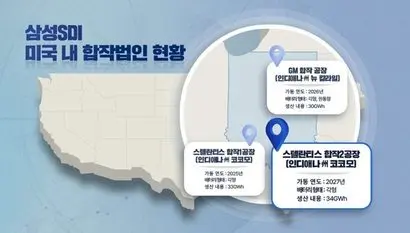
On the other hand, Samsung SDI pursued the establishment of JVs (Joint Ventures) in North America and Europe, but the results have not yet appeared significantly. The North American JV “StarPlus Energy,” a joint venture with Stellantis, began plant operations in the fourth quarter of 2024, but due to a sharp drop in EV demand, it recorded a cumulative revenue of 471.1 billion won and a cumulative loss of 101.1 billion won through the third quarter of 2025. Also, in terms of business diversification, such as LFP conversion, response to multi-form factor cells, and strengthening the ESS field, it is lagging behind major competitors including CATL and LG Energy Solution.
However, Samsung SDI has its strengths. Samsung SDI is at the forefront alongside Toyota, CATL, and others in developing technology for all-solid-state batteries, the “game changer” of the market. With the goal of commercialization in 2027, it is currently on the verge of initial mass production.
Short-Term Strategy: Securing a Foundation for Survival Through Portfolio Diversification
The sharp drop in EV battery demand due to the EV chasm is becoming an immediate survival threat to Samsung SDI. To respond to this, portfolio diversification through investments in other battery-related sectors such as ESS, which domestic companies including LG Energy Solution are currently undertaking, is inevitable.
The ESS battery market is expected to grow by an annual average of 12–14% due to AI development and increased demand for data centers, and it aligns with the macro trend of renewable energy expansion. In a situation where the EV market is stagnant due to the chasm, ESS becomes an alternative revenue source that generates stable cash flow. In addition, the small lithium-ion battery sector, where SDI holds a global top-tier market share, is also seeing applications expand to wearable devices and small mobility, so it can diversify its profit base by strengthening investment in this sector.
This portfolio diversification strategy is not just about risk mitigation; it is about building a hedging mechanism against market volatility. By creating a structure where ESS or small battery profits supplement the decrease in EV demand, the company can maintain sustainable operations even during short-term market shocks. Since the resolution of the chasm is inevitable in the long term, the core of the short-term strategy is to secure the capacity to execute mid-to-long-term strategies to survive in the rapidly changing battery market through this portfolio diversification strategy.
Mid-to-Long-Term Strategy: Taking a Leap Forward by Capturing the All-Solid-State Battery Market
After securing a foundation for short-term survival, Samsung SDI must proceed without setbacks in the current development stages, such as pilot scale-up and prototype production, to preempt the mass production of all-solid-state batteries. The 2027 mass production target must be kept for the first-mover effect, and at the same time, strategic partnerships with major OEMs must be built from the early stages to prepare for future expansion of influence.

Preempting the all-solid-state battery market has strategic significance in four aspects. First, by securing the early premium EV market (Mercedes-Benz, BMW, Porsche, etc.), it can lock in key clients for a long period. Since automotive OEMs do not easily change battery suppliers, initial supply contracts are highly likely to lead to long-term monopolies. Second, due to the nature of the battery industry, where cumulative production experience is directly linked to cost competitiveness, the first-mover company can secure a 2–3 year learning curve advantage, allowing it to maintain lower defect rates and costs than latecomers.
Third, the technology specifications of the first-mover company become the de facto industry standard, forming barriers to entry across automotive design, charging infrastructure, and the supply chain. Fourth, based on technological leadership, it can secure pricing power, create additional revenue opportunities such as technology licensing, and exercise greater influence over standard and policy discussions within the EV ecosystem. Ultimately, Samsung SDI’s preemption of all-solid-state batteries has the strategic significance of moving beyond mere technology acquisition to a position of leading market structures and rules.
In particular, it can secure a competitive edge in the high-tech premium segment, where the efficiency strategies of Chinese companies—which are competitive in LFP-based mass production and cost reduction—do not work. With high technological barriers that make short-term pursuit difficult, and the fact that the market is in its early stages where the first-mover effect is significant, it can solidify a structural advantage by entering the premium market centered on luxury car brands and building technological standards and ecosystems. The key is that it can create a new game of technology and value competition rather than price competition.
By harmoniously executing short-term responses and long-term technology strategies, Samsung SDI will be able to secure sustainable competitiveness in the post-chasm EV market and lead the shift in the industrial paradigm.
![[Gen Z Insight] Hyundai Motor's 'Entry into F1': Holy Grail or Poisoned Chalice?](https://s.bizhankook.com/attachments_thumb/2026/05/96693_thumb.webp)
![[Gen Z Insights] The Great Upheaval in the Travel Industry: The Crisis and Opportunity Facing Mode Tour](https://s.bizhankook.com/attachments_thumb/2026/05/96719_thumb.webp)
![[Gen Z Insights] Hanwha Life's Strategy to Target the MZ Generation for the 'Future'](https://s.bizhankook.com/attachments_thumb/2026/05/96670_thumb.webp)
![[Gen Z Insights] Bugs, Overshadowed by Melon and YouTube Music: Why a Premium Strategy is Needed Now](https://s.bizhankook.com/attachments_thumb/2026/05/96756_thumb.webp)
![[Gen Z Insight] How Samsung SDI Can Survive in the Rapidly Changing Battery Market](https://s.bizhankook.com/attachments_thumb/2026/05/96791_thumb.webp)
![[Gen Z Insights] The Path Forward for Dunkin' in the Era of 'Experiential Consumption'](https://s.bizhankook.com/attachments_thumb/2026/05/96809_thumb.webp)