

[비즈한국] Bizhankook is serializing a strategic report written by the Yonsei University Business Innovation Track (BIT) over approximately 10 installments. We aim to provide insights into innovation through reports that analyze the problems faced by companies at turning points from the perspective of Gen Z.
Bugs (NHN Bugs104200) was a powerhouse in the online music market until the mid-2010s. It surpassed 1 million members just 8 months after introducing paid services. However, as of April 2025, Bugs has received a dismal report card with a domestic music streaming market share of just 1.6%. What breakthroughs are available to Bugs?

From Downloads to Streaming
Since the late 2010s, two major changes have occurred in the domestic digital music market. The first is that as the way of accessing music shifted from 'ownership' to 'subscription,' the music streaming market began to grow overwhelmingly. Rather than downloading songs and storing them on their phones, the subscription model based on monthly payments felt far more convenient to consumers.
The background can be identified in three aspects: technological foundations, policies, and consumer behavior. First, with the popularization of smartphones, an environment was created where users could connect to the internet to listen to music anytime, anywhere. However, this was not enough; streaming quality remained unstable on 3G. Later, with the spread of 4G and LTE, a high-speed wireless internet environment was built that enabled real-time streaming of high-quality audio.
Simultaneously, in 2018, when the government completely banned 'bundled download discounts,' the cost burden of downloading increased, accelerating the shift to streaming. Consumers began to prefer subscription-based consumption, which is economical and easy to access, and they became hooked on the convenience of streaming. With the ability to listen to songs unlimitedly for a low cost, reduced burden of file storage, and curation services that alleviate the stress of choosing music, there was no reason for consumers not to use streaming. The emergence of FLAC (high-resolution) audio in the mid-2010s and AI/ML (Artificial Intelligence/Machine Learning)-based recommendation algorithms in the late 2010s have continuously increased the intensity of competition in the domestic digital streaming market.
The Rise of YouTube Music and Spotify
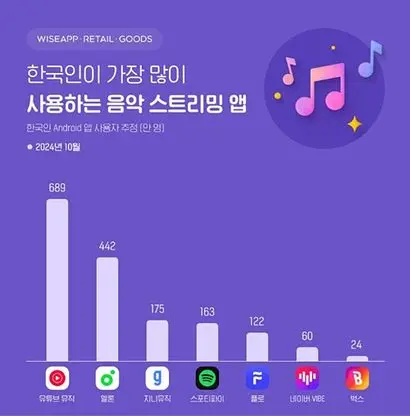
The second change is the emergence of global streaming platforms like YouTube Music and Spotify. This has led to a structural shift in market share within the domestic digital music market.
YouTube Music utilized its 45 million domestic YouTube MAU (Monthly Active Users) to offer a pricing plan of 14,900 won bundled with YouTube Premium services. Considering that domestic music streaming plans were around 10,000 won and that users could listen to unreleased songs not available as official releases, the 14,900 won price tag was sufficient to be perceived as reasonable by consumers. Although YouTube was investigated by the Fair Trade Commission for alleged violations of the Fair Trade Act, the investigation was halted on May 22, 2025, after a voluntary correction measure was effectively suggested, effectively putting the controversy to rest.

Spotify did not show impressive MAU in the domestic streaming market from its initial entry until September 2024. However, after launching 'Spotify Free' in October 2024, which allows users to listen to music for free by listening to ads, its October MAU increased by 450,000 compared to the previous month, and surged rapidly to 3.59 million by May 2025. In this way, global platforms have secured market share by implementing market expansion strategies through their respective strengths, such as 'bundling' or 'offering free services.' This poses a threat to domestic music platforms.
The Rise and Fall of Bugs
In a streaming market where competition is intensifying daily, Bugs' strategy has not been effective. Bugs has consistently developed FLAC (lossless audio). However, the general public valued price and convenience more than high-quality audio. Ultimately, Bugs' attempt to differentiate through sound quality was a strategy limited to a specific niche, failing to have a significant impact on securing MAU or increasing market share.
In terms of curation, Bugs also lacked impressive competitiveness in AI/ML-based personalized recommendations compared to competitors. Melon has 'DJ Mallang-i,' Spotify has 'Discover Weekly,' and YouTube Music utilizes sophisticated AI like 'Ask Music' for effective curation. Curation accounts for a significant portion of consumer satisfaction with listening experiences.

Bugs also lacks competitiveness in platform integration. In modern society, a platform is an ecosystem. Melon has formed an ecosystem with Kakao035720, and Genie with KT030200. In contrast, Bugs formed an ecosystem with PAYCO, a simple payment service under the NHN Group, which failed to create stronger synergies and network effects compared to its competitors.
Combined with these circumstances, Bugs' performance has been consistently declining. Revenue fell from 84.9 billion won in 2019 to 52.1 billion won in 2024, and operating profit continued to decline from 5.6 billion won in 2021, turning into a deficit of over 600 million won as of the first quarter of 2025.
A unique aspect of Bugs as a music streaming platform is that it is currently attempting to reorganize its business centering on B2B. Having decided to invest 70% of its stake in How Entertainment in 2016, it expressed its will for business diversification into content production and distribution capabilities in addition to the music business. It also explored promoting concert businesses using live streaming and VOD services in collaboration with partners. As of 2024, B2B accounts for 56.97% of total business, with B2C accounting for the remaining 43.03%.
Currently, Bugs faces two core crises amidst structural changes in the digital music market: 'weakened market position' and 'profitability pressure.'
The Hope for B2C: Premiumization
Bugs still has the potential to secure competitiveness. It is not impossible if Bugs' strengths are appropriately linked to market opportunities.
Of course, it seems difficult to catch up with the dominance of YouTube Music, Spotify, and Melon in B2C. The reasons are the aggressive strategies of global platforms with overwhelming technological prowess and the loss of internal competitiveness at Bugs, such as failed differentiation strategies. It is no longer easy to catch up with the overwhelming network effects and capital power of the top players. Platforms with high market influence like Melon often monopolize network effects to become the standard for social listening. The Melon Chart still acts as a meaningful indicator for consumers. Moreover, due to its high market share, it has an advantage in music distribution negotiations and can secure exclusive or pre-released content ahead of other platforms. It is a virtuous cycle for market-leading companies—a sad, isolated reality for Bugs.
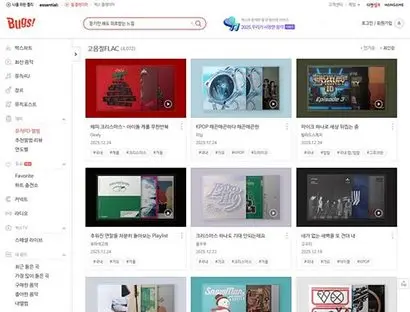
However, Bugs invested in FLAC relatively early and introduced high-quality audio certification marks, preempting technological advantages and know-how regarding sound quality. This is Bugs' first current strength. As Spotify has only just begun to introduce lossless streaming services and sound quality becomes an essential competitive factor, Bugs holds a legacy in this field. The first-mover advantage definitely exists. Bugs was the first to introduce FLAC audio and 'Premium Listening' products in 2016. It also possesses Hi-Res certified audio. Currently, Bugs' sound quality level can be considered the best in Korea.
While the general public values price or UI/UX convenience, there still exists a consumer segment of high-end audiophiles who prioritize sound quality. They are willing to pay for premium subscriptions. Although their numbers may be small, they are highly loyal, high-value consumers who are willing to purchase speakers or amplifiers worth millions to tens of millions of won.
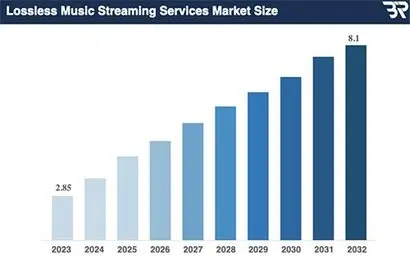
This is a global trend. According to Business Research Insights, the global lossless music streaming service market is expected to grow from $2.85 billion (4.1 trillion won) in 2024 to $8.1 billion (11.7 trillion won) by 2032 at a compound annual growth rate of 14.1%. In 2023, Bugs ranked first among domestic music apps with an average continuous usage period of 523 days. This is a case that proves the possibility that Bugs' strengths will continue to be recognized by consumers.
Therefore, Bugs should design a top-tier pricing plan specialized for FLAC/Hi-Res, rather than general streaming, and position itself as a platform exclusively for audiophiles. Super-fans are willing to pay a premium for high-quality content. It should consider establishing a top-tier pricing plan based on sound quality value to increase ARPU. It should clearly position itself as a sound-specialized high-end platform, moving away from market share competition and focusing on maximizing ARPU from premium customers. While mainstream convenience is important, if it undergoes a comprehensive revamp to provide a specialized user experience for professionals, such as exploring bitrates or mastering information, it could secure a definite revenue source in a niche market. It is also worth attempting to exclusively integrate and partner with high-end device manufacturers that share the same customer base.
Expanding B2B Market Share and Building a Niche for Small and Medium-sized Agencies
Bugs' second strength is that it has already reorganized its business structure centering on B2B. Bugs has already recognized the limitations of the B2C market and expanded its business area into various fields, including distribution and VOD production, beyond simply investing in music production. Combined with the surge in demand for K-content production and distribution, this could become a new land of opportunity for Bugs.
Due to the global growth of K-pop, domestic and international demand for music production, distribution, and overseas live streaming and VOD solutions is continuously increasing. In 2023, K-pop overseas revenue (albums, overseas streaming services, overseas concerts) recorded 1.2377 trillion won, a 34.3% increase from the previous year. In addition, the global K-pop fandom demands high-performance live and VOD solutions to consume artist content without the constraints of time and space. The growth of enter-tech startups meeting this demand is also remarkable. Bima, the operator of the 'all-in-one digital venue' platform that connects artists with global fans, is accelerating its global expansion after attracting an investment of 18 billion won. The growth of K-pop is creating technological and business B2B demand for 'the entire process of creating and distributing music, and delivering it to the fandom live.'
Kakao Entertainment has Melon, the largest music distribution network in Korea, and YG PLUS distributes its own YG artist music. HYBE also operates Weverse, a K-pop artist community platform. Many companies are already doing K-content distribution.
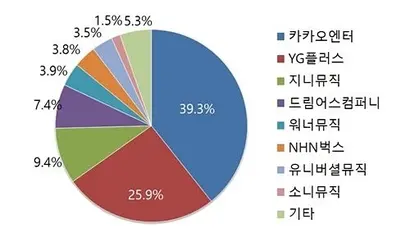
However, entertainment companies have no choice but to prioritize the distribution of their own artists, which are strategically important. Small and medium-sized agencies are naturally pushed to the back of the line on these platforms. Furthermore, as overall album distribution costs rise, small agencies are struggling with operations, and the 'rich get richer, poor get poorer' phenomenon in the K-pop market is intensifying.
Bugs can expand its role in the long term as a 'one-stop K-content distribution/technology solution company' that provides integrated services to them, from music production investment to distribution, domestic and international live streaming, and VOD services. There is also the possibility of being provided with cloud-based large-scale traffic processing technology and VOD hosting solutions through NHN Cloud, a subsidiary of the parent company NHN. Bugs needs to increase its market share in the music distribution business based on these self-owned capabilities and the demand for music distribution from small and medium-sized agencies.
Bugs has lost market share since the 2020s and has been turned away by consumers, with continuous declines in revenue and operating profit. Its former glory appears to have vanished. However, Bugs' unique strengths and market opportunities definitely exist. Repositioning its B2C services and becoming a B2B one-stop solution provider specializing in small and medium-sized agencies could be the solution for Bugs to overcome the current situation.
![[Gen Z Insight] Hyundai Motor's 'Entry into F1': Holy Grail or Poisoned Chalice?](https://s.bizhankook.com/attachments_thumb/2026/05/96693_thumb.webp)
![[Gen Z Insights] The Great Upheaval in the Travel Industry: The Crisis and Opportunity Facing Mode Tour](https://s.bizhankook.com/attachments_thumb/2026/05/96719_thumb.webp)
![[Gen Z Insights] Hanwha Life's Strategy to Target the MZ Generation for the 'Future'](https://s.bizhankook.com/attachments_thumb/2026/05/96670_thumb.webp)
![[Gen Z Insights] Bugs, Overshadowed by Melon and YouTube Music: Why a Premium Strategy is Needed Now](https://s.bizhankook.com/attachments_thumb/2026/05/96756_thumb.webp)
![[Gen Z Insight] How Samsung SDI Can Survive in the Rapidly Changing Battery Market](https://s.bizhankook.com/attachments_thumb/2026/05/96791_thumb.webp)
![[Gen Z Insights] The Path Forward for Dunkin' in the Era of 'Experiential Consumption'](https://s.bizhankook.com/attachments_thumb/2026/05/96809_thumb.webp)