

[비즈한국] Biz Hankook is serializing a strategic report written by BIT (Business Innovation Track), a business innovation society at Yonsei University, over ten installments. We aim to provide insights into innovation by analyzing the problems of companies at a turning point from the perspective of Generation Z.
Everyone says it's necessary, yet the younger generation puts off signing up. With millions of potential customers out there, why has the life insurance market stopped growing?
The domestic life insurance industry has entered a phase of structural low growth amidst low interest rates, an aging population, and strengthened regulations due to the adoption of IFRS17. The market, which recorded an average annual growth rate of over 10% until the early 2000s, plunged to the 1% range after the 2010s, and fell by about 15% in 2023 due to temporary shocks from accounting standard changes. The room for growth through traditional profit-generating methods, such as selling insurance products and investment, is gradually becoming limited.
In this environment, we intend to diagnose the structural challenges facing Hanwha Life Insurance088350 and propose a new strategic direction that reflects changes in the industry and generations. In particular, we explore Hanwha Life's sustainable growth strategy, focusing on the two pillars of supply structure changes following the introduction of IFRS17 and changes in the insurance consumption behavior of the MZ generation.

<Figure 1. Trends in Premium Income of Korean Life Insurance Companies (Unit: Trillion KRW)> Premium income: Premiums received by an insurance company during a certain period or one fiscal year.
Source = PwC, 'Securing New Growth Engines for the Insurance Industry during Low-Growth Periods'
https://www.pwcconsulting.co.kr/ko/publications/pwcconsulting_insurance-newgrowth.pdf?utm_source=chatgpt.com (p.8)
Two Pillars of Long-Term Low Growth
The crisis in the life insurance industry is deepening as changes in the two pillars of supply and demand occur simultaneously. On the supply side, IFRS17, introduced in 2023, fundamentally changed the profit recognition structure. Unlike the previous method of recognizing profit at the time of signing an insurance contract, under IFRS17, it is tied to the Contract Service Margin (CSM) and must be recognized proportionally over the entire contract period. CSM represents the present value of unrealized profits expected to arise in the future from contracts held by an insurer, and it has become a key indicator for gauging an insurer's future profitability and capital soundness. As investors focus more on the quality of CSM than on performance, insurers have naturally concentrated on selling short-term protection products with a high proportion of CSM.
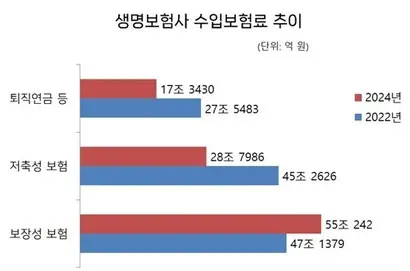
Short-term protection insurance products such as whole life insurance, health insurance, and cancer insurance, which have high CSM proportions, have increased, while sales proportions of pension insurance or savings insurance, which are disadvantageous for CSM calculation, have decreased sharply. According to the Korea Institute of Finance's 'Insurance Industry Trends and Outlook', in 2024, protection insurance premium income for life insurers increased by 17% compared to 2022, but savings insurance decreased by 38% and retirement pensions decreased by 38%. While a product structure centered on protection insurance increases CSM efficiency in the short term under the IFRS17 system, the long-term accumulation base (contract scale and duration) may weaken as the proportion of pension and savings products decreases.
On the demand side, demographic changes due to an aging population and low birth rates are weakening the industry's long-term demand base. The average age of insurance subscribers rose from 38 in 2010 to 46 in 2019, and new contracts for those in their 30s and younger are continuously decreasing. Conversely, the number of subscribers aged 60 and older is steadily increasing, shifting the center of the life insurance market toward the elderly. Considering that the profit structure of life insurance is inherently dependent on risk diversification through the new influx of younger age groups, this change means that the industry's cyclical growth mechanism is weakening.
As these two pillars of change interlock, the life insurance industry is moving toward an unbalanced structure centered on short-term profitability. While insurers maintain external performance by focusing on short-term product sales due to IFRS17, the qualitative accumulation of CSM, which is the foundation for future profits, is actually decreasing. At the same time, they are suffering from a double whammy: the inflow of new customers is stagnant due to the departure of the younger generation, weakening long-term growth momentum. Ultimately, the sustainability of the industry depends on the MZ generation. Insurers are at a point where they must attract new customers with products that reflect the characteristics of the MZ generation.
Short-term Sales Increased, but Long-term Profitability Slowed
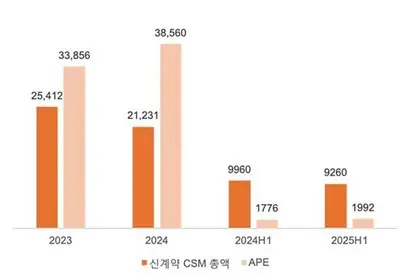
Although Hanwha Life succeeded in maintaining sales through short-term contracts (APE), the imbalance between short-term growth and long-term profitability is deepening as CSM efficiency, a key indicator for long-term value creation, has rapidly deteriorated. This is a common trend across the industry. Structural limitations, such as weakening competitiveness in long-term products and asset management foundations, are also evident for Hanwha Life.
Hanwha Life's new contract CSM for the first half of 2025 showed a downward trend, while the Annualized Premium Equivalent (APE), which converts initial premiums into a one-year basis, increased by 12.2%. This means that while short-term new contract sales are maintained at a certain level, the accumulation of CSM, which signifies the long-term profit base, is gradually slowing down. Looking at the product portfolio, health insurance has the highest proportion at 601 billion KRW. Whole life insurance (274 billion KRW) and pension/savings insurance (51 billion KRW) both decreased. This signifies that the portfolio is being reorganized into a short-term centered structure due to a strategy that focuses on protection products with high short-term profitability.
As a result, the total CSM volume decreased from 2.386 trillion KRW to 1.983 trillion KRW (-16.9%), and new contract CSM efficiency also fell by 38.5%. Although CSM profitability in the health insurance sector improved from 14.4 times to 15.3 times last year, this is closer to defending short-term performance rather than structural innovation.
Limitations of Overseas Expansion Strategy and the Need for Digital Transformation
To overcome these limitations, Hanwha Life is seeking digital innovation and overseas expansion as a breakthrough. It launched a Big Data TF in 2014, the earliest among domestic insurers, and has been building AI and machine learning-based insurance services. Recently, it has been continuously investing in the insurtech field, such as automating underwriting and coverage analysis. It is also attempting to expand its global financial network by acquiring Indonesia's Nobu Bank and the US securities firm Velocity.
However, this is difficult to fundamentally resolve the growth stagnation of the core domestic life insurance business. While there is a temporary effect of diversifying the profit portfolio, without increasing the domestic held-contract CSM and supplementing the long-term profit structure, overseas risks due to expansion could only be added. Therefore, Hanwha Life's mid-to-long-term task is not simple external expansion, but the discovery of a new growth axis that will restore the long-term CSM base in the domestic market. The starting point is understanding the changes in the MZ generation's consumption behavior and their high preference for digital-based insurance.
Post-coverage? Manage my health right now
Unlike the middle-aged and older generations who are the main customer base for life insurance, the MZ generation focuses on current health, risk management, and quality of life improvement rather than the traditional concept of post-coverage. Therefore, the preference for long-term protection products such as whole life insurance or pension insurance is significantly lower. The whole life insurance enrollment rate for ages 15-39 fell by nearly half from 27.4% in 2012 to 14.1% in 2022, and the enrollment rate for ages 20-24 was only 14.6% for men and 13.6% for women as of 2022. On the other hand, the total protection insurance premiums for life insurers increased from 47 trillion KRW in 2022 to 55 trillion KRW in 2024, showing a polarization phenomenon where health and disease coverage demands centered on the elderly are driving market growth.

This change is also caused by shifts in social structure and values. The necessity of traditional insurance for family support has weakened due to the rising age of marriage and the increase in single-person households. The younger generation perceives insurance as a tool to manage current financial risks rather than a product to prepare for after death. They value immediate and tangible coverage experiences rather than long-term post-death preparation, and show higher interest in products combined with healthcare, wellness services, or investment functions. According to a KB Management Research Institute survey, the MZ generation has a stronger tendency to utilize practical asset growth tools like stocks and ETFs rather than insurance as their main financial means.
Such generational changes are also affecting insurers' product strategies. As of the first quarter of 2023, there were 7 new whole life insurance products, more than the 4 new health insurance products, but in the first quarter of 2024, there were no new whole life insurance products, and only 10 new health insurance products were launched. This shows that insurers are shifting the focus of their product portfolios from post-coverage to health and living coverage, reflecting the interests, family structure, and economic constraints of the MZ generation.
Insurance exploration is online, enrollment is offline
There is also a distinct generational gap in the behavior of utilizing digital channels. The MZ generation searches for insurance information through SNS, YouTube, and financial apps, but the actual enrollment stage still remains centered on offline planners. According to a Korea Insurance Research Institute survey, more than 80% of the MZ generation enroll through planners, and the ratio of digital claims and consultation experience is less than 10%.
If the current planner-centered structure is shifted to digital, how much new market could open up? According to a May 2024 Kyobo LifePlanet survey, 67.5% of non-face-to-face channel subscribers and 51.7% of face-to-face channel subscribers among life insurance subscribers responded that they intend to purchase insurance through digital channels in the future. When weighted and added by customer group, about 29.6% of all life insurance customers are classified as potential digital transformation demand groups. In other words, about 1 in 3 of all life insurance subscribers has the potential to access insurance products through non-face-to-face and online-based digital channels in the future.
The total number of domestic life insurance subscribers is about 40 million, and about 13 million of them are in the 20s-40s MZ generation. Applying the aforementioned 29.6% digital enrollment intention rate, the size of customers potentially accessible to digital-based life insurance services is estimated to be about 3.8 million. This means that there is a significant scale of new demand.
However, there is a structural disconnect where exploration starts digitally, but actual enrollment is still done offline. Such inefficiency shows that life insurance companies have not provided enough digital experiences that meet generational changes and customer expectations. If they can provide this, it could be a structural growth opportunity that goes beyond simple channel conversion and transforms unrealized demand into actual customers.
What are competitors doing?
Shinhan Life is differentiated in that it has performed a qualitative transition of its existing insurance portfolio and improved profitability indicators beyond simple non-insurance expansion. As of April 2025, the proportion of protection insurance among new individual insurance contracts reached 93.1%, and the CSM base was strengthened by reorganizing the portfolio around long-term products such as integrated health insurance (ONE) and dementia nursing insurance with high long-term retention rates. As a result, the CSM balance (the total net profit the insurer will recognize in the future), which indicates future profitability, increased by 2.1% from 7.07 trillion KRW in the first half of 2023 to 7.26 trillion KRW in the first half of 2024, and the K-ICS also improved to 196.7%. Shinhan Life can be considered a representative success case that has secured long-term financial soundness and profit bases, securing long-term growth foundations in the IFRS17 system.
On the other hand, Hanwha Life maintained a strategy of focusing on products with high short-term profitability, such as short-term/renewal health insurance, and succeeded in defense in terms of short-term sales (APE), but showed a trend where new contract CSM decreased and total CSM also shrank. While both Shinhan Life and Hanwha Life took the common direction of being 'protection-oriented', Shinhan Life expanded its future value through structural reorganization centered on long-term products, whereas Hanwha Life remained in a business strategy centered on short-term performance.
While domestic insurers have the same problem recognition of responding to an aging population and targeting the MZ generation, their market response strategies are different.
KB Life and Shinhan Life are focusing on aging risks and long-term retention rates, strengthening long-term protection structures for seniors and the middle-aged. KB Life acquired 'KB Golden Life Care' to operate nursing/residential complex facilities, and Shinhan Life launched its subsidiary 'Shinhan Life Care' to provide senior complex facilities and care programs in major locations across the country, building an integrated senior business model.

Samsung Life is taking a strategy of expanding into a prevention-centered insurance ecosystem based on healthcare data, attempting to cover not only seniors but also the health management market for the middle-aged. It is leading digital transformation through AI-based underwriting and automatic screening systems, and has built a virtuous cycle structure that improves loss ratios and retention rates simultaneously by combining customer health management data with the insurance business, centered on its own platform 'The Health'. In fact, as of the first quarter of 2024, it recorded a loss ratio of 83% and a retention rate of 89.7%, achieving the industry's highest level of CSM efficiency.
Overseas, insurtech is growing rapidly through AI automation, digital onboarding, etc., centered on the 2030 digital native generation. The US company Lemonade automated the entire insurance process through AI/chatbots, completing enrollment in an average of 90 seconds and insurance payouts within about 3 minutes, and secured a young customer base with 34-year-olds and under accounting for more than 75% with premiums 68% cheaper on average than existing insurers. Also, through a data-based customized coverage structure, they redefined insurance as a 'lifestyle service' rather than a simple 'post-coverage'. Bowtie, Hong Kong's first digital life insurer, achieved cumulative investment of 118.1 billion KRW, total coverage of 15.6 trillion KRW, and a retention rate of over 94% as of 2024. More than 90% of all customers enroll directly online, and it has recorded 1st place in Hong Kong direct channel sales for 7 consecutive quarters. These are representative models showing the monetization potential of MZ generation-centered digital insurance.
Hanwha Life must also move in a direction that evolves into a generation expansion strategy through AI/digital transformation. The nursing business is an alternative that can mitigate aging risks in the short term, but the demand layer is limited to the elderly, so there is a limit to breaking through the low-growth phase of the insurance industry as a whole in the long term. It is difficult to see this as an 'aggressive strategy' leading the future industrial structure. Therefore, it is necessary to build a future-oriented growth strategy centered on an MZ generation entry model based on healthcare/data rather than profit stabilization centered on seniors.
Must Evolve into Healthcare-Based Insurtech
Unlike the nursing industry, the healthcare industry is a field with universality regardless of generation and high growth potential. In fact, the domestic digital healthcare market size was 6.493 trillion KRW as of 2023, growing by 13.5% compared to the previous year, showing a continuous expansion trend. In particular, young MZ generations like those in their 20s and 30s have a clear tendency to value 'current health management/wellness' and 'data-based customized services'.
Therefore, if Hanwha Life redefines insurance based on healthcare, insurance can be transformed into a real-time health management platform combined with prevention, management, and rewards, going beyond a simple post-coverage product. It is a strategic shift of the paradigm from 'protection-centered insurance' to 'living-centered insurance'.
Furthermore, the healthcare industry can create synergies through combination with insurtech technology. Using AI and machine learning, customer health data can be analyzed to implement a customized structure that automatically adjusts premiums and coverage scope according to individual risk profiles. Such changes lead not only to customer experience innovation but also to the improvement of the inherent profit structure of insurance. Since Hanwha Life already holds digital channels and vast customer data through the LIFEPLUS brand, it has the execution base to build a platform model that integrates 'health management–insurance–rewards'.
If Hanwha Life successfully pushes for a healthcare-based insurtech transition, it will be able to secure a new growth axis that encompasses both the MZ generation and the middle-aged, while at the same time preparing a core strategy to break through the industry's structural low growth.
![[Gen Z Insight] The Paradox Faced by Beauty Platform 'Hwahae'](https://s.bizhankook.com/attachments_thumb/2026/05/96664_thumb.webp)
![[Gen Z Insight] Hyundai Motor's 'Entry into F1': Holy Grail or Poisoned Chalice?](https://s.bizhankook.com/attachments_thumb/2026/05/96693_thumb.webp)
![[Gen Z Insights] The Great Upheaval in the Travel Industry: The Crisis and Opportunity Facing Mode Tour](https://s.bizhankook.com/attachments_thumb/2026/05/96719_thumb.webp)
![[Gen Z Insights] Hanwha Life's Strategy to Target the MZ Generation for the 'Future'](https://s.bizhankook.com/attachments_thumb/2026/05/96670_thumb.webp)
![[Gen Z Insights] Bugs, Overshadowed by Melon and YouTube Music: Why a Premium Strategy is Needed Now](https://s.bizhankook.com/attachments_thumb/2026/05/96756_thumb.webp)
![[Gen Z Insight] How Samsung SDI Can Survive in the Rapidly Changing Battery Market](https://s.bizhankook.com/attachments_thumb/2026/05/96791_thumb.webp)