

[비즈한국] Bizhankook is serializing a strategy report written by the Business Innovation Track (BIT) academic society at Yonsei University over 10 installments. We aim to provide innovation insights through reports that analyze the problems of companies at a turning point from a Gen Z perspective.
Starting with Disclosing All Cosmetic Ingredients
A small revolution occurred in the Korean beauty market in 2013. Starting from the simple question, "What is inside this cosmetic product?", 'Hwahae' was launched as an app that transparently displays all ingredients and harmful components of cosmetics.

In the early 2010s, when Hwahae was launched, the cosmetics market was brand-centric rather than consumer-centric. The ingredient lists on the back of cosmetic containers were filled with technical terms, making it difficult for average consumers to understand which ingredients had which effects or how they would affect their skin.
Hwahae filled this void. It systematically collected and classified scattered ingredient information to build a database and translated difficult chemical terms into language that consumers could understand. It also provided personalized ingredient recommendations and product suggestions based on user reviews that mirrored the user's skin type. It handed powerful tools—an ingredient database and user reviews—to consumers who had previously relied on information unilaterally provided by brands.
With a clear mission of 'resolving information asymmetry,' Hwahae gained consumer trust and grew into the nation's largest beauty platform, holding over 13 million cumulative downloads, 9.6 million reviews, and ingredient information for 380,000 products.
Growing Revenue, Continuing Deficits
However, as of 2025, Hwahae finds itself in a paradoxical situation. While 2024 revenue reached 83.8 billion KRW, showing meaningful growth compared to the previous year, it failed to stop its streak of losses since 2021, recording an operating loss of 2.8 billion KRW. More notably, it has remained in a state of complete capital impairment since 2020. The cumulative deficit of 61.3 billion KRW suggests that these are not temporary difficulties but rather structural issues.
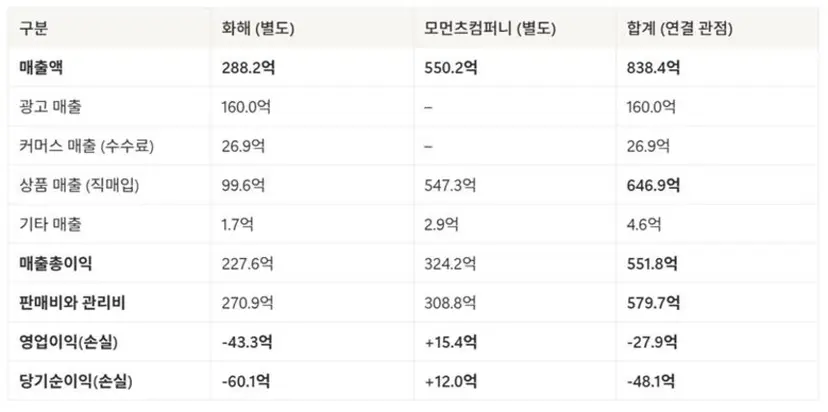
The essence of the problem is revealed when looking at Hwahae's revenue structure. While commerce revenue (separate basis) is 2.7 billion KRW, product revenue is approximately 10 billion KRW, and advertising revenue is 16 billion KRW, the revenue of its subsidiary Moments Company, which operates the beauty brand beplain, is 55 billion KRW. On a consolidated basis, 66% of total revenue is generated by the cosmetics manufacturing subsidiary. Hwahae, which started as an information platform, now relies on its own brand sales as its primary source of income. This demonstrates that while its credibility as an information platform and its user base remain strong, the efficiency of converting this into profit is significantly low.
The classic principle of platform business is clear. Where information asymmetry exists, a mediator is needed, and the mediator creates value by resolving that asymmetry. But what happens if the mediator performs its job 'too' well? The standard of information provision within the market improves, consumers become smarter, and brands start to become transparent on their own. At that moment, the mediator becomes unnecessary. Furthermore, if other platforms absorb that transparent information and integrate it into their own services, the independent mediator’s reason for existence disappears.
Hwahae is exactly in this situation right now. In the consumer-centric market that Hwahae helped create, Hwahae itself is being left behind. We aim to dissect the drivers of change that created this paradoxical situation one by one.
The Beauty Market Has Standardized Upwards Over the Last 10 Years
The beauty market is completely different from what it was 10 years ago. In the past, ingredient disclosure was a legal requirement, but it was limited to being listed in small text on the back of product containers. Online product pages also provided only minimal information. Even if ingredient information was legally accessible, the environment for effectively understanding and utilizing it was not there.
However, now brands actively utilize product pages like 'comprehensive manuals.' They visually emphasize and structure key ingredients, clinical trial results, and institutional certifications. It has become an era where, beyond merely disclosing information, brands strategically position information to actively persuade consumers.
Product power has also generally leveled up. This is because most brands can no longer survive in the market if they fail to secure at least a basic level of safety and quality. Most products have gone beyond being just 'decent,' and keywords like 'mild ingredients' or 'low-irritation formulas' are no longer differentiators but the minimum industry standard and entry barrier. Competition between brands has shifted to a structure determined by the minute blending ratios of ingredients, the completeness of the formulation, specific usage sensations, and above all, how the product is told through storytelling and positioning.
Consequently, consumers' questions have also changed. In the past, the most important concern was what ingredients were in a product; now, it has shifted to what actual changes the product creates for their skin. For example, a qualitative review like "My dark spots faded in two weeks" is far more persuasive than the quantitative information "Contains 5% Niacinamide." Consumers judge the value of a product by looking at the experiences of users with similar skin types rather than analyzing ingredient lists. The yardstick for verification has shifted from ingredients and their safety to visual efficacy.
Consumers Have Become More Emotional and Immediate
Then, in a market where information is transparent and product quality has improved, have consumers become more meticulous, rational, and cautious in choosing products?
Interestingly, the exact opposite is happening. As quality levels across the market have risen, consumers have developed a basic trust that "it probably won't be a problem whichever product I choose at this level." The reason to compare products by cross-checking ingredient lists one by one and reading dozens of reviews as in the past has disappeared.
Instead, emotional factors like 15-second influencer short-form videos, dramatic before-and-afters, and stylish packaging have taken on a greater weight in purchase decisions. More notably, these impulsive and emotional choices often lead to surprisingly satisfying results. This experience further reinforces and justifies a consumer pattern of skipping the information verification stage.
These changes are aligned with the shift in content consumption methods. The proliferation of short-form platforms like TikTok, Instagram Reels, and YouTube Shorts has fundamentally changed the process of discovering beauty products and building trust. As short-form-centered content commerce grows rapidly, consumers perceive and purchase products through video content that has higher visual and experiential persuasive power than text-based reviews. The 'conviction felt the moment you see it' has become far more persuasive than text information that requires careful reading and analysis. In this context, Hwahae's text-based content structure is becoming increasingly out of step with the times.
The Absolute Stronghold Olive Young and the Rapid Rise of Daiso
Furthermore, the market environment itself is being reorganized to Hwahae's disadvantage. The 'super-app-ification' of Olive Young is a prime example. Olive Young, which recorded 4.7 trillion KRW in revenue in 2024, has completely integrated offline and online, completing a structure where curation, reviews, and purchases are all handled within a single app. Information provision and verification are no longer the unique functions of an independent app, but are being absorbed as one of the functions integrated internally by retail, social, and creator platforms.
The influence of the recently surging Daiso beauty is also noteworthy. This is pressuring Hwahae from another angle. Because Daiso beauty, with its high accessibility and excellent price-to-performance ratio, is rapidly expanding its market share, the very process of consumers searching for information and comparing products is being shortened. As the quality of value-for-money products has improved, the mentality of "even if it fails, it's not a huge loss, so I'll just buy it" is at work, reducing the position of information search platforms.
It is not that Hwahae has stood still amidst these changes. It recognized early on that differentiation is no longer possible through 'ingredients' alone, and set a direction to move beyond simply providing information to consumers to becoming a 'K-Beauty Brand Acceleration Platform' that directly supports brand growth. In the second half of 2025, it executed various strategies to materialize this vision, initiating structural improvements centered on three key pillars.
Hwahae’s New Attempts and Limitations
Hwahae linked commerce management solutions (Sabangnet, PlayAuto) to reorganize its system, allowing registered brands to manage everything from product registration to inventory and delivery at once. It promoted commission waivers and top-exposure promotions for new brands, and sought to provide a growth stage for emerging brands by selecting and promoting promising brands based on review data through the 'onlyHwahae' lineup.
However, from a supplier's perspective, Hwahae is a platform that brands can do without. Olive Young entry is still the key to revenue, and content marketing through TikTok or Instagram shows higher efficiency. In such an environment, no matter how much Hwahae provides commerce integration solutions and creates a brand-friendly ecosystem, it will be difficult to autonomously expand the scale of transactions within the platform. The same goes for the vision of growing new brands. While the intent to discover and highlight brands is good, there is a limitation in that since it does not hold equity in product production or distribution, the growth of the brand does not directly lead to Hwahae's profit.
It also attempted globalization. Hwahae launched an English global web version at the end of 2024, followed sequentially by Japanese and Chinese versions, surpassing 500,000 monthly active users as of October 2025. The proportion of North American users reached 57%, and the '#hwahae' hashtag views recorded 29 million, a 60-fold increase compared to the previous year.
However, this does not overcome the essential limitations as an information platform. 500,000 monthly active users is just a scale of traffic, not a direct profit structure. Even if overseas users obtain K-Beauty information through Hwahae, actual purchases take place on external commerce platforms like Amazon or TikTok Shop. Hwahae's announcement of linking to Amazon purchase links also shows that it remains in the role of an information stopover.
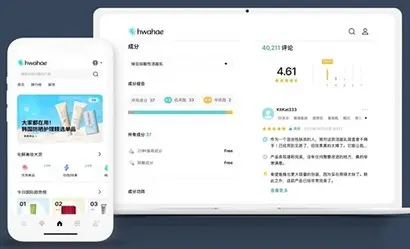
In August 2025, Hwahae launched a 'Beauty Select Shop,' an influencer affiliate program. It is a structure where anyone—influencers, YouTubers, bloggers, etc.—can curate products from Hwahae Shopping, introduce them on their own channels, and earn profits based on sales performance.
However, such influencer affiliate programs are already being operated by various platforms, including Coupang Partners and the TikTok Shop Creator Marketplace. As Hwahae enters as a latecomer, the only point of differentiation is the catalog of brands entered into Hwahae Shopping, but this alone is not enough for creators to make Hwahae a major profit channel. From the creators' perspective, it is more profitable to be active on platforms where they already have a follower base and promote products with the highest conversion rates there.
These attempts by Hwahae are meaningful but do not guarantee sustainability. The essence of the problem is that the information-centered platform model itself does not fit the way the beauty market works. The Korean beauty industry is a brand- and experience-centric market. Consumers trust brands more than platforms, and the factors that determine actual purchases are images, concepts, sensations, and experiential narratives rather than objective information. With the massive on-offline integrated commerce platform Olive Young dominating the market, it is difficult for Hwahae to be competitive while remaining a platform that adds commerce to an information core. What Hwahae needs now is not an improvement in platform functions, but a fundamental redesign of its business model itself.
Possibilities Shown by the Own Brand 'beplain'
Here, it is necessary to re-examine the case of beplain, which Hwahae has already successfully nurtured. beplain is a brand that grew based on the ingredient data and consumer needs analysis accumulated by Hwahae, and it received clear market resonance with its low-irritation skincare line. The message this case shows is clear: Hwahae's real competitiveness lies not in the platform itself, but in its vast ingredient database, precise consumer insights, and the ability to realize these into actual products. The vast assets of 380,000 cosmetic ingredient data, 9.6 million reviews, and skin-type reaction patterns can act as a competitive advantage that can understand consumer skin reactions and ingredient preferences more specifically than any other company.
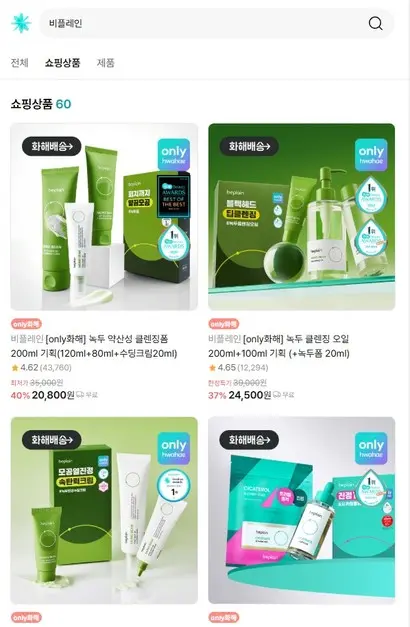
However, there are clear limits to Hwahae expanding its brand business domestically. With Olive Young already reigning as the absolute powerhouse of domestic beauty distribution, Hwahae actively growing its own brands carries a significant risk of damaging its neutrality as a platform. If a platform mediating between brands and consumers operates competing brands simultaneously, it will inevitably lose the trust of other entering brands.
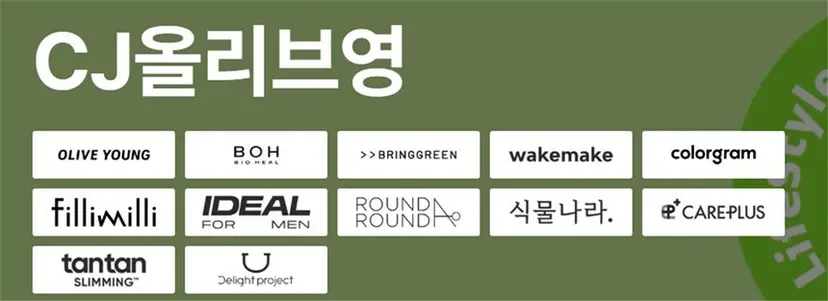
Olive Young, being a commerce-centered platform rather than an information-centered one, does not require neutrality, but it does possess own brands like Colorgram and WakeMake. These are positioned as independent brands in form and do not push the name Olive Young to the forefront. This is a strategy to minimize conflicts of interest between the platform and the brands.
The global market offers Hwahae entirely different opportunities. The domestic beauty market is already sufficiently mature, and consumer understanding of ingredient information is quite high. On the other hand, emerging markets such as Southeast Asia, the Middle East, and South America have plenty of room for differentiation using only the data and know-how Hwahae possesses. These markets have relatively low awareness of ingredient-focused beauty and continuous growth in demand for K-Beauty, creating an environment where Hwahae's data-based brand development capabilities can shine even more.
'Plus Alpha' to Olive Young
Olive Young has already proven the possibility of this strategy. Olive Young grew as a retail platform in Korea, but chose a strategy of putting its own brands to the fore when entering overseas markets.
After both its offline expansion into China in the early 2010s and its US expansion in 2018 ended in failure, Olive Young shifted its direction to a detour strategy through PB (private brand) brands rather than the platform. It began to see results by entering its own brands like Bioheal Boh, WakeMake, and Fillimilli into overseas platforms such as Rakuten, Qoo10 Japan, and Amazon. In particular, the revenue of Olive Young's PB in the Japanese market has grown at an annual average of 125% over the past four years, and upon entering the Japanese market in 2023, it put its own brand portfolio at the forefront, led by WakeMake. This clearly shows that brands are a more effective entry tool than platforms in overseas markets.
For Hwahae to succeed in the global market, it should refer to Olive Young's strategy but go one step further. The key is to operate the brand business clearly separated from the Hwahae platform. By developing brands based on Hwahae's data but positioning them externally as independent brands, it can avoid neutrality controversies and expand aggressively.
It is also good to launch several new brands with the global market in mind, in addition to beplain. Developing a variety of brands, such as brands targeting the global market from the start like Beauty of Joseon or Skin1004, or brands specialized for the cultural and religious values of specific regions, is effective. For example, if it launches a brand that has secured vegan and halal certifications in Indonesia, Malaysia, and the Middle East, where the 'halal beauty' market is growing rapidly, it can secure differentiated positioning. It is about approaching strategically to become established as a brand that meets the values of local consumers, beyond just utilizing interest in K-Beauty.
Platforms Must Focus on Securing Core Users
Then, what role should the Hwahae platform play? The attempt to expand the platform itself on a large scale domestically and internationally is inefficient. It is difficult to grow as a commerce platform in the domestic market where a massive competitor like Olive Young exists, and it is unrealistic to compete directly with existing platforms like Amazon or TikTok Shop overseas.
Instead, the Hwahae platform should be redefined as a data creation conduit and a channel for securing core users. The true value of the Hwahae platform lies not in transaction volume but in the continuously accumulated ingredient data and consumer insights. Therefore, Hwahae should focus on securing and maintaining a core user layer that truly values information rather than pouring excessive resources into platform operation. These users are very interested in ingredient analysis, are locked into the community, and naturally use commerce within the platform through incentives like Hwahae points. They are the group that provides the core data for Hwahae's brand development.
Even if MAU decreases slightly, securing a loyal user base that will maintain the quality and depth of data is sufficient as a role for a platform. The Hwahae platform should function as an insight engine for brand development, rather than a structure that relies on advertising revenue or commerce commissions through large-scale traffic.
Clear Separation of Platform and Brand
Ultimately, Hwahae's new business model can be summarized as follows: The domestic platform is operated with minimal resources, but high-quality data is continuously secured through core users. Based on this data, various brands targeting the global market are developed, and these are positioned as independent brands separated from Hwahae and sold through global marketplaces.
The core of this strategy is the clear division of roles between the platform and the brand. The platform focuses on data creation, and the brand focuses on profit generation. Domestically, it avoids a head-on confrontation with Olive Young, and globally, it maximizes Hwahae's data capabilities. It is about recognizing that the beauty industry operates essentially centered on brands and commerce rather than information, and converting the data assets Hwahae possesses into a practical profit model called brand development.
While Olive Young moved from a retail platform to a brand operator
![[Gen Z Insights] SAMG Entertainment: What comes after 'Catch! Teenieping'?](https://s.bizhankook.com/attachments_thumb/2026/05/96484_thumb.webp)
![[Gen Z Insights] The Unbearable Lightness of Short-Form: 'TikTok Lite'](https://s.bizhankook.com/attachments_thumb/2026/05/96620_thumb.webp)
![[Gen Z Insights] HYBE Dreaming of Becoming an IP Giant: Why Their Blockchain Venture Failed](https://s.bizhankook.com/attachments_thumb/2026/05/96516_thumb.webp)
![[Gen Z Insight] The Paradox Faced by Beauty Platform 'Hwahae'](https://s.bizhankook.com/attachments_thumb/2026/05/96664_thumb.webp)
![[Gen Z Insight] Hyundai Motor's 'Entry into F1': Holy Grail or Poisoned Chalice?](https://s.bizhankook.com/attachments_thumb/2026/05/96693_thumb.webp)
![[Gen Z Insights] The Great Upheaval in the Travel Industry: The Crisis and Opportunity Facing Mode Tour](https://s.bizhankook.com/attachments_thumb/2026/05/96719_thumb.webp)