

[비즈한국] Biz Hankook is serializing a strategic report written by the Business Innovation Track (BIT) of Yonsei University's Business School. The report aims to provide insights into innovation by analyzing the problems of companies at turning points from the perspective of Generation Z.
The K-pop industry traditionally follows a structure where agencies cultivate artists and repeatedly generate diversified revenue sources through fandoms—including albums, merchandise, concerts, and licensing. Within this structure, the K-pop industry is attempting technical innovations in various fields such as Artificial Intelligence (AI), the Metaverse, VR/AR, and blockchain. The blockchain sector, in particular, is expected to see stronger involvement from entertainment companies as a means to create new business opportunities and ensure fairness. Blockchain features—such as transparent revenue distribution via smart contracts, tamper-proof fan event logs, and real-time data recording—have the potential to improve existing opaque structures and restore fandom loyalty.
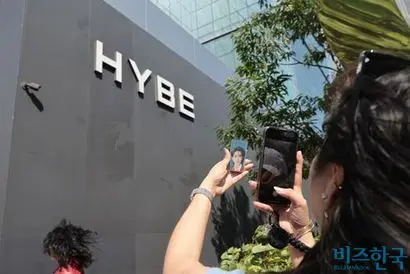
HYBE's Trial and Error, Limits of a Tech-Centric Approach
Blockchain is characterized by its ability to record transaction history simultaneously for all participants in an encrypted form, making it impossible for any individual or institution to arbitrarily tamper with it. Shortly before changing its name from Big Hit Entertainment to 'HYBE' in 2021, the company announced its transition from an entertainment firm to an IP platform company. As part of its new business strategy, HYBE actively pursued projects utilizing blockchain technology, but performance was lackluster, leading to the eventual termination of these ventures. Representative examples include the withdrawal of Binary Korea and the failure of the Momentica platform.
Binary Korea was established in 2022 as a HYBE subsidiary to turn entertainment IP into digital content using Web3 and blockchain technology; however, it withdrew from the blockchain business through a merger and acquisition in March 2025. Additionally, 'Momentica,' an NFT (Non-fungible token) platform operated by 'Levvels'—a joint venture between HYBE and Dunamu—offered a service where fans could collect, trade, and exhibit digital cards called 'TAKE,' featuring unreleased photos, videos, and voice messages of HYBE artists as NFTs that prove ownership of digital assets. The service was terminated in June 2025.

The main causes of the failure are as follows. First, complex procedures such as setting up wallets and purchasing cryptocurrency, along with unfamiliar terminology, created high entry barriers for the fandom, hindering participation. To purchase NFT-style photo cards on Momentica, fans could not simply complete a payment; they had to download a wallet app, sign up for an exchange, purchase cryptocurrency, pay gas fees (network fees incurred during transactions), and wait for the 'minting' process (the process of issuing an NFT), which was a significantly complicated journey.
HYBE overlooked the fact that fans purchase IP not as 'assets' to be traded, but for the experience and emotional connection. Criticism that the company was "obsessed only with developing products for profit" led to fan resistance, including merchandise boycotts and refund certifications.
Ultimately, having recorded poor performance in 2024 with revenue of 468,000 KRW and a net loss of 4.28 billion KRW, and confirming the low consumer receptivity to the technology, HYBE decided to focus on its core business, such as artist management.
Modhaus: Fans Decide Idol Members Through Participation
On the other hand, Modhaus, a newly established agency, is a content startup based on NFTs and blockchain that created a fan-participatory entertainment platform, showcasing a different operational model from traditional idol agencies. The results have been positive. Modhaus saw its revenue grow by 242.2% from 5.9 billion KRW in 2023 to 20.3 billion KRW in 2024, and its deficit, which stood at 8.6 billion KRW in 2023, improved significantly, narrowing to 4.4 billion KRW in 2024. Regarding artists, the group tripleS, which debuted through this service, proved its success by winning the Rookie of the Year award at the 2023 MAMA.
The core platform of Modhaus, 'COSMO,' begins when fans purchase or receive digital cards called 'Objekts.' When the QR code on each Objekt is scanned, the user simultaneously owns the same Objekt digitally, and is provided with one 'COMO' (a voting token). This is recorded on the blockchain and is exchangeable. Fans use their COMO to participate in 'DIMENSIONS' (the formation of active units) and vote on promotional songs, members, and more.
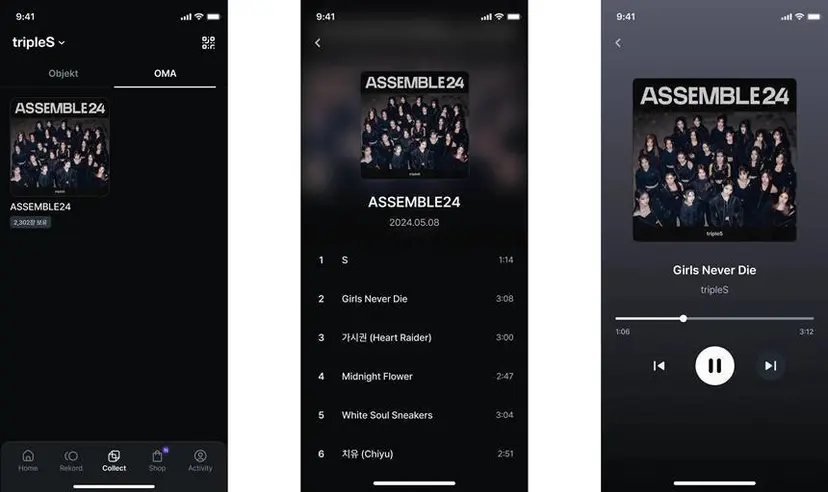
COSMO serves as a foundation that allows fans to participate directly in the production of idol groups. It provides fans with an immersive experience of being co-producers rather than mere consumers. In a media interview, Baek Kwang-hyun, Vice President of Modhaus, stated, "For an idol group to be more immersive and enjoyable for fans, 'fan participation' is essential," adding that they "introduced blockchain technology to realize this." Rather than putting Web3 and blockchain technology at the forefront from the start, they focused on facilitating communication between artists and fans.
Experience is More Important Than the Product
HYBE, aiming to become a technology-based IP company, is attempting to turn Weverse into a 'super app' that handles everything from fan communities to communication. In the past, when HYBE introduced technology, it overlooked that fans do not view IP as assets, but as experiences and emotions. To avoid repeating this failure, they need to conceptualize blockchain as 'experience-based' rather than as a 'product' like they did in the past. The core of the entertainment business is fan participation. While fan participation fundamentally arises from affection for the artist, for that participation to be maintained, there must be trust in the company. What fans want from an agency is how well their opinions are reflected and how transparent the structure is.
If you want to introduce technology, you shouldn't put the technology at the forefront. Technology should always be invisible. Consumers (fans) do not buy the technology itself, but the 'new and valuable experience' realized through it. Technology can naturally be embedded into fan activities without ever mentioning 'blockchain.' Fans should be able to easily interact with IP without being aware of the technology, and this must work 'without resistance.'
Currently, Weverse functions as a fan community and also handles services such as applications for public broadcast appearances, concert entries, and the sale of merchandise and memberships. If they want to add fan participation to this, the introduction of blockchain to increase reliability is essential. Modhaus uses blockchain on COSMO to transparently verify voting results. Weverse has more processes that require transparency than Modhaus, such as public broadcast applications and concert entries. If they disclose application processes and results transparently using blockchain, they will surely gain the trust of fans.
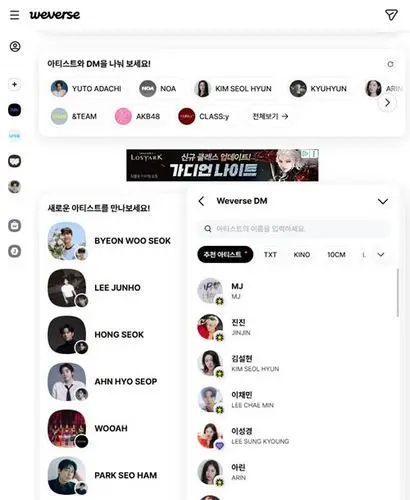
For entertainment companies, merchandise sales, which offer high profit margins, are crucial. This is the same for HYBE. They can create a virtuous cycle by utilizing blockchain for product sales as well. Currently, when purchasing products on Weverse, the process ends with the purchase decision, sales, and delivery. If blockchain is introduced, there is a high possibility that it will lead to additional purchases. First, NFTs could be used as a means of verification when purchasing products on Weverse, and NFTs recorded on the blockchain could be converted into currency. Weverse already has its own currency called 'Jelly,' which is used for paying for DM services with artists. Beyond this, fans spend money on merchandise and memberships. A circular structure could be built where rewards increase with more purchases, and those rewards induce further participation.
HYBE has something it does well: creating artist lore, from BTS's 'The Most Beautiful Moment in Life' series to ENHYPEN's and &TEAM's 'Dark Moon' series. Blockchain will also have the greatest synergy when combined with stories that fans can be most immersed in. For example, by introducing a gamification format where fans use blockchain-based NFTs they collect to directly vote on and decide how a story unfolds. Simply collecting could transition into creative participation, increasing immersion in the story and enhancing fan loyalty.
The success of HYBE's blockchain business does not depend on the introduction of the technology itself, but on 'how effectively it provides experiences that meet the needs of fans.' Introducing blockchain technology alone does not guarantee profitability. The business direction must shift from emphasizing technology to centering on experience. Ultimately, for HYBE to be reborn as a true technology-based IP company, it must pursue 'invisible innovation' that does not put technology at the forefront, but hides behind fan experiences to naturally support their participation and immersion. This will be a key strategy to break through the limits of existing business models by maximizing the long-term 'participation value' of the fandom, beyond immediate profits.
![[Gen Z Insights] "This Is an AI Ad": Why Wrtn Is Pivoting to AX](https://s.bizhankook.com/attachments_thumb/2026/05/96443_thumb.webp)
![[Gen Z Insights] SAMG Entertainment: What comes after 'Catch! Teenieping'?](https://s.bizhankook.com/attachments_thumb/2026/05/96484_thumb.webp)
![[Gen Z Insights] The Unbearable Lightness of Short-Form: 'TikTok Lite'](https://s.bizhankook.com/attachments_thumb/2026/05/96620_thumb.webp)
![[Gen Z Insights] HYBE Dreaming of Becoming an IP Giant: Why Their Blockchain Venture Failed](https://s.bizhankook.com/attachments_thumb/2026/05/96516_thumb.webp)
![[Gen Z Insight] The Paradox Faced by Beauty Platform 'Hwahae'](https://s.bizhankook.com/attachments_thumb/2026/05/96664_thumb.webp)
![[Gen Z Insight] Hyundai Motor's 'Entry into F1': Holy Grail or Poisoned Chalice?](https://s.bizhankook.com/attachments_thumb/2026/05/96693_thumb.webp)