

[비즈한국] BizHankook is publishing a 10-part series of strategy reports written by Yonsei University's Business Innovation Track (BIT). Through reports that analyze the problems of companies at turning points from a Gen Z perspective, we aim to provide insights into innovation.
Making a Name Abroad First
The name 'SamG' still feels unfamiliar to many. However, if you think of 'Catch! Teenieping,' a series that children find impossible to pull away from once they fall for it, the connection is made immediately. The studio that created that very series is SamG, now known as SAMG Entertainment.
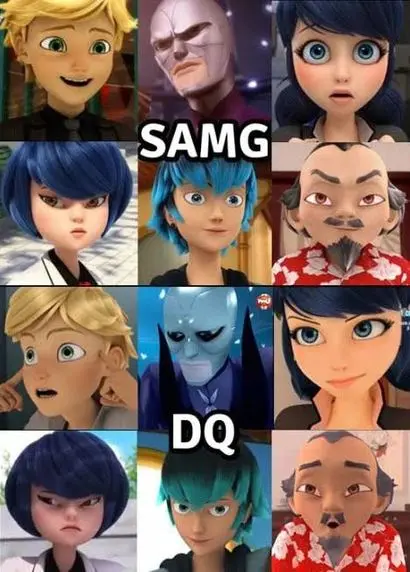
SamG built its presence abroad before doing so in Korea. By producing 3D animation for seasons 1 through 5 of 'Miraculous: Tales of Ladybug & Cat Noir,' which gained popularity in France and South America, the perception that "if SamG does it, it's different" took root among the fanbase. When news broke that SamG would not be participating in season 6, comparison videos and debates over quality flooded the internet; since then, every announcement of a new season has been met with comments asking, "Is SamG participating this time?" The studio's name has become the benchmark for content quality.

While 3D animation is now considered the industry standard, the situation was different just 30 years ago. In the midst of the 2D golden age, where tens of thousands of cels were pieced together, 'Toy Story' emerged in 1995, and the industry slowly tipped toward the conviction that "the future is 3D." SamG read that inflection point and opened its doors in 2000. However, the market had not yet fully embraced the 3D transition, and it was not easy for a startup studio with single-digit employees to find opportunities in Korea.
Therefore, SamG changed its direction. The strategy was to prove its technical prowess abroad first rather than competing domestically. The letter 'G' in the company name 'S.A.M.G' stands for 'Global Graphic Group.' It was a declaration from the start that they would set their stage overseas. This strategy quickly led to results. They participated in the production of the American work 'Firebreather,' which won an Emmy Award, and produced the 'Ladybug' series, which became popular in France and South America, firmly etching the name SamG into the global market.
However, there were clear limitations to outsourcing alone. No matter how excellent the technical skills were, the profits from merchandise and licensing returned to the copyright holder, and revenue would vanish as soon as a season ended. As long as the company relied on project-based revenue, the studio constantly had to look for the next job, and the company's growth curve was bound to fluctuate wildly. SamG decided that to grow in the long term, it had to move beyond technical prowess and choose the path of becoming an IP owner.
In the end, they decided to change their direction entirely. They shifted their identity from a company providing technology to a company owning IP, moving away from dependence on outsourcing to a company capable of designing its own revenue map spanning broadcasting, toys, theatrical releases, and retail. The transition from SamG to SAMG Entertainment started with this strategic shift.
Teenieping: Planned as an IP, Not Just an Animation
To secure its own IP, SAMG ventured into independent animation production for the first time. They began by analyzing the structures of successful works by age group worldwide to find character conditions and narrative formulas that could minimize the possibility of failure. Planning began in 2017. At the time, the toddler market was still dominated by 'Pororo,' but viewership was largely concentrated on children aged 2-3, and interest waned quickly as they reached ages 5-6. Girls in this age group preferred 'magical girl' genres that combined transformation and problem-solving narratives. SAMG added small fairy assistants to this, and incorporated a mechanism of "searching, collecting, and catching," similar to Pokémon. That is how the basic structure of 'Catch! Teenieping' was formed.
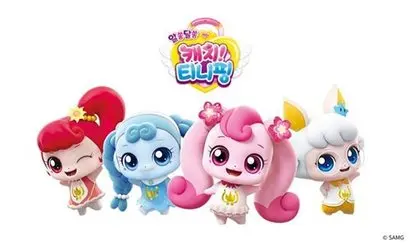
The initial barriers were clear. There was a strong stereotype in the industry that "girls' content equals princesses and magic wands," and many distributors rejected collaboration on the grounds that they weren't placing princess characters at the forefront. SAMG chose expansion over stability. Instead of one princess leading the world, they designed a structure where multiple fairies represented different emotions. By matching one character to one emotion, it is easier for children to remember, and the toys naturally adopt a collection system. Clear matching relationships, such as Love for Hachuping and Courage for Ajaping, are examples of this.
The design SAMG built was a franchise strategy that went beyond a single animation. CEO Kim Su-hoon revealed in an interview with the Chosun Ilbo that "Teenieping is a franchise that was thoroughly calculated from the beginning." Since one animation takes over 5 years just to plan and produce, leading to high failure risk, they considered everything from character design, toys, and theatrical releases to global expansion during the planning stage. Therefore, SAMG planned Teenieping as an IP where multiple businesses mesh together, not as individual content. In Korea, they built a long-term trajectory leading from TV broadcasts to toys, theatrical films, theme cafes, and theme parks. Later, they signed with Sony Pictures to enter terrestrial TV in Japan and expanded the market in China with an OTT-centered strategy. Teenieping was born as an IP with a self-circulating revenue structure from the start.
The Three Success Factors of Teenieping
The first success factor of Teenieping is the consistency of its central characters and its expandable worldview structure. SAMG clearly set the central axis of the story. A method where central characters are maintained, like Pokémon, has the advantage of not shaking the worldview, whereas if the protagonist and settings change every time, like Digimon, the continuity weakens. Referencing this contrast, SAMG designed it to keep the center fixed while allowing change to occur in the periphery.
The center of Teenieping is Romi and Hachuping. They maintained these two axes while expanding the world by adding new Teeniepings every season. Because the center remains stable, they can naturally compose the next season with only small variations, and the lifespan of the characters also becomes longer. The series has continued up to season 5, and future expansion is already planned.
This structure was considered from the planning stage. While most animations have fixed protagonists, Teenieping was designed on the premise of a worldview where new characters are naturally introduced. A child enters with one character and then participates more deeply in the story through collecting. The fandom built in this way naturally supports expansion into next channels like musicals or games, creating the momentum needed for the IP to widen its business domain. Ultimately, the worldview of Teenieping became a structural foundation that enables continuous expansion and fan migration, going beyond just a way to unfold a story.
The second success factor of Teenieping is that it translated emotions that children feel but find difficult to explain into characters. Children before entering elementary school experience emotions they frequently encounter in daily life, such as jealousy or shyness, but they have difficulty pinning them down with words. SAMG filled this gap with an emotion-based character structure. By matching one character to one emotion—Tutupping is jealousy, Chanaping is laziness, and Shypping is shyness—they composed the story around the process of encountering and resolving those emotions in every episode. Setting the hometown of Romi and the Teeniepings as the ‘Emotion Kingdom’ follows the same logic. It is a structure that manages the entire world on a map of emotions.
This approach continues outside the screen. Children watch the animation and distinguish emotions, saying, "Oh, this is jealousy," and connect it to their own experiences. At home, they might playfully call family members "Angry-ping" or "Jealous-ping" depending on the situation, turning the atmosphere around. As abstract emotions are materialized into characters, emotions become the language of play and a tool for daily communication.
Another point to note is the attitude of not fixing Teeniepings as simple 'villains.' Even characters that appear as villains at first eventually reveal their backstories, resolve their conflicts, and turn into likable characters over time. It is a composition that makes the audience understand and handle characters within a context, rather than branding specific emotions as 'bad.' In the end, they become characters that children cannot hate.
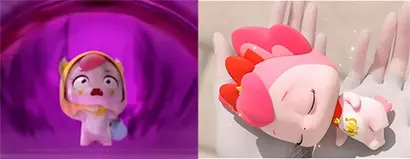
The third and most core success factor of Teenieping is expanding the target audience to 'kidults.' This is a major factor that led to current achievements and a task that must be tackled going forward. SAMG did not leave the story in the exclusive realm of children; it expanded the scope to theatrical content that the whole family can enjoy, encompassing parent generations and the MZ generation. While Pororo theatrical films remain 'child-centered' experiences even when the target age is slightly raised, Disney's 'Frozen' or 'Inside Out' touch adult hearts through narratives of emotion and growth. Referencing this method, SAMG made 'a movie watched together by children and adults' the center of Teenieping's expansion.
TV broadcast animation has a time constraint of 11 minutes, making it difficult to introduce new characters and contain both conflict and resolution. This is also why SAMG ventured into producing theatrical films. A longer narrative was needed to widen the brand's age range, and through this, they aimed to create a touchpoint that not only children but also the parent generation could watch together. 'Love Hachuping' was produced with the goal of "quality that allows parents to enjoy it more than the children they brought to the theater." Collaborations with various brands were also designed in diverse forms to coincide with the release.
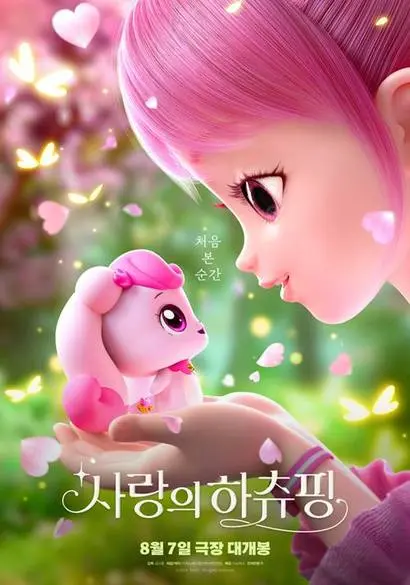
This strategy was proven by its success. 'Love Hachuping,' released in August 2024, became the first Korean-made animation to surpass 1 million viewers in 12 years, and social media reactions were particularly strong. Choi Jae-won, Vice President of SAMG, evaluated it at the 2025 Federation of Korean Industries Jeju Summer Forum on July 17, stating, "The social media virality exploded to the level of a 10-million-viewer film." After its release, reports continued to emerge that "the adults cried more," expanding the fanbase to 30- and 40-something parents. The theatrical film was not just supplemental content, but a turning point for Teenieping to establish itself as shared content that families consume together, beyond just the children's domain.
So, let's ask again here: Why now are adults empathizing with children's characters? Why is this mechanism only starting to work now? And why has kidult expansion become an inevitable task in the IP industry?
"In Our Day It Was Pikachu, Now It's Hachuping"
You may remember the Pokémon Bread craze of 2022. Full-grown adults were doing "open runs" at convenience stores to get the stickers, sold-out products were being resold at double the regular price, and notices saying "Pokémon bread is sold out" became memes. What mattered wasn't the bread, but the 'nostalgic character.' It is a representative example of how an adult's desire for collecting and emotional empathy directly led to consumption.
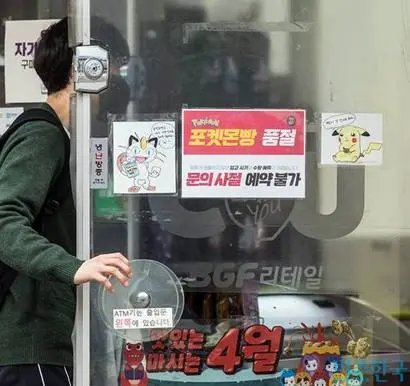
Kidult consumption leads directly to family consumption. Vice President Choi Jae-won explained, "The generation that grew up watching the Pokémon series in the 2000s has become parents who buy Teenieping for their children," explaining that character consumption has already taken root as family culture. In fact, Teenieping has drawn both adults and children into its fandom, surpassing 7 million cumulative figure sales in Korea alone. Vice President Choi evaluated, "Repeated purchases occur to the point that each person owns an average of 10, confirming a strong instinct for collection."
Parents who grew up watching Pokémon are the first generation to emotionally understand their children's content and consume it together. "If there was Pikachu in our day, now there's Hachuping." Amidst this generational shift that naturally accepts children's worlds, Teenieping has become shared content where parental nostalgia and children's tastes meet.
This is also evident in toy sales. For example, the Teenieping hospital set, which costs over 100,000 won, only works if you place specific character figures in designated spots. Because the magnet positions, standards, and sizes change every season, there are cases where previous season figures are not compatible with the latest series. It is a structure that naturally leads to additional purchases. While jokes like "Bankruptcy-ping" and "Spine-breaking-ping" (a pun on a term for toys that break parents' bank accounts) circulate among adults, this is closer to a typical pattern of kidult consumption where immersion and the collecting instinct are combined, rather than a complaint. There are also many reactions on online communities saying, "The quality of toys these days is so good that adults buy them before children even ask."
Domestic Market Limitations Due to Low Birth Rate
"Since the infant and toddler business is a long-term business, I think companies are now finally realizing that long-term business is possible because adults who grew up watching infant and toddler IP in Korea are finally beginning to emerge. Production companies also need to have a long-term vision, create strategies to cultivate IP, and need to grow their capacity for IP expansion much more." (Lee Seong-min, Professor of Media and Communications at Korea National Open University, in an interview with Yonhap News)
The Korean infant and child market faces a structural constraint called low birth rate. In an environment where the infant and child population is continuously declining, it is difficult to expect long-term growth for infant and toddler-based IP in the domestic market alone. In particular, IP presupposes circulation between generations. A long-term structure is only completed when the generation that consumed a specific IP in childhood becomes parents and consumes that IP again with their children, and this circulation requires at least 20 years or more. The point at which the generation watching Teenieping now becomes parents is also a matter of 20 years later.
Korea's demographic outlook suggests that this circulation is unlikely to work in the intended way. The birth rate has fallen to the world's lowest level, and the aging speed is the fastest among OECD countries. Korea is being pointed to as the 'world's first disappearing country.' While it might look like an 'opportunity' for long-term business design now that adults who grew up watching Korean infant and toddler IP are just beginning to appear, it must realistically be interpreted as the point when the final cycle begins.
Sustainability can no longer be secured with just the status of being the No. 1 infant/toddler IP in Korea. Competition is not the problem; the market itself is contracting. For Teenieping to remain an IP with sustainability, it must shift its stage for growth to the world.
To Grow Into 'The Second Disney'
SAMG has already taken the first step of global expansion, starting with Japan and China. In Japan, to overcome the barrier of local IP, they cooperated with Sony Pictures Entertainment to enter the market from cable to terrestrial TV. The 'collection-type fairy' structure of Teenieping hit a chord with Japan's unique collection culture and quickly established itself. In China, they recorded No. 1 in viewership immediately after release with a strategy of dominating TV and OTT simultaneously, which led to immediate licensing expansion. A pipeline of a scale unreachable by domestic demand was thus built.
However, this is not enough. A strategic shift is needed, taking market expansion as the central axis and expanding the IP's vitality and experience within it.
First, the market's scope must increase. When the media channel is expanded to all of Asia based on achievements in Japan and China, and a virtuous cycle structure where broadcasting, OTT, toys, and licensing move together takes root, the IP's external presence is secured. A new pie to replace the shrinking domestic market is made at this stage.
Building on that, the task of extending the IP's time follows. If they move away from the TV animation-centered structure and expand the kidult demand confirmed in theatrical films into narratives aimed at adults and teenagers, Teenieping moves from being short-term consumer goods to cultural assets shared by generations. It is a structure where the IP's lifecycle lengthens within the widened market.
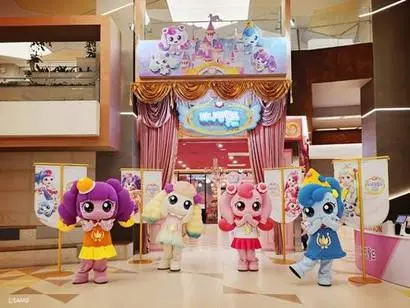
Finally, the IP's experience must be expanded. Global IP is ultimately completed in physical space. As Disneyland proves, landmarks where you can experience IP firsthand are key infrastructure that overwhelmingly boost brand loyalty and lead premium family-unit consumption. When the theme spaces that started in Pangyo and Incheon move to major cities abroad, the Teenieping worldview transitions from 'possession' to 'experience.'
SAMG should not be satisfied with the title of No. 1 in Korea. When they build a structure that extends time and experience within the central axis of market expansion, they can dream of being the 'second Disney' beyond Korea.
![[Gen Z Insights] "This Is an AI Ad": Why Wrtn Is Pivoting to AX](https://s.bizhankook.com/attachments_thumb/2026/05/96443_thumb.webp)
![[Gen Z Insights] SAMG Entertainment: What comes after 'Catch! Teenieping'?](https://s.bizhankook.com/attachments_thumb/2026/05/96484_thumb.webp)
![[Gen Z Insights] The Unbearable Lightness of Short-Form: 'TikTok Lite'](https://s.bizhankook.com/attachments_thumb/2026/05/96620_thumb.webp)
![[Gen Z Insights] HYBE Dreaming of Becoming an IP Giant: Why Their Blockchain Venture Failed](https://s.bizhankook.com/attachments_thumb/2026/05/96516_thumb.webp)
![[Gen Z Insight] The Paradox Faced by Beauty Platform 'Hwahae'](https://s.bizhankook.com/attachments_thumb/2026/05/96664_thumb.webp)
![[Gen Z Insight] Hyundai Motor's 'Entry into F1': Holy Grail or Poisoned Chalice?](https://s.bizhankook.com/attachments_thumb/2026/05/96693_thumb.webp)