

[비즈한국] BizHankook is serializing a strategy report written by BIT (Business Innovation Track), a business innovation society at Yonsei University, over the course of 10 installments. Through this report, which analyzes the problems faced by companies at turning points from a Gen Z perspective, we aim to provide insights into innovation.
As of June 2025, TikTok Lite ranked first in usage time among SNS apps for the middle-aged demographic in South Korea. In November of last year, the app saw an increase of 3.95 million users compared to January, topping the list of rapidly growing apps. However, few people around us seem to perceive TikTok Lite as a content platform on par with Instagram or YouTube. If it’s not the "TikTok" widely known to the MZ generation, then when and how did "TikTok Lite" creep into our society and grow to its current size?

Explosive Growth in Emerging Markets, Attempting Global Expansion
TikTok is currently attempting to expand TikTok Lite, which was previously operated only in emerging markets such as India and Indonesia, to the rest of the world.
TikTok Lite is a lightweight version of the TikTok app that incorporates a W2E (Watch to Earn) system. It is tailored to the technological and cultural characteristics of emerging markets, where there is a high penetration rate of low-end devices and a high perceived value of time-to-income conversion. At the time of market entry, it quickly secured users by promoting the phrase "You get paid just by watching videos," and this W2E viewing reward system proved highly effective for targeting users in emerging nations. Furthermore, because these markets had relatively fewer regulatory pressures, TikTok Lite was able to grow explosively in a short period of time.
Starting in 2024, TikTok has shown moves to expand TikTok Lite, originally aimed at emerging markets, to high-income countries including those in Europe and South Korea.
A Strategy Born Amidst Massive Competition and Regulatory Pressure
The background behind TikTok's expansion of TikTok Lite lies in fears of user churn due to intensifying market competition and tightening regulations in various countries.
TikTok is a short-form content platform launched as the global version of Douyin, which was an app for the Chinese domestic market. As TikTok rapidly increased its user base, major social media platforms also began introducing short-form content of their own. Since 2021, YouTube and Meta have added "Shorts" and "Reels" features, respectively, grabbing a slice of the short-form market and accelerating competition.
Major platforms are seeing significant results by actively utilizing short-form content to keep users on their apps for longer periods. Since the introduction of Reels, over 40% of Meta advertisers had adopted Reels ads by the fourth quarter of 2022, and YouTube's ad revenue in the first quarter of 2024 increased by 21% year-on-year due to the rise in Shorts views.
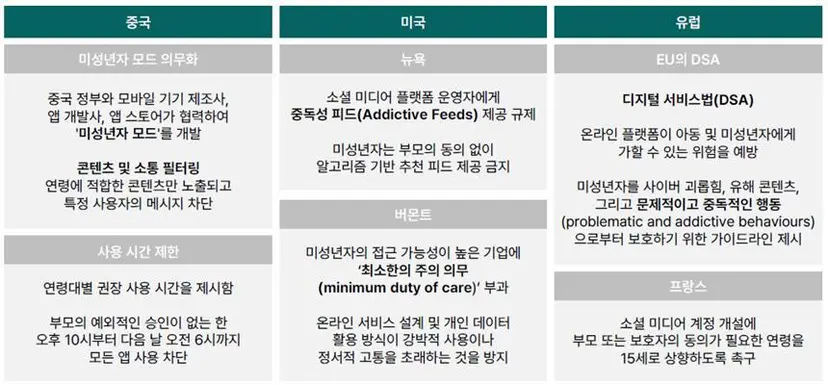
Meanwhile, as the social media market has grown, movements to regulate SNS and mobile media have spread globally. China limits content and usage time through a "minor mode," while the U.S. is restricting algorithm-based recommendation feeds in various states or placing constraints from the service design stage. The European Union is protecting minors under the DSA (Digital Services Act). As seen in the cases of these leading nations, most regulations were created out of concern for the addictive nature of SNS, particularly the risks faced by minors. As regulatory pressure from authorities grows in major markets, the business model of social media platforms—which relies on addiction—is under pressure. Consequently, the need for platform companies to establish safety measures is growing.
As a short-form platform, TikTok relies heavily on advertising revenue. While it has recently attempted to diversify revenue sources by increasing the proportion of e-commerce revenue through "TikTok Shop," ad revenue still accounts for a large portion of its earnings. In the social media ecosystem, the departure of users equates to the departure of advertisers. Ultimately, TikTok finds itself in a situation where it faces risks of advertiser loss due to increased competition, while simultaneously being pressured by expanding regulations and geopolitical tensions.
A More 'Potent' Paradigm of Addiction Than TikTok
For TikTok, which is facing a crisis, the powerful addiction system of TikTok Lite—combining "SNS + AppTech"—has become an effective breakthrough to prevent existing user churn and attract new subscribers in a short period.
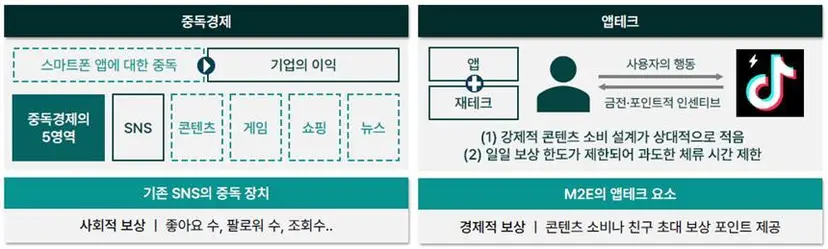
While the addiction economy and AppTech had been independent until now, TikTok presented a new paradigm in the SNS market by adding AppTech elements to the addiction economy. In the addiction economy system, where addiction to smartphone apps is converted into corporate profit, SNS is one of the core domains. The number of likes, followers, and views on SNS act as social rewards that make people addicted. To this, TikTok Lite added the AppTech element of W2E. It provides material rewards in the form of monetary or point-based incentives for specific user actions.
In TikTok Lite, where economic rewards through AppTech elements are added to the social rewards of SNS, the traditional SNS addiction system is reinforced, and not only content producers but all app users now have opportunities for profit generation.
KCC Also Mentions Need for Regulation
The problems TikTok previously faced were intensifying short-form competition and pressure from regulatory authorities. While the introduction of AppTech elements strengthened the app's addiction system, providing a breather from competition, the regulatory pressure remains. TikTok Lite is showing limited operating patterns in each market segment. This suggests that the unhealthy model of TikTok Lite cannot be a long-term survival plan for TikTok.
TikTok was ousted in 2020 from India, its largest emerging market, on grounds of national security and data privacy protection, and it withdrew its W2E model in Europe—where it recently attempted to expand—due to the Digital Services Act (DSA). In South Korea, where it entered around the same time as Europe, it continues to grow with 4 million MAU as of mid-2024, but it is only a matter of time before the domestic regulatory environment changes.
Furthermore, as Denmark and Australia have recently proposed strict SNS countermeasures, it is expected that discussions on independent research and regulatory measures will soon begin in South Korea as well. TikTok Lite, with its more powerful and dangerous addiction system than existing SNS, is currently the most likely target for regulation. Already aware of TikTok Lite's rapid growth in 2024, the Korea Communications Commission (KCC) has defined events that "pay more cash the more you invite friends as essentially a multi-level marketing scheme for SNS," stating that "just as the EU has taken measures for a permanent suspension, Korea also needs to sanction cash reward programs on SNS," highlighting the need for relevant regulations.
Toward a Sustainable Direction
In this article, I recommend that TikTok move away from addiction-based services, diversify its portfolio into e-commerce, external ecosystems, etc., and promote mutual development with society.
TikTok Lite is unlikely to be a fundamental solution for the situation TikTok finds itself in. In its current model, the monetary reward incentive of AppTech is so powerful that it is criticized as a "harmful reward structure" and a "dangerous addiction system." While a cash-reward addiction structure is effective for customer acquisition in the short term, it cannot avoid ethical and regulatory risks in the long term, and it simultaneously increases user fatigue. The attempt to simply secure users by strengthening the existing addiction system may be a rash choice. Ultimately, TikTok must establish a long-term strategy to reduce risk by diversifying its business portfolio.
The direction can be set in two ways. First, TikTok can expand into a local service brokerage platform. Short-form is a platform optimized for the "discovery" of various information. There is a high possibility of expanding beyond the e-commerce occurring in the existing TikTok Shop to the brokerage of offline services in each market. By providing features that allow users to book directly within the app while watching content in various fields such as beauty, food, healthcare, and education, it can absorb vertical services in each sector. Since there are already many suppliers using TikTok as an advertising channel, expansion into local service brokerage is a realistic strategy.
Second, I propose an AI-based creator tool business. CapCut, a video editing app provided by ByteDance, TikTok's parent company, is used by many people. CapCut is easy to use, and its accessibility is high as it offers both free and paid versions. By grafting AI automatic shooting and editing functions onto content editing tools optimized for TikTok like CapCut to enhance the service, and combining performance data from a brand’s commerce and short-form ads within TikTok, it could evolve into a B2B solution. A creator tool enhanced as a B2B model would be a way to boost TikTok's competitiveness in an SNS ecosystem where securing creators is crucial.
Ultimately, TikTok needs a strategic shift that prioritizes long-term corporate value and social responsibility over short-term user growth. Reward-based growth methods like TikTok Lite may yield fast results, but they eventually lead to greater losses in the form of regulatory risk and damage to brand trust. Conversely, a diversification strategy leading to e-commerce, local services, and AI creator tools can expand the platform's influence in a sustainable way and build a healthy ecosystem from which users, creators, and businesses all benefit. If it leads the development of technology and content under the principle of "value expansion" rather than "addiction strengthening," TikTok will be able to secure an even more solid position in the global platform market.
![[Gen Z Insights] "This Is an AI Ad": Why Wrtn Is Pivoting to AX](https://s.bizhankook.com/attachments_thumb/2026/05/96443_thumb.webp)
![[Gen Z Insights] SAMG Entertainment: What comes after 'Catch! Teenieping'?](https://s.bizhankook.com/attachments_thumb/2026/05/96484_thumb.webp)
![[Gen Z Insights] The Unbearable Lightness of Short-Form: 'TikTok Lite'](https://s.bizhankook.com/attachments_thumb/2026/05/96620_thumb.webp)
![[Gen Z Insights] HYBE Dreaming of Becoming an IP Giant: Why Their Blockchain Venture Failed](https://s.bizhankook.com/attachments_thumb/2026/05/96516_thumb.webp)
![[Gen Z Insight] The Paradox Faced by Beauty Platform 'Hwahae'](https://s.bizhankook.com/attachments_thumb/2026/05/96664_thumb.webp)
![[Gen Z Insight] Hyundai Motor's 'Entry into F1': Holy Grail or Poisoned Chalice?](https://s.bizhankook.com/attachments_thumb/2026/05/96693_thumb.webp)