

[비즈한국] Bizhankook is serializing a strategic report written by BIT (Business Innovation Track), a business innovation academic society at Yonsei University. We aim to provide insights into innovation by analyzing the challenges faced by companies at turning points from a Gen Z perspective.
“This is an AI ad.” In the summer of 2025, a short video of G-Dragon holding a smartphone and saying exactly that phrase flooded TV and YouTube. This ad, which repeated the same sentence without any further explanation, triggered reactions like, “It’s super annoying, but I can’t stop watching it.” Within weeks of the campaign’s launch, analysis showed a 57% increase in app installs, a 44% increase in user registrations, and a surge in ad visibility ranking to the top 2-3 in its category. Among the many domestic AI apps, Wrtn became "the brand Gen Z knows" with just this one ad.

However, that autumn, Wrtn made a move in a completely different direction. It announced the establishment of an internal independent company, "Wrtn AX," and officially entered the B2B AI Transformation (AX) business for corporations, schools, and public institutions. Why would a company that championed "lifestyle AI" and aimed to open the era of "one AI per person" suddenly start B2B consulting and solutions? While it appears to be a business expansion on the surface, beneath it lies the paradox of growth and a massive deficit structure that the company is facing.
Surpassing 5 Million Active Users with a Free, Lifestyle AI Strategy
After emerging in late 2023 as an AI portal where users could access global commercial models like GPT-4, Claude, and Gemini within a single app, Wrtn surpassed 5 million monthly active users (MAU) as of October 2024. Its growth rate was faster than Toss (3 years and 3 months) and Danggeun (2 years), and it has the most users among domestic generative AI apps, second only to ChatGPT.
In April 2025, Wrtn launched "Wrtn 3.0" with the slogan, "From generative AI to lifestyle AI." By combining AI supporters, character chats, and reward functions, it aimed to be an "everyday AI friend" that manages everything from morning greetings and schedules to news, lunch menus, and horoscopes, envisioning "one AI for every citizen." According to the 2024 Wrtn User Report, the top users spent an average of around 1,300 minutes per month (about 40 minutes per day) on the platform. Usage trends showed that people in their teens and 20s primarily used it for studies and assignments, those in their 30s and 40s for work and self-development, and those in their 50s and older for health and financial consultations.
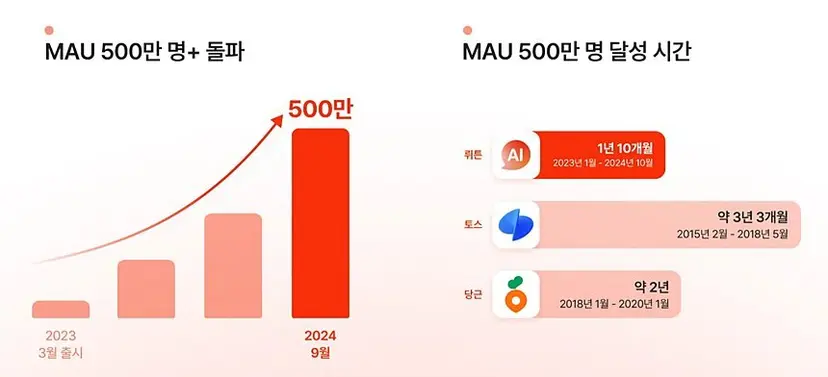
Character chat, in particular, showed strong engagement indicators. With reports of monthly revenue exceeding 1 billion KRW just one month after monetization, Wrtn—previously a "free app"—was credited with securing a tangible B2C revenue model. The G-Dragon advertisement and the lifestyle AI strategy were clearly successful in gathering users.
The Paradox of Growth: A Deficit in the 20 Billion KRW Range
The problem is that despite this rapid growth, Wrtn’s profit structure is not healthy. According to analysis of domestic AI company performance, while Wrtn’s annual revenue for 2024 is estimated at only a few billion KRW (roughly 3 billion KRW), its annual operating loss has expanded to the 26 billion to 29 billion KRW range due to rising external LLM API costs, personnel expenses, infrastructure, and marketing spend.
To simplify the structure: instead of its own LLM, Wrtn is a wrapper/portal service that uses API models from OpenAI, Anthropic, and Google, adding features and UX such as search, documents, character chats, and AI supporters. As the number of users increases, the model call volume and API costs increase accordingly. Combined with large-scale marketing campaigns like the G-Dragon ad, this created a paradoxical graph where "MAU explodes, but profitability worsens."
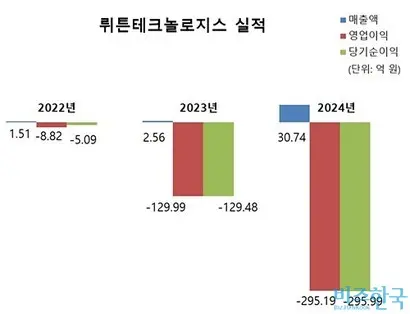
The fact that monthly revenue of over 1 billion KRW began in late 2024, thanks to character chat monetization and an advertising platform (Wrtn Ads), is positive. However, it is still far from offsetting the annual deficit of over 20 billion KRW. Globally, companies like OpenAI and Google, and domestically, Naver and Upstage, are pushing their own AI services leveraging their respective strengths. The structural limitation of being an "AI portal riding on someone else’s model" has become a mountain that Wrtn must overcome.
The Launch of a Dedicated AI Transformation Organization: Why Now?
At this point, the card Wrtn played is B2B AX. In September 2025, Wrtn established the CIC 'Wrtn AX' and officially launched an organization dedicated to AI transformation (AX, Artificial eXperience) for companies, schools, and public institutions. Wrtn AX focuses on three pillars: AI transformation training and consulting for executives and staff, providing Wrtn-based platforms and agents tailored to each organization, and building RAG/MCP-based Agentic AI linked to internal data.
Upon its launch, Wrtn AX published the 'AX Report 2025,' disclosing figures from actual internal and external projects. According to the report and media coverage, the introduction of AI agents in customer service led to a 73% reduction in total labor time and a 35% increase in productivity. In the finance department, automated settlement tasks—which previously required extensive manual work like checking receipts, reviewing invoices, payroll processing, and drafting financial statements—saw a 40% reduction in labor time and a 21% increase in productivity. Frontend and backend development agents showed productivity gains of 15% and 28%, respectively, with work hours reduced by 28% and 55%.
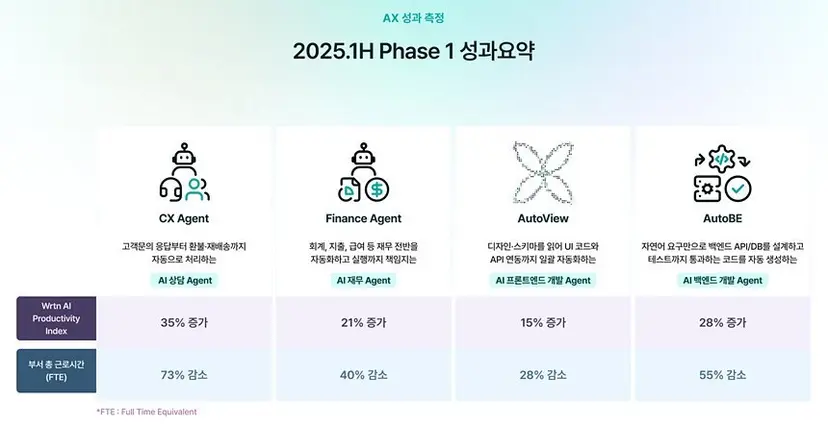
The picture becomes clearer when looking at a customer service case. Previously, consultants spent all day repeatedly handling FAQs and simple inquiries. This was redesigned so that an agent trained on internal policies, FAQs, and order data handled the first line of response, while follow-up actions like refunds, re-delivery, and reservations were automatically processed by linking with systems. As a result, consultants could focus on complex complaints and high-value consultations, allowing the company to handle more customers with the same number of staff. The "Agentic AX" that Wrtn AX speaks of ultimately means incorporating LLM, search, and RAG into existing workflows to hand off repetitive human tasks to agents.
The market environment is also shifting rapidly toward AX. Microsoft states that 70% of its Azure customers in Korea are already using AI services, and numerous companies like LG Uplus, Hyundai Glovis, KB Life, and KT have introduced M365 Copilot to automate document creation, meeting minutes, reports, and data analysis. Upstage has been conducting AX projects for financial and public institutions with its Korean-specialized LLM 'SOLAR' and document AI solutions, securing an additional 62 billion KRW in its Series B bridge round. Traditional SI and solution companies are also highlighting "AX packages" that bundle cloud, RPA, and chatbots, restructuring their software business models.
In other words, Wrtn’s B2B entry is less a simple business diversification and more a choice for survival. It is the result of overlapping factors: the internal realization that it is difficult to build profitability with a free-focused B2C strategy alone, the external environment where AX has grown into an area with actual budget allocation, and the choice to convert the UX, orchestration, and educational experience gained in B2C for corporate use.
To Survive via AX
For Wrtn AX to become a meaningful revenue stream, it must eventually answer the question: "Even if you borrow models, what value will you create that is hard to replace?" Given its current position and market structure, Wrtn’s realistic focus can be summarized into three directions.
First, it needs an AX package targeting the "middle and lower tiers" rather than the top. Currently, the top tier of the Korean AX market is occupied by Microsoft Copilot, Upstage, and traditional SIs. MS bundles Copilot for its existing M365 customers to automate documents, emails, meetings, and data analysis, while Upstage digs into high-difficulty document tasks for financial and public institutions with its own LLM 'SOLAR' and document AI. These companies are the natural choice for large corporations and central public agencies that have IT organizations because they can provide cloud, office, security, and infrastructure all at once.
Therefore, it is unrealistic for Wrtn AX to go head-to-head in the same customer segments or stack. It is strategically more rational to focus on lightweight AX packages tailored for mid-sized and small businesses, schools, and local public institutions that do not have M365 licenses, dedicated IT staff, or sufficient budgets.
These organizations are closer to the stage of wondering what they can change immediately in their teams rather than what AI is, and they are more likely to prefer an AX "starter kit" that shows visible effects within 2–4 weeks rather than a DX consulting project costing hundreds of millions of KRW. Having already conducted AI education projects with various educational institutions and local governments, Wrtn is in a good position to expand this point of contact into "quick PoCs (proofs of concept) + subscription-based AX packages."
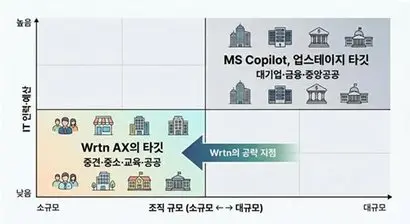
Second, it needs a design that weaves B2C lifestyle AI and B2B AX into a "dual engine" rather than two disconnected businesses. Wrtn’s greatest asset remains the users, data, and branding accumulated in B2C.
Instead of separating these assets from AX, it is better to create a structure where the individual Wrtn experience naturally leads to the workplace Wrtn experience. For instance, an AI supporter that a user utilized in their personal account could evolve into a "work-type Wrtn supporter" that understands the organization's documents, schedules, and policies when switched to a company account. Conversely, a virtuous cycle could be designed where employees who adopt Wrtn AX at work also use Wrtn in their daily lives.
In this way, B2C acts as an entry channel that builds brand, data, and AI literacy, while B2B/AX acts as a channel that creates revenue and LTV, forming a continuous line in user experience and data despite separated roles.
Third, Wrtn must focus on the direction of creating "the AI that best understands our company’s way of working" in the long term—that is, Korean workflow data and mid-sized models. Looking at cases of hyper-scale LLMs like HyperCLOVA X and SOLAR, initial training and infrastructure investments cost tens of billions of KRW, and continuous tuning and operating costs are required. For Wrtn, which is already recording a deficit in the 20 billion KRW range, following the same path is burdensome in terms of capital, personnel, and time. Yet, it cannot remain "an app that just puts a pretty UI on top of someone else's model" forever.
The point Wrtn should aim for is not the LLM itself, but the "actual work patterns, domain knowledge, and document structures of Korean/Asian organizations" that pile up on top of the LLM. As seen in the counseling, financial, and development projects in the Wrtn AX report, the more experience is gained in putting Agentic AI into actual organizations, the more data and know-how are collected regarding which prompts, workflows, and tool combinations actually work in the field. Therefore, if this data is structured and integrated into mid-sized sLLMs, specialized RAG pipelines, or agent templates, the reputation that "agents made by Wrtn actually fit the work of Korean companies well" could become a unique competitive advantage.
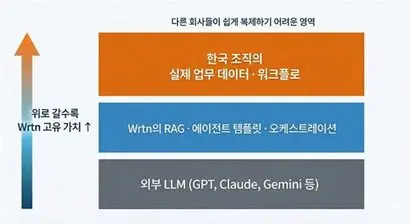
This is why positioning itself as the company that best understands the workflow data and agentic orchestration of Korean/Asian small and mid-sized organizations—rather than becoming a foundation model company—appears to be a more realistic long-term strategy for Wrtn.
These three directions are all attempts to find the point where what Wrtn does well (B2C UX, fast product execution, education/onboarding) meets what the market demands (AX, workflow automation, cost reduction). Even if they are not the perfect answer, at the very least, they can help Wrtn move beyond the binary logic of "proprietary LLM vs. portal" and narrow down the actual battlefield it is fighting on.
What Wrtn Must Prove with AX
Ultimately, Wrtn’s story boils down to the question: "Can an AI startup that cannot build foundation models on its own survive in the long term?" Wrtn became one of the most popular AI apps in Korea by placing UX and orchestration on top of external LLMs, but its free strategy and high model and marketing costs resulted in a deficit in the 20 billion KRW range. Lifestyle AI and AX are the two axes attempting to overturn this structure, and they can be seen as different answers to the question, "Where will you create revenue that is hard to replace?"
If so, the one thing Wrtn must prove through AX is close to this sentence: Even without a proprietary LLM, can it become the first "AI partner that changed the way of working" for countless organizations in Korea? Depending on the answer to this question, it will be determined whether Wrtn is remembered as "just a fun free AI app" or as a "Korean-style AX platform."
![[Gen Z Insights] "This Is an AI Ad": Why Wrtn Is Pivoting to AX](https://s.bizhankook.com/attachments_thumb/2026/05/96443_thumb.webp)
![[Gen Z Insights] SAMG Entertainment: What comes after 'Catch! Teenieping'?](https://s.bizhankook.com/attachments_thumb/2026/05/96484_thumb.webp)
![[Gen Z Insights] The Unbearable Lightness of Short-Form: 'TikTok Lite'](https://s.bizhankook.com/attachments_thumb/2026/05/96620_thumb.webp)
![[Gen Z Insights] HYBE Dreaming of Becoming an IP Giant: Why Their Blockchain Venture Failed](https://s.bizhankook.com/attachments_thumb/2026/05/96516_thumb.webp)
![[Gen Z Insight] The Paradox Faced by Beauty Platform 'Hwahae'](https://s.bizhankook.com/attachments_thumb/2026/05/96664_thumb.webp)
![[Gen Z Insight] Hyundai Motor's 'Entry into F1': Holy Grail or Poisoned Chalice?](https://s.bizhankook.com/attachments_thumb/2026/05/96693_thumb.webp)