

[비즈한국] It has already been 10 years since the introduction of 'social housing' projects, where public institutions provide land and private enterprises handle operations. While it started as an alternative to solve housing problems, it is now being pointed out that it is actually more vulnerable to risks such as jeonse (lump-sum deposit) fraud. Although social housing appears to be operated by public institutions like the Seoul Metropolitan Government, Seoul Housing & Communities Corporation (SH), and Korea Land and Housing Corporation (LH), private operators are actually in charge of management. This leads to a recurring situation where parties shift responsibility to one another when problems arise. BizHankook aims to examine the problems and institutional limitations of social housing as it reaches its 10th anniversary and seek solutions.
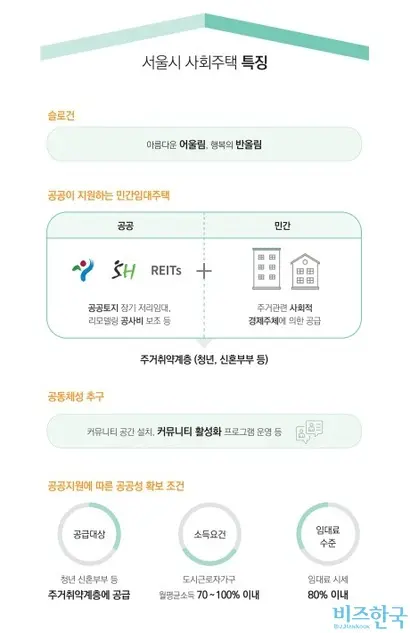
“A new alternative for youth housing, starting with social housing.” This is the promotional slogan used by the Seoul Metropolitan Government for social housing. There are two main types among the approximately 100 social housing units operated by Seoul: land-lease social housing, where private companies build the structures, and remodeling-type social housing, where public institutions purchase existing buildings and entrust their operation to private companies.
In land-lease social housing, public institutions lease land to private companies for the long term, and the companies build structures there to rent out housing to the socio-economically vulnerable, such as young people and newlyweds. From a resident's perspective, it is an ideal model where they can live stably at an affordable price without being significantly affected by fluctuations in the real estate market.
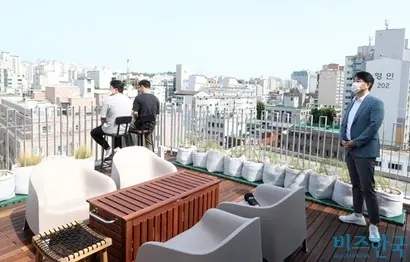
Contrary to these ideals, the biggest factor behind the current crisis in social housing is 'guarantee insurance.' Because the owners of the land and the buildings are different, it is impossible for land-lease social housing to join the 'Rental Deposit Guarantee Insurance.' The only solution is for the public institution that owns the land to issue a 'purchase commitment' to buy the building in the event of a deposit default. However, for the Seoul Housing & Communities Corporation (SH), which is governed by the Local Public Enterprises Act, such a purchase commitment could be considered a 'breach of trust in the line of duty,' making it impossible.
Even though it has been mandatory for rental housing operators to join guarantee insurance since August 2021, operators of land-lease social housing are still unable to do so. While it is realistically impossible to sign up for insurance, theoretically, fines can still be imposed on operators who fail to do so. Amid this contradictory structure, Seoul social housing has quickly been tagged with the negative image of being 'jeonse fraud bait.'
Social housing operators inevitably have low margins because they accept deposits and monthly rent at low rates, and one slight misstep can turn them into perpetrators of jeonse fraud. Person A, an official from a social housing operator, said, “Social enterprises participate in various housing projects for public institutions, but if business goes poorly or they receive payments from the commissioning agency even slightly late, they have no way to generate their own funds. In most cases, they have already maxed out their loans when building the structures, and even if they wanted to sell the building as a last resort, they cannot because the land is owned by a public institution.”
As the situation worsened, the Seoul Metropolitan Government, SH, and the Korea Housing & Urban Guarantee Corporation (HUG) gathered to discuss launching separate guarantee insurance for 'land-lease social housing operators,' but no concrete measures have emerged yet. An official from the Korea Social Housing Association pointed out, “We have been discussing the creation of guarantee insurance since 2021, but it doesn’t seem to be pursued actively.”
Regarding this, an official from the Seoul Metropolitan Government stated, "Nothing has been concluded yet." An SH official also explained, "We are continuing three-way discussions, but no concrete results have come out yet. We plan to continue the discussions in the future."
The Korea Land and Housing Corporation (LH), where signing up for guarantee insurance is possible, no longer supplies land-lease social housing. LH is replacing the existing supply of land-lease social housing through projects like specialized purchase rental housing. An LH official stated, "In the case of LH, because there is a purchase commitment condition, the rental operator can join guarantee insurance. However, there are no plans to expand beyond the rental housing currently in operation."
Some point out that the land-lease social housing model itself is the problem. Lee Chang-moo, a professor of urban engineering at Hanyang University, pointed out, “Land-lease social housing is a difficult model to succeed. First, ownership is not clear, and it cannot be recognized at market price when resold later. Because full ownership and property rights cannot be exercised, it is an inferior structure compared to other private housing on the market. From the perspective of a private operator, there is a possibility of bankruptcy because there is no cash liquidity from operating income. It is an unstable choice for private companies to engage in a business that carries these risks and does not generate stable profits. Of course, the risk of jeonse fraud is also a consequence derived from Korea’s unique jeonse system.”
Ultimately, social housing tenants have no choice but to move in while harboring anxiety that they "might not get their deposits back." Person B, a social housing operator, lamented, "Discussions have continued behind the scenes, and we have even come close to legislation. However, because social housing itself isn't shared as a critical agenda, legislation has been thwarted every time by other pending issues."
![[Crisis in Social Housing] Moved in Trusting the Seoul City Name, Only to Fall Victim to a 'Jeonse Fraud'](https://s.bizhankook.com/attachments_thumb/2026/05/93924_thumb.webp)
![[Social Housing in Crisis] Unstable Support Based on 'Mayor's' Preference Makes Consistent Operations Difficult](https://s.bizhankook.com/attachments_thumb/2026/05/94046_thumb.webp)
![[Crisis in Social Housing] Youth who trusted LH lived in homes with collapsing ceilings and rampant mold](https://s.bizhankook.com/attachments_thumb/2026/05/94039_thumb.webp)
![[Crisis in Social Housing] The Last Line of Defense for Tenants, 'Guarantee Insurance': Why Can't Social Housing Join?](https://s.bizhankook.com/attachments_thumb/2026/05/94177_thumb.webp)
![[Social Housing in Crisis] We Imported the European Success Model, but Why Isn’t It Working in Korea?](https://s.bizhankook.com/attachments_thumb/2026/05/94522_thumb.webp)
![[Crisis of Social Housing] Presidential Election Held on 'Day for the Homeless,' Yet Housing Policy Remains 'Missing'](https://s.bizhankook.com/attachments_thumb/2026/05/94619_thumb.webp)