

[비즈한국] It has been 10 years since the introduction of "Social Housing," a project where public institutions provide land and private enterprises handle operations. Although it began as an alternative to solve housing problems, it is now being pointed out that it is actually more vulnerable to issues like "jeonse" fraud. While it may appear that social housing is run by public institutions such as the Seoul Metropolitan Government, Seoul Housing & Communities Corporation (SH), and Korea Land and Housing Corporation (LH), private operators are actually the ones managing them on a consignment basis. This leads to a recurring situation where parties shift responsibility to one another when problems arise. BizHankook aims to examine the problems and institutional limitations of social housing as it reaches its 10th anniversary, and seek potential solutions.
A sense of crisis is currently circulating among social housing operators. The anxiety stems from the fear that "financial difficulties" could potentially lead them to become perpetrators of jeonse fraud. A source at a social housing operating company, identified as A, analyzed the cause as follows:
"Most social housing units have rents set at 80% or less of the market rate, and security deposits are around 60%. We start these projects accepting some level of loss. The problem is that even if we want to stop operating the social housing, we can't. Because the land is owned by public institutions, we cannot buy or sell the buildings. While no social housing project has yet been legally recognized as a 'jeonse fraud' case, the overall situation is not good."
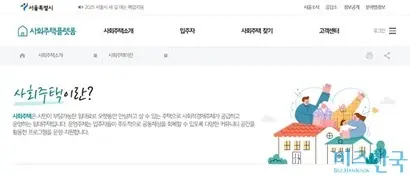
Some companies argue that the crisis began in October 2022, when the Seoul Metropolitan Government halted the additional supply of social housing. Another operator, B, lamented, "When Mayor Oh Se-hoon took office, the policy stance of the Seoul Metropolitan Government changed, and the social housing business was sidelined. As a result, opportunities for loans and other support previously provided to social enterprises have decreased."
In fact, the scale of loans provided by the Seoul Metropolitan Government to social housing operators has shrunk. The budget for loans to social economy enterprises and social housing in Seoul plummeted by 91%, from 13 billion KRW in 2021 to 1.1 billion KRW in 2022. While the figure rose again to 5 billion KRW in 2023 and 2024, and 6 billion KRW in 2025, it remains less than half of the 2021 level.
So, what is the current financial state of the consignment companies operating social housing in Seoul? It has been confirmed that there are operators caught in litigation for failing to pay balances after construction or failing to repay borrowed funds.
In August 2024, a court ruled that Company C must return a total of 946.32 million KRW to fund management entity D, as it failed to repay the loan. Company C had borrowed a total of 1.598 billion KRW for the Seoul social housing project in two installments in 2018 and 2019. Later, in June 2022, due to financial difficulties, it extended the repayment period, with a final deadline promised for December 2023. However, Company C failed to make payments starting in November 2023.
In November 2024, Company E was sued by a remodeling contractor for failing to pay the remaining balance of 1 billion KRW for social housing remodeling work.
Previously, source A expressed, "The maturity dates for the loans are approaching, but extensions are not being granted. In the meantime, we are being sued by subcontractors who haven't been paid for their work. We try to resolve these issues, but when problems actually arise, the Seoul Metropolitan Government steps back, citing that they are not a party to the contract. Operators with no money are stuck in a catch-22."
![[Crisis in Social Housing] Moved in Trusting the Seoul City Name, Only to Fall Victim to a 'Jeonse Fraud'](https://s.bizhankook.com/attachments_thumb/2026/05/93924_thumb.webp)
![[Social Housing in Crisis] Unstable Support Based on 'Mayor's' Preference Makes Consistent Operations Difficult](https://s.bizhankook.com/attachments_thumb/2026/05/94046_thumb.webp)
![[Crisis in Social Housing] Youth who trusted LH lived in homes with collapsing ceilings and rampant mold](https://s.bizhankook.com/attachments_thumb/2026/05/94039_thumb.webp)
![[Crisis in Social Housing] The Last Line of Defense for Tenants, 'Guarantee Insurance': Why Can't Social Housing Join?](https://s.bizhankook.com/attachments_thumb/2026/05/94177_thumb.webp)
![[Social Housing in Crisis] We Imported the European Success Model, but Why Isn’t It Working in Korea?](https://s.bizhankook.com/attachments_thumb/2026/05/94522_thumb.webp)
![[Crisis of Social Housing] Presidential Election Held on 'Day for the Homeless,' Yet Housing Policy Remains 'Missing'](https://s.bizhankook.com/attachments_thumb/2026/05/94619_thumb.webp)