

[비즈한국] It has been 10 years since the introduction of "social housing" projects, where public institutions provide land and private enterprises handle operations. Although it began as an alternative to solve housing problems, critics point out that it is even more vulnerable to issues like jeonse fraud. While social housing appears to be operated by public agencies like the Seoul Metropolitan Government, Seoul Housing & Communities Corporation (SH), and Korea Land and Housing Corporation (LH), in reality, private operators are entrusted with the management. This often leads to a cycle of finger-pointing when problems arise. Bizhankook aims to examine the problems and institutional limitations of social housing as it reaches its 10th anniversary and seeks potential solutions.
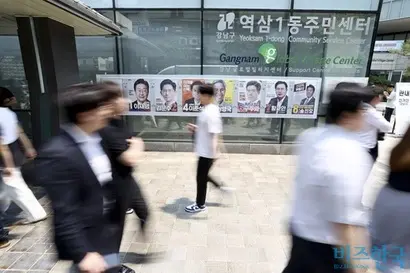
In the 2022 20th presidential election, "housing policy" was a core agenda. Major candidates unanimously put forward pledges related to public housing, such as the supply of long-term public rental housing and the expansion of housing welfare. Candidates Yoon Suk Yeol, Lee Jae-myung, Sim Sang-jung, and Ahn Cheol-soo all promised to increase the supply of long-term public rental housing. In particular, candidate Lee Jae-myung, who is also running in this 21st presidential election, promised the "revitalization of social housing" during the last election.
However, in this presidential election, held just three years later, it is difficult to find housing policies in the candidates' platforms. The term "social housing" does not even appear in the campaign books or election brochures of the six presidential candidates.
On May 29, 42 civic groups, including the Housing Rights Network, held a round-table discussion to evaluate housing and real estate pledges for the 21st presidential election. Above all, they pointed out that housing and real estate pledges are weaker compared to the last election. At the discussion, Seo Dong-gyu, chairperson of the Mink-Snail Housing Union, remarked, "Although this election is being held on June 3, the Day for the Homeless, housing and real estate pledges are generally weaker than in the previous election. Housing policies for low-income and vulnerable groups are almost non-existent."
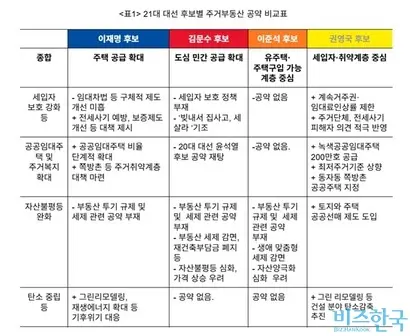
Candidate Lee Jae-myung’s pledges—including expanding the supply of long-term public rental housing, preventing jeonse fraud and supporting victims, and pushing for public housing projects in "jjokbangchon" (slum) areas—were analyzed positively. Candidate Kim Moon-soo presented various agendas such as private housing supply, housing supply and support by generation, and regional housing issues, but was evaluated as having merely recycled the pledges made by candidate Yoon Suk Yeol in the last election.
Candidate Lee Jun-seok, who emphasizes policies for youth, was criticized for failing to provide any pledges related to leases for the housing stability of tenants, making his platform difficult to understand. Finally, candidate Kwon Young-gook was evaluated as distinct from other major candidates for his plans to guarantee the right to reside for long-term tenants, mandate registration for rental housing, and supply 2 million green public rental housing units.
Experts point out that "housing policy" has vanished from this presidential election. Choi Eun-young, head of the Korea Center for City and Environment Research, told Bizhankook, "First of all, the problem is that there is no mention of actual supply volume for public rental housing. There are only very abstract pledges, making them quite difficult to evaluate. However, it is expected that social housing policies will be established to encompass social economy entities."
It is unclear where social housing policy will head after the election. According to a report on the Yoon Suk Yeol administration's public rental housing budget released by the Nara Policy Institute on May 28, the budget for public rental housing has steadily declined over the three years of the Yoon administration. The 2025 budget is over 7.1 trillion won lower than in 2022. The institute noted, "Although the government announced that it has achieved the OECD average of 8% for public rental housing stock relative to the total housing units, the ratio of long-term public rental housing of over 30 years—which tenants actually need—is only 5.2%."
The Seoul Metropolitan Government has also completely halted the supply of social housing. Since October 2022, Seoul decided not to supply any additional social housing. The city intends to manage only the existing supply, and this policy is understood to remain unchanged. An official from the Seoul Metropolitan Government stated, "There have been no changes since the decision to stop additional supply."
However, some expect that policies related to social housing will be established after the election ends. A political insider remarked, "Since the candidates were not well-prepared, it seems likely that specific policies will be formulated after the winner is inaugurated."
In the midst of this, the Korea Social Housing Association held a policy discussion with the Democratic Party's Social Economy Committee on May 21 and delivered a policy proposal for the revitalization of social housing. The association emphasized, "Social housing is a future-oriented housing model that contains multi-functional public values such as care, energy transition, local job creation, and community building," and urged the establishment of a national-level strategy.
The policy proposal points out that while the current social housing policy operates on the basic structure of "public land, private implementation, and tenant restrictions," the biggest problems are the lack of policy continuity, a dedicated organization, and a financial support system. Consequently, they proposed key tasks: establishing a national social housing master plan, installing a dedicated department within the Ministry of Land, Infrastructure and Transport, securing exclusive supply quotas and public land ratios for social housing, creating a specialized fund, securing public-entrusted management models, enacting a Social Housing Act to legalize categories, and creating/publicizing related statistics.
They also proposed customized supply reflecting the needs of various classes such as youth and elderly households, as well as the introduction of new development models like remodeling idle buildings in city centers and mixed-use construction. The association emphasized, "It is urgent to create an institutional framework where social economy entities can function as stable suppliers."
An official from the Korea Social Housing Association told Bizhankook, "Because it is an early presidential election, it is more about presenting general directions and basic principles than a policy-centered election. Detailed parts will likely be created later. We have proposed the necessary policies in that context."
![[Social Housing in Crisis] Unstable Support Based on 'Mayor's' Preference Makes Consistent Operations Difficult](https://s.bizhankook.com/attachments_thumb/2026/05/94046_thumb.webp)
![[Crisis in Social Housing] Youth who trusted LH lived in homes with collapsing ceilings and rampant mold](https://s.bizhankook.com/attachments_thumb/2026/05/94039_thumb.webp)
![[Crisis in Social Housing] The Last Line of Defense for Tenants, 'Guarantee Insurance': Why Can't Social Housing Join?](https://s.bizhankook.com/attachments_thumb/2026/05/94177_thumb.webp)
![[Social Housing in Crisis] We Imported the European Success Model, but Why Isn’t It Working in Korea?](https://s.bizhankook.com/attachments_thumb/2026/05/94522_thumb.webp)
![[Crisis of Social Housing] Presidential Election Held on 'Day for the Homeless,' Yet Housing Policy Remains 'Missing'](https://s.bizhankook.com/attachments_thumb/2026/05/94619_thumb.webp)
![[Crisis in Social Housing] Ministry of the Interior and Safety’s Ruling Contradicts Seoul City’s Stance… Relief for Victims Remains Difficult](https://s.bizhankook.com/attachments_thumb/2026/05/94858_thumb.webp)