

[비즈한국] K-pop has become South Korea’s greatest export. However, deep shadows linger behind the glamour. The symbols of K-pop, the idols, are recruited at a young age and endure grueling years as trainees. In this process, labor rights and human rights are frequently ignored. What happens to the countless trainees who never even make it to debut? Through the series "K-Pop: Idols in Wonderland," BizHankook intends to point out the problems that have been overlooked during the growth of K-pop and examine alternatives from various perspectives. We believe that those who make K-pop must be healthy for the people who enjoy K-pop to be even happier.
Major domestic entertainment companies that have expanded into the U.S. are primarily based in Los Angeles (LA), California. HYBE352820, which established HYBE America after acquiring Scooter Braun's Ithaca Holdings, has offices in LA and Santa Monica. The North American joint venture between SM Entertainment and Kakao035720 Entertainment, established last year, is also located in Culver City, California. SM's existing North American entities are also all in LA. JYP Entertainment has likewise established JYP USA in LA.


Why do domestic entertainment companies that went to the U.S. congregate around LA? Accountant A, who provides consulting and accounting services for Korean agencies in LA, explained, "Since there are many Koreans in LA, Korean companies have more business partners, and the infrastructure is already built. However, that doesn't mean LA's regulations or laws are more advantageous for business than other states."
In fact, California, where Hollywood is located, has strict child labor laws. Unlike Korea, which does not view idols as laborers, California recognizes artists signed to entertainment companies as workers. In particular, for minors, companies must report to the California Department of Industrial Relations every six months and must obtain separate permits when hiring minors.
How do industry insiders in California evaluate the possibility of localizing the K-pop idol training system? To gauge the local atmosphere in LA, BizHankook met with an American music producer who is actively collaborating with Korean entertainment agencies on July 2 (local time).
After BTS: More Composers Want to Work with K-Pop
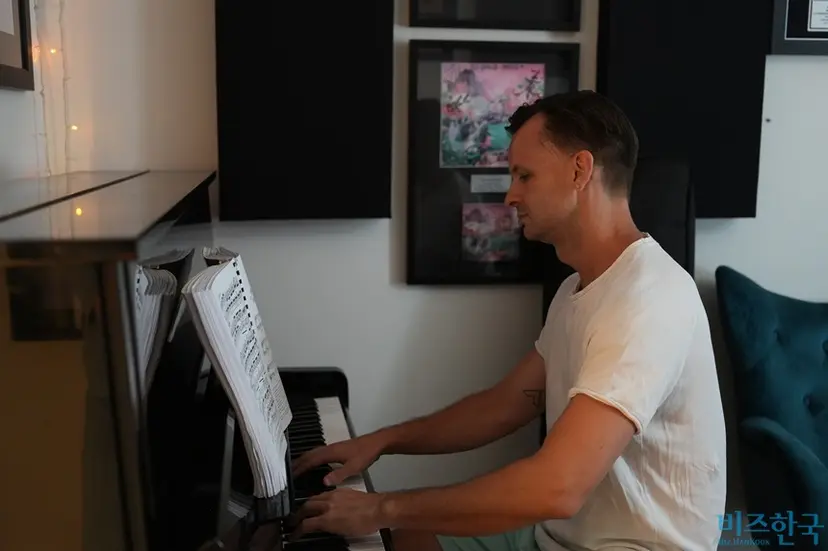
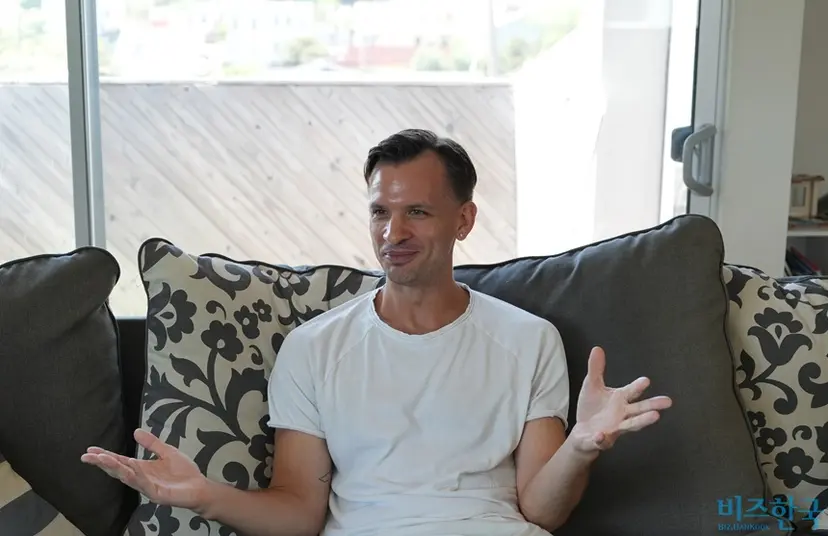
Music producer David Amber, who lives in LA, has composed several songs including TWICE’s "Heart Shaker" and "YES or YES," and IZ*ONE’s "Eyes." K-pop is currently his main field. How did an American producer living in LA end up making K-pop?
David didn't start out composing K-pop. The first work he did as a music producer was advertising music. He first came into contact with K-pop around 2011 while making ad music in New York, when SM Entertainment invited him to the SM Town concert held in New York. "SM Entertainment proposed that we work together, and from then on, I started composing K-pop in earnest. Girls' Generation was the most popular group at the time, and after I got to know K-pop, I thought, 'Wow, this is really great.'"
The element that drew David to K-pop is its "diversity." He explains that every Korean entertainment company has a distinct musical identity. "Companies like SM, YG, and JYP each had their own unique musical identity. It was clearly different from Western pop. Each company and each artist had a clear musical direction. What makes K-pop different from other music genres is that it cannot be defined as a single genre. K-pop doesn't have a specific sound like country, hip-hop, or rock; it can be anything."
Is composing K-pop different from composing for other genres? David says he focuses on the "group" when composing K-pop. "Since I'm making music for a group, I tend to consider the relationships within the group and their visual performance. I watch their music videos and consider the characteristics of each member when creating the tracks. When working with other Western artists, we meet and compose together, but K-pop is a bit different. The agency suggests that I make a song, and I create and send it. I've only worked with a K-pop artist in person once. Recently, Hyolyn from SISTAR came to LA, and we worked together. That was my only experience."
He says there has been a change in K-pop music as well. "I think Korean entertainment companies glimpsed the possibility of entering the global market after BTS achieved worldwide success. Since then, I’ve felt that K-pop music has also become more global. They’ve started creating music aimed at a wider market, not just for Korea or Asia."
In the 2010s, when David first started working in K-pop, many American composers didn't know what K-pop was. However, the atmosphere has changed since the COVID-19 pandemic. "Before 2020, LA composers weren't very interested in K-pop. But after 2020, they contact me saying they 'want to work on K-pop.' Especially after the success of BTS, a big change occurred. Now, every composer here wants to work on K-pop. Everyone knows what K-pop is now."
Idols Are Amazing... But I Wouldn't Want To Do It
LA composers are now enthusiastic about K-pop. But what do they think of the idol training system?
David says the attempts by Korean entertainment companies are "interesting." "It’s a very interesting attempt. This is especially true considering that the Korean and American methods are very different. In Korea, they audition at a young age, become trainees, and train for several years. However, the U.S. doesn't have this system. The U.S. doesn't 'develop' artists. Their way is to see artists who have already grown and sign them. The closest case might be 'Disney,' where they cast stars like Selena Gomez or Sabrina Carpenter when they are young and have them perform. Of course, even that is different from the way Korean idols are trained."
Are there any moves in the U.S. to follow the Korean training system? "I think Western artists are following some elements like marketing. However, there are no moves to follow the trainee system. Major label companies like Universal Music Group or Warner Music Group are not in the business of developing artists. Their role is 'marketing'."
He says that for the idol training system to succeed in the U.S., many changes would be needed. "I think the idol training system is really cool. They are incredibly dedicated and work hard. Thanks to this system, huge entertainment companies were created, and the Korean music industry became successful worldwide. But I wouldn't want to do it myself."
David also pointed out that the current idol training system doesn't fit with California’s regulations. "California has very strict child labor laws. Minors can only work for a limited amount of time and must receive education every day. So, training all day like they do in Korea is impossible. The U.S. does not allow children to train for 12 hours a day. American parents would also be highly unlikely to agree to such training."
Cultural differences cannot be ignored either. "In the U.S., individualism and freedom are considered very important, so it would be a huge challenge to make children follow strict trainee training. There may be American children who want to become idols, but the idea and the reality are different. I was also shocked when I visited Korea and saw how Korean trainees are trained. The weighing and recording of their body weight was one of those things. I think most American kids would quit once they realized how hard it is (to become an idol)."
What does he think about the recently debuted local girl groups like HYBE’s 'KATSEYE' and JYP’s 'VCHA'? "I haven't heard KATSEYE’s songs yet. I haven't heard any reactions from people around me, either. VCHA’s songs seem closer to Western pop than K-pop. We’ll have to see how it goes. It’s a really big project. I am very curious about how they will handle marketing and communication with fans."
※ The next installment will feature an article on the idol training system as viewed by American agencies.
※ This project was supported by the Press Promotion Fund, which was funded by government advertising fees.
![[K-Pop: Idols in Wonderland] The Reality of 'Idol Academies', the Practice Required to Become a Trainee](https://s.bizhankook.com/attachments_thumb/2026/05/92216_thumb.webp)
![[K-Pop: Idols in Wonderland] Suggesting the "Trainee" Path to American Teenagers: "What About School?"](https://s.bizhankook.com/attachments_thumb/2026/05/92221_thumb.webp)
![[K-Pop: Idols in Wonderland] Why couldn't a blue-eyed New Yorker become a K-Pop idol?](https://s.bizhankook.com/attachments_thumb/2026/05/92287_thumb.webp)
![[K-Pop: Idols in Wonderland] "Exporting the Korean Training System to the U.S.?" Why an LA Producer Shakes His Head](https://s.bizhankook.com/attachments_thumb/2026/05/92306_thumb.webp)
![[K-Pop: Idols in Wonderland] Tracing the Roots of BTS’s Missed Grammy to K-Pop](https://s.bizhankook.com/attachments_thumb/2026/05/92365_thumb.webp)
![[K-Pop: Idols in Wonderland] Nordic fans: "We love K-Pop, but we don't want to become idols"](https://s.bizhankook.com/attachments_thumb/2026/05/92402_thumb.webp)