

[비즈한국] K-Pop has become South Korea's top export. However, there is a deep shadow behind the glamour. The idols who symbolize K-Pop are scouted at an early age and undergo grueling periods as trainees. In this process, labor and human rights are often ignored. What happens to the countless trainees who never even make it to debut? Through the series ‘K-Pop: Idols in Wonderland,’ BizHankook intends to point out the problems that have been overlooked while K-Pop has grown, and examine alternatives from various angles. We believe that when the people who create K-Pop become healthier, the people who enjoy K-Pop can also become happier.
On a Sunday afternoon in August, while the heatwave was relentlessly intense, cars arrived one after another on the street in front of a K-Pop academy located in Nonhyeon-dong, Gangnam-gu, Seoul. These were vehicles driven by parents dropping off their elementary school children, who are still too young to navigate public transportation alone. They come here not only from Seoul but from all over the country to take weekend classes. Some vehicles come from Hwacheon in Gangwon-do or Ulsan in Gyeongsang-bukdo. It is not much different from the scene in Daechi-dong, the "Number 1" district for private education, located just 10 minutes away. The only difference is that the children coming here are learning K-Pop dance and singing with the goal of getting into a famous agency, rather than getting into a prestigious university.
Parents who held their children's hands until they arrived inside the academy greeted the vocal and choreography trainers before sending their children in. They sat outside the practice rooms, sharing information related to "idols" with other parents from the same class who were waiting. Their main topic of conversation was about recording their children's challenge videos using social media platforms like Instagram and TikTok.
Rigorous Training Courses for Elementary Students Aiming to Become Trainees
In a vocal practice room of about 5 pyeong (approx. 16.5 square meters), four young female students, who looked like elementary schoolers, were sitting around a trainer, singing a K-Pop song. Unlike their young faces, they were listening to the lesson with serious expressions. The average age was 11, in the 5th grade of elementary school. Most of the students attending this academy are elementary school students, with the youngest being 9 years old. A total of 30 students are receiving training.
The class proceeded in a way that the trainer provided immediate feedback as the students sang the song phrase by phrase. Vocal training continues by repeating a single song dozens of times. The academy representative, who is also a vocal teacher, meticulously observes and educates the children on everything from their vocalization to the shape of their mouths. Those who haven't done their homework are sharply pointed out for their problems. "Voice cracks are okay, but not being able to hit the pitch means you aren't listening to the song enough. You might be the only one who ends up lip-syncing during recording. The chorus is an important part of this song, so you need to take more responsibility for the team. Don't forget to send your practice videos."
The representative of this "Improve Ability" academy, who has long experience preparing as an idol trainee, is particularly strict with the students. This is because they know all too well that if you fail to debut, your life's career path can become complicated. "Even if you become a trainee, you can be cut at any time. It's difficult to go to a regular university after preparing until high school. Even in practical music or dance, you are bound to fall behind in practical skills."
After finishing their vocal class, the students take a short break before moving to the next room to prepare for the next lesson.
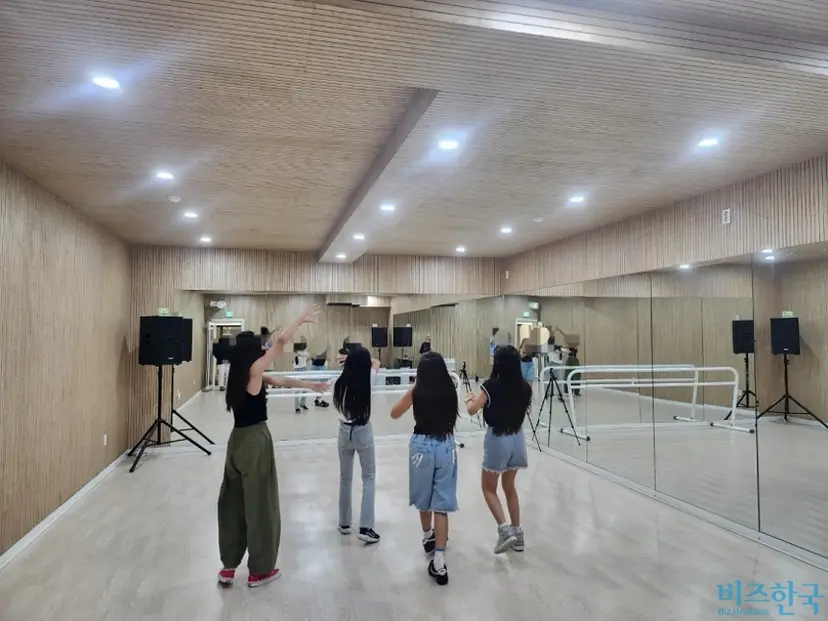
“Left, right, left, right, left, right,” the students are adjusting their formations to the loud voice of the dance trainer. A famous girl group song is playing loudly in the practice room with mirrors. The four students are stretching their limbs and performing a "sharp" dance in time with the trainer's instructions. Various dance moves like isolations and waacking unfold without rest.
The trainer watched the children's dancing with a sharp gaze before yelling. "Please, just do it as I taught you!" As the word "Again" is shouted countlessly, simple movements are repeated endlessly. Training continued for 25 minutes until the dance for that section was memorized. There are times when difficult dance moves take an hour to memorize. When a difficult part appears in the next section, the trainer demonstrates the choreography personally to guide them. Beads of sweat had already formed on the children's foreheads. The trainer encourages them by saying that even if the movements are difficult and exhausting, they must pull them off. This is because they can only become trainees if they show their skills in a performance. 45 minutes passed without a moment to drink water.
The dance trainer here, who says they have taught active idols and trainees for a long time, said, "You have to show 'vicious' determination to get into an agency. Since the students are young, they might think learning to dance is a kind of play, but they shouldn't be smiling when they look in the mirror. The competition for the students learning here are their peers who have already become trainees. You can only survive if you pour your heart and soul into every movement and its level of perfection in this cold reality where you can be cut at any time."

Scouted by Agencies through Showcases… Strict Feedback through Monthly Evaluations
Despite the repeated practice and criticism, the children were engrossed. This is because they will be holding a showcase in front of agency officials this coming October. This performance is a very important event for the K-Pop academy, the students, and their parents alike. Students who stand out here can go straight to an agency. From the academy's perspective, it can leave a track record of having sent students to famous agencies. Parents trust the academy more and entrust their children as more of these achievements accumulate.
Students preparing for the showcase are currently sweating in the 'Performance Class.' "The performance class is the most popular class. It costs about 800,000 won for three months of classes. Hair, makeup, outfits, and profiles are all included. Through word of mouth among parents, inquiries about the performance class are the most frequent." Outside of the performance class, regular classes cost 450,000 won each for four dance and vocal lessons.
The academy representative said that about 70 agencies are keeping an eye on this showcase and that they plan to rent a large concert hall in Hapjeong-dong, Mapo-gu, Seoul, to hold it. Students who successfully completed the previous showcase all passed the first round of agency auditions. Three students also went on to join agencies as trainees after final selection. Generally, agency trainee auditions proceed up to four rounds. As word of this spread, they tipped us off that many agencies contact them in advance. "Agencies prefer 5th and 6th graders the most. They usually want to secure 'raw gems' first."
Like agencies, students here also undergo monthly evaluations. They are held on the last Saturday of every month, and vocal/dance trainers and agency officials evaluate their skills. Agencies and trainers deliver evaluation reports to the parents. Looking at the monthly evaluations obtained by BizHankook, the student's fundamentals, body type, and more are evaluated in detail.
When asked which agency they want to go to, the children unanimously answered that they want to go to large companies like SM, YG, JYP, and HYBE. The parents were the same. For many of the students, this was not their first academy. They are also attending idol academies during the week after school. Kim Ji-seok (pseudonym), a parent who came with their child from Siheung, Gyeonggi-do, said, "Since every academy holds public auditions, I have no choice but to pay attention. My child loves it so much, so I just want to be able to let them attend during the week as well."
※ The next installment will feature an article about K-Pop from the perspective of a New York dancer.
※ This project was supported by the Korea Press Foundation's fund, which was created using government advertising commissions.
![[K-Pop: Idols in Wonderland] The Truth Behind the 'Opaque Settlement' That Even Lee Seung-gi Suffered From](https://s.bizhankook.com/attachments_thumb/2026/05/92121_thumb.webp)
![[K-Pop: Idols in Wonderland] "16 is old": Why trainee time runs backward](https://s.bizhankook.com/attachments_thumb/2026/05/92151_thumb.webp)
![[K-Pop: Idols in Wonderland] What a U.S. Trainee Experienced in the Korean Training System…](https://s.bizhankook.com/attachments_thumb/2026/05/92180_thumb.webp)
![[K-Pop: Idols in Wonderland] The Reality of 'Idol Academies', the Practice Required to Become a Trainee](https://s.bizhankook.com/attachments_thumb/2026/05/92216_thumb.webp)
![[K-Pop: Idols in Wonderland] Suggesting the "Trainee" Path to American Teenagers: "What About School?"](https://s.bizhankook.com/attachments_thumb/2026/05/92221_thumb.webp)
![[K-Pop: Idols in Wonderland] Why couldn't a blue-eyed New Yorker become a K-Pop idol?](https://s.bizhankook.com/attachments_thumb/2026/05/92287_thumb.webp)