

[비즈한국] K-Pop has become South Korea's greatest export. However, deep shadows lurk behind the glamour. Idols, the symbols of K-Pop, are scouted at a young age and must endure grueling trainee periods. In that process, labor and human rights are frequently ignored. What happens to the countless trainees who never even make their debut? Through the 'K-Pop: Idols in Wonderland' series, BizHankook aims to highlight the problems that have been ignored during K-Pop's growth and examine potential solutions from various angles. We believe that when those who create K-Pop become healthier, the people who enjoy K-Pop can also be happier.
'A top star who never received a single music revenue settlement in 18 years.' This is not a story from the 90s. It happened just two years ago, and it involves a top star. The so-called 'Lee Seung-gi incident' that erupted in 2022 clearly exposed the irregularities of the entertainment industry. Even a top star like Lee Seung-gi could not receive proper settlements.
Agencies are not legally required to provide settlement data to their contracted entertainers. It is a structure where the artist does not know how much was spent or where, nor how much was earned. The settlement ratios for idols are also frequently a topic of debate. Even after deducting trainee expenses and various other costs included by the agency, the split usually ranges from 9 to 1 to 6 to 4. Naturally, the agency takes the larger share.
Following the controversy, the Ministry of Culture, Sports and Tourism and the National Assembly drafted a revision, commonly known as the 'Lee Seung-gi Act,' which would make it mandatory for agencies to notify artists of their 'settlement details,' but it failed to pass in the previous National Assembly. How are idol settlements actually being handled?

A 5-to-5 Contract, But Only Taking Home 5%
In the idol industry, even after all expenses are deducted, the agency takes more than the idols. The recent trend is 7 to 3 or 6 to 4. One agency representative stated, "With idols frequently leaving midway, there are many cases where the split is 7 to 3 in the beginning, and then adjusted to 6 to 4 or 5 to 5 after three or four years."
In a 5-to-5 scenario, one might assume the idols take half the net profit, but that half must be divided by the number of members in the idol group. As the number of members increases, the portion taken by each individual decreases.
Lawyer Jung Ji-seok (Law Firm Namgang) pointed out, "In reality, agencies expand upon the contents written in the standard contract to deduct even more. Furthermore, if the distribution ratio reaches 9 to 1, for a group with 10 members, the settlement ratio per person drops to 90 to 1."
So, how much money do idols actually earn? BizHankook obtained and analyzed a past settlement statement of a famous idol member, 'A.' The statement was received after the 'Standard Contract' was established in 2009. There were 6 members, and the profit-sharing ratio was 5 to 5.
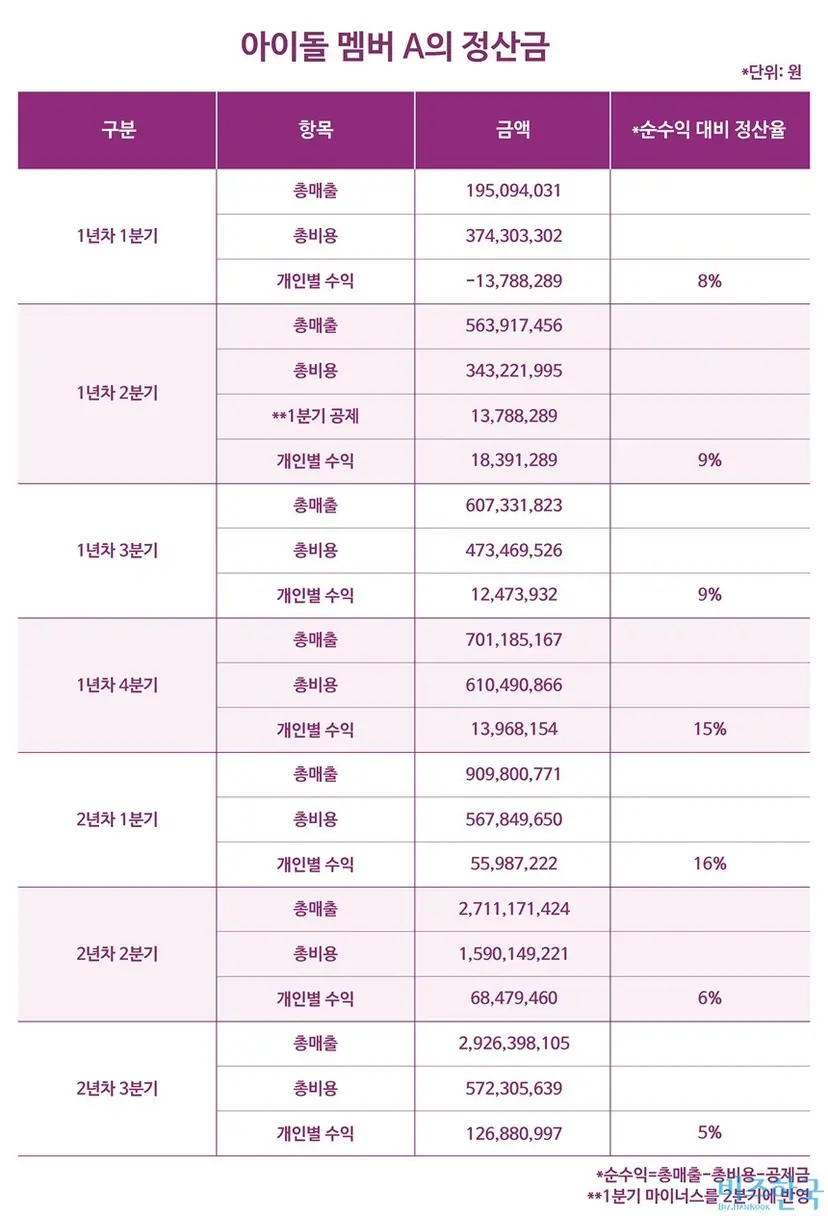
Although 'A' was under 'favorable' conditions of receiving 'half' of the net profit, they did not actually take home 50% of the revenue. After subtracting all expenses from the total sales, half went to the company, and the other half was divided among the 6 members. In the first quarter of their first year, the year after their debut, the profit was negative, and these costs were deducted in the second quarter.
The actual settlement rate relative to net profit for 'A' fluctuated between 5% and 16%. In particular, after earning 2.926 billion KRW in the third quarter of their second year, which was their highest revenue, the money 'A' took home was only 126.88 million KRW, which is just 5% of the net profit.
While the settlement conditions remained the same throughout the contract period, the way the agency calculated profits changed every time. Sometimes they calculated total sales and expenses all at once before splitting the profit, and other times they calculated profits separately by categories such as music and management.
Member 'A' side says they were suspicious of the sales and expense amounts. 'A's side confided, "When we raised the issue in our third year, the agency placated us by saying they would increase the settlement ratio from 5 to 5 to 4 to 6. However, the settlement details were strange. They would omit performance fees of 50 to 60 million KRW or include the losses of other groups in our group's settlement."
'A's side lamented, "(The expenses) included the agency CEO's travel expenses, and the CEO even took large sums of money under the guise of production fees. The lease fees for vehicles used by the CEO and other company employees were also all paid for as our group's expenses. Even though most of our stage outfits were sponsored, they deducted tens of millions of KRW per person per stage for outfit costs. The cost of water consumed by one member in a single quarter (3 months) was 6 million KRW. These were details that made no common sense."
The problem was the basis for the settlement. 'A' never once received supporting documents for the settlements. 'A's side explained, "The amounts were just written as numbers on A4 paper. I never even saw a receipt. We hired an accountant to review it. We were told that we could terminate the contract and sue for damages, but we couldn't engage in a legal battle because we wanted to continue our activities."
"Never Even Received Data, Let Alone a Settlement"
Member 'B,' who lived as an idol for 7 years, also testified, "In 7 years, I have never received a settlement. Let alone a settlement, I have never even received 'settlement data.' According to the contract, the settlement ratio was 7 to 3 until the 5th year, and 6 to 4 thereafter. I never once saw how much was spent or earned in data or even on A4 paper. Some members raised objections, but they were told, 'If you have 1.6 billion KRW, pay it and leave.' We couldn't even know exactly how much the deficit was."
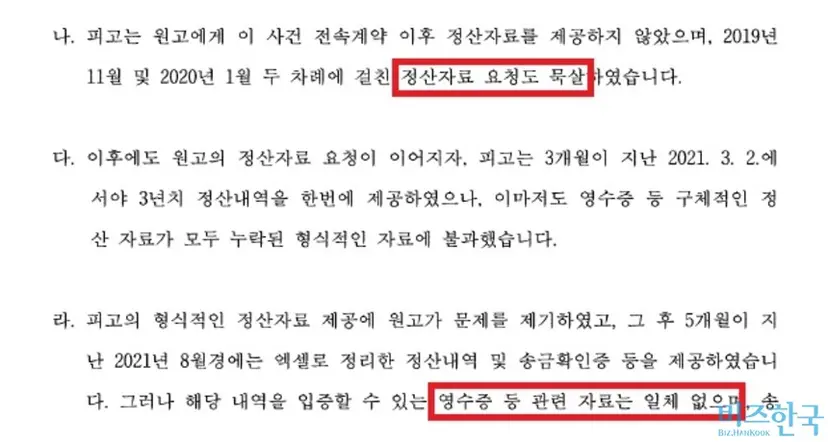
Requesting settlement data from an agency is synonymous with halting activities. According to a civil lawsuit judgment on the existence of the validity of an exclusive contract delivered in November 2022, idol member 'C' requested settlement data from the agency after signing the exclusive contract in 2018 but did not receive any details for 3 years. The member claimed that it was only in 2021 that they received formal data missing 'receipts and settlement records.' The court acknowledged this and ruled that the exclusive contract was invalid.
Earlier, lawyer Jung Ji-seok pointed out, "Lee Seung-gi had zero settlements for decades. Agencies insert (underhanded) poison clauses into contracts and expand the expenses to be deducted. It is a problem that this settlement system continues even now. If the artist's side suggests revising these contract contents, the agency refuses to sign. We need to create a settlement structure that does not exploit artists, such as providing a salary so that they can at least maintain a basic standard of living."
※ The next installment will feature an article on the increasing number of underage idols.
<We are waiting for tips from those involved>
BizHankook plans to focus on reporting stories about K-Pop and idols.
Trainees, those who have experienced idol life firsthand, or insiders working in the K-Pop industry, please send us your tips. allhyeon@bizhankook.com
※ This project was supported by the Korea Press Foundation's fund, which is financed by government advertising fees.
![[K-Pop: Idols in Wonderland] Are Trainees Workers or Students?](https://s.bizhankook.com/attachments_thumb/2026/05/92017_thumb.webp)
![[K-Pop: Idols in Wonderland] 'One Day, Idols Disappeared': Their Survival Story](https://s.bizhankook.com/attachments_thumb/2026/05/92034_thumb.webp)
![[K-Pop: Idols in Wonderland] What has changed since the 'TVXQ Incident'?](https://s.bizhankook.com/attachments_thumb/2026/05/92051_thumb.webp)
![[K-Pop: Idols in Wonderland] The Truth Behind the 'Opaque Settlement' That Even Lee Seung-gi Suffered From](https://s.bizhankook.com/attachments_thumb/2026/05/92121_thumb.webp)
![[K-Pop: Idols in Wonderland] "16 is old": Why trainee time runs backward](https://s.bizhankook.com/attachments_thumb/2026/05/92151_thumb.webp)
![[K-Pop: Idols in Wonderland] What a U.S. Trainee Experienced in the Korean Training System…](https://s.bizhankook.com/attachments_thumb/2026/05/92180_thumb.webp)