

[비즈한국] K-Pop has become South Korea's premier export product. However, there is a deep shadow behind the glamour. Idols, the symbols of K-Pop, are scouted at a young age and endure rigorous training periods. In this process, labor rights and human rights are frequently ignored. What happens to the countless trainees who never even get to debut? Through the series "K-Pop: Idols in Wonderland," BizHankook intends to highlight the problems that have been overlooked during K-Pop’s growth and examine alternatives from various angles. We believe that when those who create K-Pop become healthier, the people who enjoy K-Pop can also become happier.
The idol industry hit a turning point in 2009. The so-called "TVXQ Incident" flipped the script on the K-Pop industry. A 13-year exclusive contract period, excessive penalty clauses, and profit-sharing clauses that meant not a single cent could be taken home unless over 500,000 albums were sold—the contract the members of TVXQ had signed with their agency, SM Entertainment, was nothing short of a "slave contract."
As the TVXQ dispute and the late Jang Ja-yeon case surfaced simultaneously, the Fair Trade Commission (FTC) created a "Standard Exclusive Contract" for pop culture artists such as actors and singers. It was from this point that the standard for an idol's exclusive contract period became "7 years." It also became "common sense" that costs incurred during training could not be charged before debut and that settlement data had to be provided. The standard contract has since been revised several times. In 2019, a standard contract for idol trainees and an auxiliary agreement for underage idols and trainees were also established.
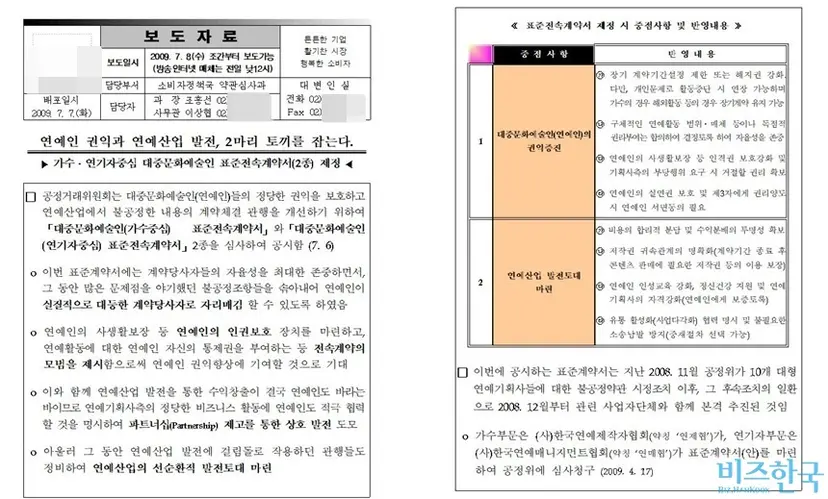
However, the "slave contract" controversy has not ended. In 2021, "Chuu," formerly a member of LOONA, filed a lawsuit to confirm the invalidity of her exclusive contract regarding unfair settlement terms and won in the first trial last year. This is not just a problem for small and medium-sized agencies. Recently, EXO subunit CBX (Chen, Baekhyun, Xiumin) has been embroiled in a legal battle with SM Entertainment, claiming their contracts are "slave contracts."
Fifteen years after the enactment of the standard contract, what do idol contracts look like now? Are the standard contracts being followed well? Before that, is the current standard contract really fair?
The Standard Contract Itself is "Unfair"
Contracts for idols and trainees are extremely unique. While the standard contract states that trainees and artists provide "services," it does not recognize their status as laborers. In particular, trainees must repay the costs incurred during their training period after debut. Even after debut, the agency "pre-deducts" various costs they invested before distributing net profits to the artists. This is a structure rarely found in existing legal frameworks.
Idol groups The East Light and TRCNG have even faced controversy over child abuse, with members being habitually assaulted by agency employees during their contract periods. Lawyer Jung Ji-seok (Law Firm Namkang), who represented them in their lawsuits, says the "standard contract" notified by the Ministry of Culture, Sports and Tourism is the problem itself.
Lawyer Jung pointed out, "Idol contracts can be seen as a form of partnership where the agency provides funding and the artist or trainee provides service or labor. The problem is that the agency recovers its investment before distributing the settlement money. If you deduct the investment, it is no longer a partnership. Once the investment is fully recovered, you should withdraw from the partnership. But agencies have a concept of distributing what remains only after they have fully recovered their investment. There is no such unfair structure. The legal approach starting from the Ministry of Culture, Sports and Tourism's standard contract is wrong."
Idol Contracts: What is the Reality?
The problem is that even the "tilted" standard contract is not being followed properly. Industry insiders say in unison that the standard contract is merely a formality and the "auxiliary agreement" is the actual contract. Lawyer Jung Ji-seok also explained, "Agencies mostly use the standard contract, but they insert toxic clauses into special terms or auxiliary agreements." This is why countless idols are still experiencing legal disputes over unfair contracts.
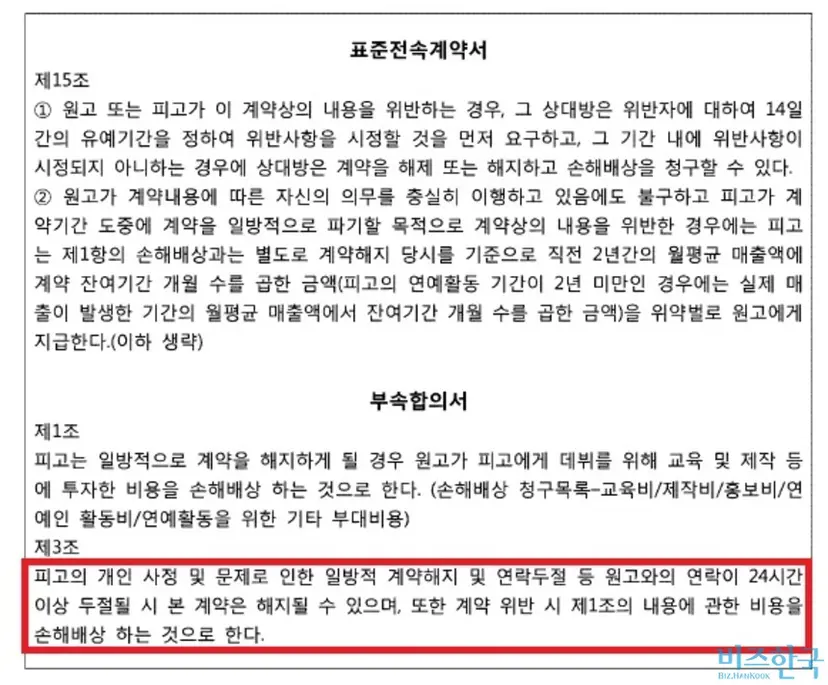
The act of forcing idols to report their location to the agency was already defined by the FTC as an "infringement of privacy" back in 2009, yet it still openly appears in "auxiliary agreements." This was revealed in a damage compensation ruling delivered on August 18, 2023. In 2016, the CEO of Agency A signed an exclusive contract with Member B of a five-member group and also drew up an auxiliary agreement. It stated, "If contact with the plaintiff is cut off for more than 24 hours, this contract may be terminated, and in the event of a breach of contract, damages shall be paid for the costs related to the contents of Article 1."
Later, in 2022, CEO A filed a damage compensation lawsuit demanding 121,622,900 KRW, claiming that B had been unreachable in 2017. The court dismissed the suit, stating that five years had passed and there was no evidence to acknowledge that contact had been cut off.
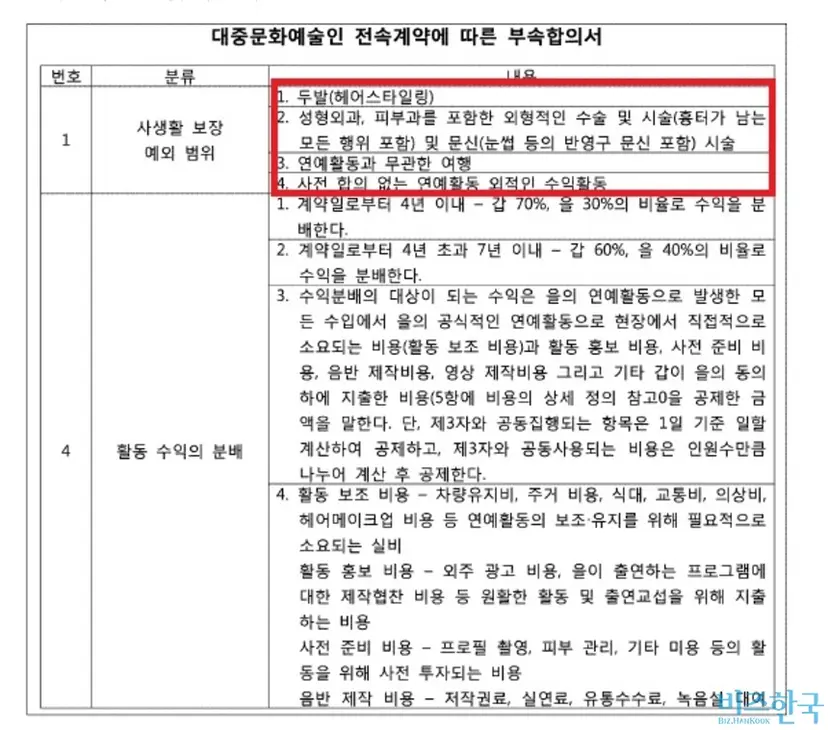
The clause requiring agency consent for economic activities other than entertainment was deleted by the FTC in 2009, but it is still valid in reality. In 2018, Agency C signed an exclusive contract with girl group member D and drew up an auxiliary agreement. At this time, the agency included cosmetic procedures, tattoos, plastic surgery, travel, and profit-making activities in the exceptions to privacy guarantees.
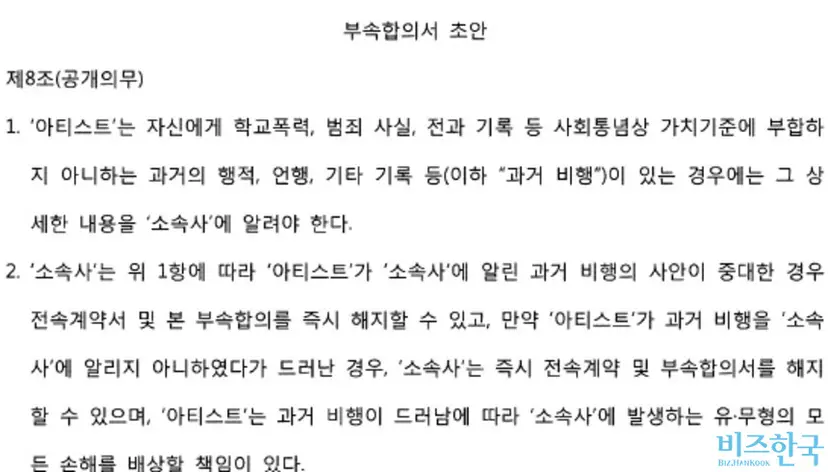
As the "school violence" controversy involving idols has recently emerged as an issue, a clause requiring the disclosure of past records has also appeared in "auxiliary agreements." In 2021, while discussing an exclusive contract with trainee F, Agency E specified in an auxiliary agreement: "If you have any past conduct, speech, or other records that do not meet social values, such as school violence, criminal facts, or a criminal record, you must inform the agency of the details." Trainee F's parents requested revisions to this clause and the profit-sharing clause, but the company did not accept them. When F's side stated they would not sign the contract, Agency E filed a damage compensation lawsuit demanding 31,734,865 KRW from F.
In addition to this, there have been several cases where agency CEOs have been criminally punished for taking nude photos of underage trainees or forcing them to expose themselves under the guise of shooting profile photos.
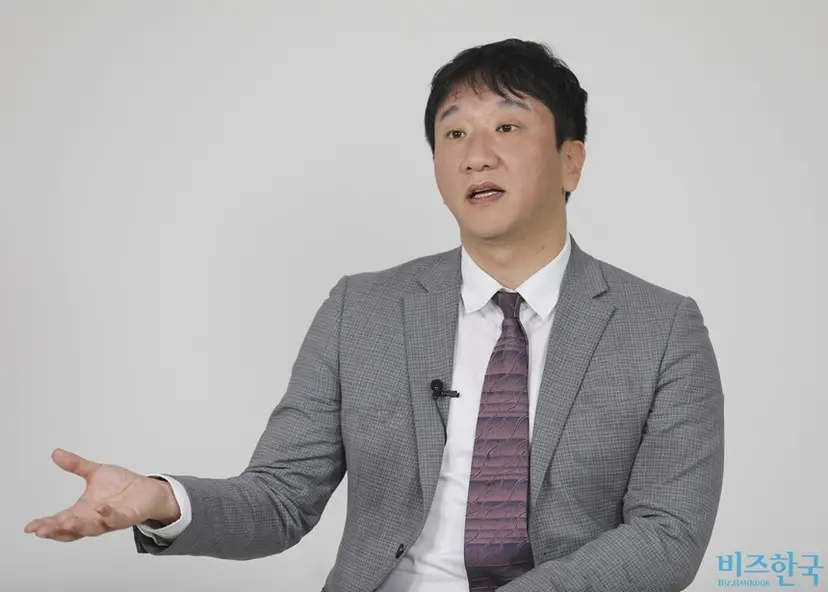
Lawyer Roh Jong-eon (Law Firm Jonjae), who represented the idol group Omega X in their habitual assault case, said, "There are a great many cases of human rights abuses and missing settlement payments. In particular, there are many cases where trainees suffer abuse and assault during their training period. When entertainers file lawsuits, they are effectively unable to work due to damage to their image, regardless of the truth of the allegations. Even if they win a settlement lawsuit, it is very difficult to recover damages because there are cases where the funds have been siphoned off."
Lawyer Roh says it is time to pay attention to the problems of the K-Pop industry. He pointed out, "The entertainment industry has grown rapidly, leading to increased side effects. Companies unrelated to the entertainment industry are also investing indiscriminately, leading to large-scale fraud victims. Ultimately, these damages fall on the artists belonging to the company. Meanwhile, the dominance of the idol market by large agencies has actually increased. I believe the time has come to seriously resolve these problems."
※ The next installment will feature an article on the problems of idol settlements.
<We await tips from insiders>
BizHankook plans to focus its reporting on stories about K-Pop and idols.
We invite tips from trainees, those who have experienced idol life firsthand, or industry insiders working in the K-Pop field. allhyeon@bizhankook.com
※ This project was supported by the Korea Press Foundation's fund, which was created using government advertising fees.
![[K-Pop: Idols in Wonderland] "15-Year Slave Contract: They Said I Couldn't Consult a Lawyer"](https://s.bizhankook.com/attachments_thumb/2026/05/91969_thumb.webp)
![[K-Pop: Idols in Wonderland] Are Trainees Workers or Students?](https://s.bizhankook.com/attachments_thumb/2026/05/92017_thumb.webp)
![[K-Pop: Idols in Wonderland] 'One Day, Idols Disappeared': Their Survival Story](https://s.bizhankook.com/attachments_thumb/2026/05/92034_thumb.webp)
![[K-Pop: Idols in Wonderland] What has changed since the 'TVXQ Incident'?](https://s.bizhankook.com/attachments_thumb/2026/05/92051_thumb.webp)
![[K-Pop: Idols in Wonderland] The Truth Behind the 'Opaque Settlement' That Even Lee Seung-gi Suffered From](https://s.bizhankook.com/attachments_thumb/2026/05/92121_thumb.webp)
![[K-Pop: Idols in Wonderland] "16 is old": Why trainee time runs backward](https://s.bizhankook.com/attachments_thumb/2026/05/92151_thumb.webp)