

[비즈한국] We are launching Season 12 of the 'Korean Art Support Project,' a support program designed to cultivate the fertile soil of Korean art. This initiative is now recognized within the art world as a meaningful event for discovering and fostering artists. It has established a reputation among artists as a project they aspire to participate in. The fundamental keywords that the 'Korean Art Support Project' has pursued from the beginning are the 'acceptance of diverse trends in Korean art and the pursuit of developmental change.' As a result of these principles, it is credited with establishing a unique perspective on contemporary Korean art.
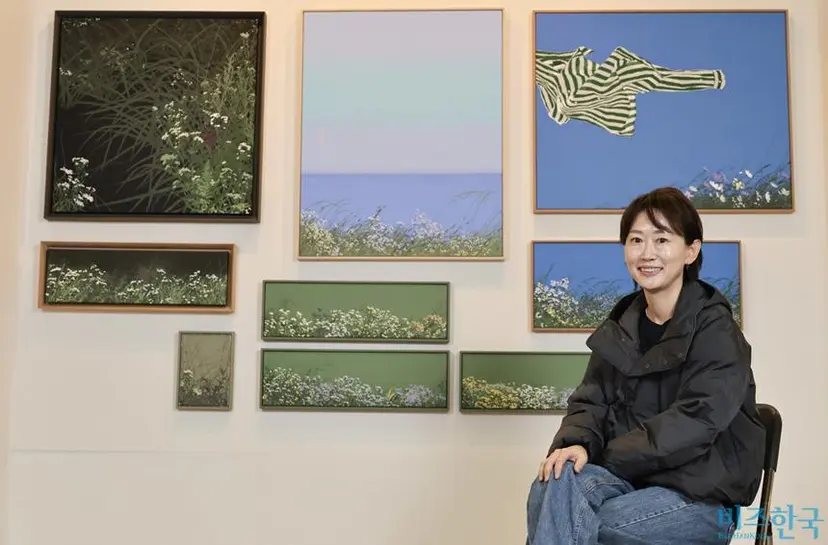
Nature is the greatest teacher. It is constantly sending us messages. The wise individuals who have left their mark on human history are those who knew how to read the messages sent by nature.
Artists, in particular, must possess an excellent sensor for nature. This sensor can only function properly when it is fully charged with rich emotions.
Kwon Ji-hyun is clearly an artist with a sensitive sensor. She paints landscapes. Not breathtaking vistas, but the ordinary scenery one encounters anywhere. From such mundane views, she draws out extraordinary landscapes. She has learned to read the messages nature sends.
Landscapes contain messages through various expressions. The first thing that comes to mind is the visible scenery; this is the most powerful expression a landscape possesses. Faithfully following this expression constitutes realistic painting.
Landscape painting, which began by tracing the visible scenery, has evolved into a style where the artist curates only what they wish to see, and further into a stage where the artist projects their own thoughts onto the landscape. Capturing these stages is the role of an artist who reads the messages of nature.
Landscapes also convey messages through other expressions, such as sound or movement. While movement in a landscape often reminds us of natural phenomena created by gravity, like rain or waterfalls, it mostly appears as the traces of wind. Wind creates magnificent scenes by swaying forests or sweeping across the ocean to stir up waves.
Sound accompanies movement. The art form that best interprets the expression of sound within a landscape is music. Yet, musicians who paint landscapes through sound ultimately aspire to reach the visual world of painting. French Impressionist composer Claude Debussy, who earned fame for music that felt like painting, also yearned to reach the world of Impressionist art. This is why listening to his masterpiece 'La Mer' brings to mind a calm sea with sparkling sunlight.
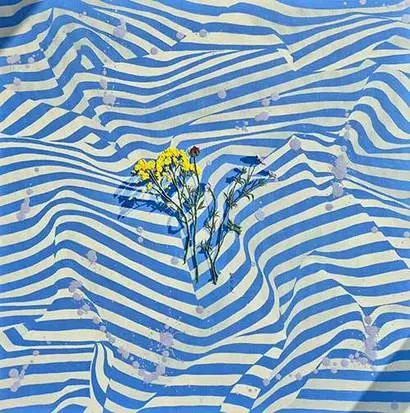
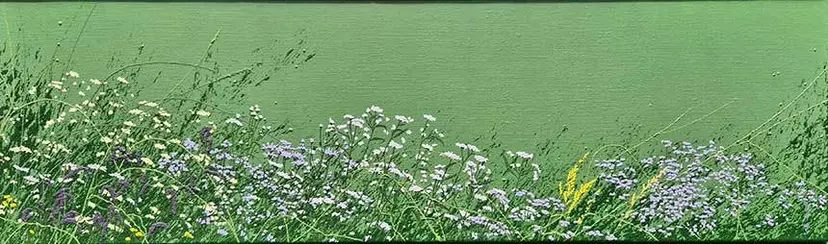
The starting point of Kwon Ji-hyun’s work is also the landscape. She captures emotions spontaneously triggered by the nature she encounters on her walks—the sea, the sky, seagulls, wildflowers, and the sand on the beach—and translates them into painting. However, while she follows the methodology and composition of a landscape, it is difficult to classify them simply as landscape paintings.
This is because she chooses to interpret and express the messages from nature through her own sensibility. As a result, her work feels like abstraction based on form. Wildflowers appear most frequently in her compositions. Clusters of swaying wildflowers even convey a sense of motion. She captures her emotional state through this movement, color, and the thickness of her layered brushstrokes.
Kwon Ji-hyun’s paintings are able to achieve both popular appeal and artistic merit because she reads the messages of nature within ordinary scenery.
![[Korean Art Support Project Season 12] Kwon Ji-hyun - The Message in Wildflowers](https://s.bizhankook.com/attachments_thumb/2026/05/98175_thumb.webp)
![[Korea Art Promotion Project Season 12] Seo Je-ah - Growing Pains Expressed Through Leather Art](https://s.bizhankook.com/attachments_thumb/2026/05/98480_thumb.webp)
![[Korea Art Promotion Project Season 12] Kim Hyun-bin: Capturing the Traces of Time in Abstraction](https://s.bizhankook.com/attachments_thumb/2026/05/98642_thumb.webp)
![[Korea Art Promotion Project Season 12] Joo Kyung-sook - Lines Containing the Energy of Life](https://s.bizhankook.com/attachments_thumb/2026/06/106488_thumb_74bfae90.webp)
![[Korean Art Support Project Season 12] Kim Kyung-won - Original Paintings Created Through Optical Illusions](https://s.bizhankook.com/attachments/2026/07/4942ec34bbf7_bd974ed4.jpg)
![[Korea Art Promotion Project Season 12] Claire Kim - Cartoon-like Paintings](https://s.bizhankook.com/attachments/2026/07/79ed5c5967a3_47729c25.jpg)