

[비즈한국] The 12th season of the 'Korean Art Support Project,' a program dedicated to cultivating the fertile soil of Korean art, has begun. This project has now been recognized by the art world as a meaningful event for discovering and fostering artists, and it is well-regarded among artists as a project they aspire to join. The fundamental keywords that the 'Korean Art Support Project' has pursued from the beginning were 'embracing the diverse flows of Korean art and seeking progressive change.' As a fruit of these principles, it is evaluated as having established a perspective on contemporary Korean art.
One of the major keywords in Western art, which has explored the visible world, is illusionism. This movement, often translated as 'hwan-yeong-ju-ui' (illusionism), has been a primary driving force behind the development of Western painting.
Illusionism is the creation of a 'hwan-yeong' (illusion) by plausibly reproducing real-life objects or spaces within a specific frame. It is a technique that effectively expresses the appearance or sense of space of objects for naturalistic representation. In a sense, illusionism provides us with an illusion through a trick of the eye caused by optical illusions.
'Optical illusion' (chaek-si) means seeing something wrongly or failing to judge it correctly, leading to a different perception. However, this often sparks pleasant imagination or leads us into a world of fantasy. The greatest trick of the eye is perspective, as it is the culprit behind the illusion that makes a flat plane appear three-dimensional.
The painter who developed these optical illusion effects into his own aesthetic and carved out a unique territory in Western art history is Giuseppe Arcimboldo (1527-1593). His works, created during the late Renaissance, possess a power that transcends time, continuing to inspire the imagination of artists even today.
Arcimboldo's works combine fruits, vegetables, clothing, or books to create human figures. Seen up close, each object simply looks like it is jumbled together. However, from a distance, a grumpy-looking character or a face with a comical appearance emerges. It is painting that shows the pinnacle of optical illusion effects.
Arcimboldo's ingenious method of creating images served as a precursor to early 20th-century Surrealist painting and still possesses such strong vitality that it influences modern advertising. The reason is that his work does not end with a mere trick of the eye but is based on clear content. In other words, while the objects appearing as props on the canvas to create the image retain their inherent characteristics, they transform into entirely new images when combined.
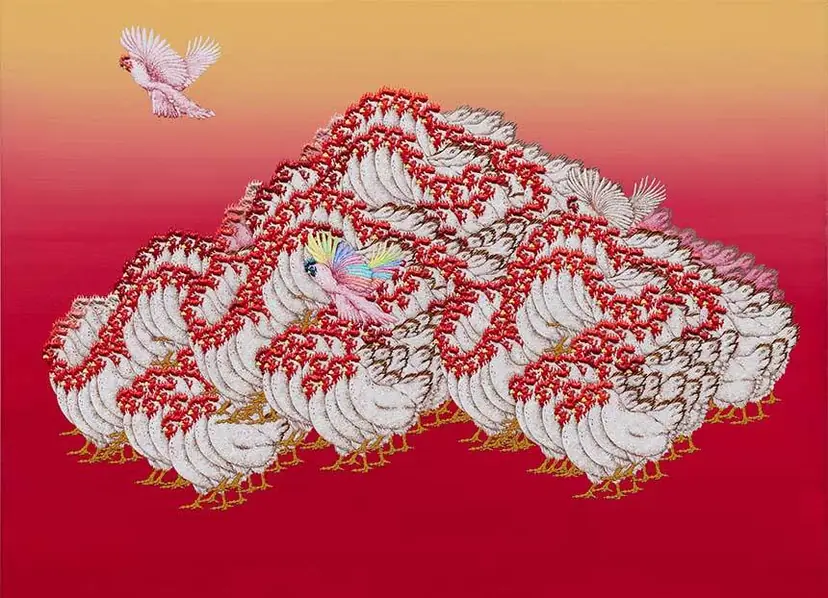
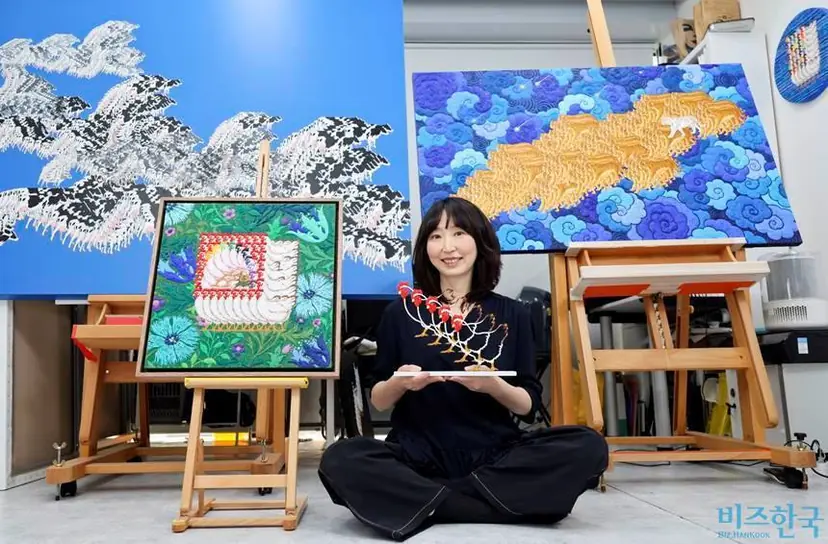
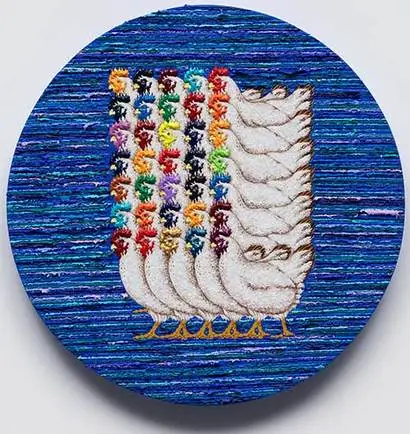
Kim Kyung-won reinterprets this flow to show original paintings. He repeatedly connects animals (chickens, cows, tigers, etc.) to transform them into new images. Consequently, the superimposed animals appear as shapes like mountains or waves, or other shapes are created through specific parts of the animals (such as a chicken's comb) or patterns (such as a cow's spots or a tiger's stripes).
The idea of utilizing optical illusions to transition into new images is well-expressed in the artist's note: “The red colors of the overlapping chicken combs resemble autumn foliage rooted along flowing mountain ridges, the brown tails look like solid granite, and the white feathers of the bodies feel like low-hanging misty clouds.”
Kim Kyung-won’s imagination, which finds the image of an autumn mountain within a chicken, is expanding the realm of optical illusion and creating a new type of painting.
![[Korea Art Promotion Project Season 12] Seo Je-ah - Growing Pains Expressed Through Leather Art](https://s.bizhankook.com/attachments_thumb/2026/05/98480_thumb.webp)
![[Korea Art Promotion Project Season 12] Kim Hyun-bin: Capturing the Traces of Time in Abstraction](https://s.bizhankook.com/attachments_thumb/2026/05/98642_thumb.webp)
![[Korea Art Promotion Project Season 12] Joo Kyung-sook - Lines Containing the Energy of Life](https://s.bizhankook.com/attachments_thumb/2026/06/106488_thumb_74bfae90.webp)
![[Korean Art Support Project Season 12] Kim Kyung-won - Original Paintings Created Through Optical Illusions](https://s.bizhankook.com/attachments/2026/07/4942ec34bbf7_bd974ed4.jpg)
![[Korea Art Promotion Project Season 12] Claire Kim - Cartoon-like Paintings](https://s.bizhankook.com/attachments/2026/07/79ed5c5967a3_47729c25.jpg)
![[Korean Art Support Project Season 12] Song Gwang-chan - Making Ordinary Daily Life Extraordinary](https://s.bizhankook.com/attachments_webp_no_wm/2026/07/134426_no_wm_c2f8a941.webp)