

[비즈한국] Among rare diseases, those with an exceptionally low number of patients are classified as 'ultra-rare diseases.' In South Korea, this generally refers to conditions with 200 or fewer patients or those lacking a specific disease classification code. The scarcity of patients means there is a lack of diagnostic experience, treatment data, and social interest. Consequently, it takes a long time to identify the illness, and even after a difficult diagnosis, patients and their families are left to bear the full burden of suffering because treatments and systematic support lag behind. Bizhankook examines the reality and medical blind spots of ultra-rare disease patients hidden behind the statistics.
For South Korean ultra-rare disease patients, news of new drug approvals is welcome but does not offer full hope. Because drug prices are astronomically high, they cannot be covered out-of-pocket. Patients wait for inclusion in the national health insurance coverage, but the tragedy of being forced to give up on life despite having the drug right in front of them—due to failing to pass the health authorities' stringent screening thresholds—is a recurring story. The Health Insurance Review and Assessment Service's (HIRA) economic evaluation and coverage criteria are sometimes perceived by these patients as a direct threat to their right to life.
The Korean Organization for Rare Diseases lists about 20 conditions, including Von Hippel-Lindau (VHL) syndrome, idiopathic pulmonary fibrosis (IPF), neurofibromatosis, and neuromyelitis optica spectrum disorder (NMOSD), as rare/intractable diseases where patients struggle to access medicine even after official approval by the Ministry of Food and Drug Safety because of restricted health insurance coverage.

Indefinite Wait for Coverage… Despite 50,000 Signatures on a National Petition, No Movement
Welireg (belzutifan), the only treatment for VHL, an autosomal dominant genetic rare disease, was approved by the Ministry of Food and Drug Safety in May 2023. The disease causes multiple tumors throughout the body over a lifetime, including renal cell carcinoma and central nervous system hemangioblastomas. Patients live with serious organ function loss and complications, constantly repeating surgeries to remove tumors. There are an estimated 200 VHL patients in Korea.
Although Welireg underwent review by the HIRA Cancer Disease Review Committee three times (August 2024, March 2025, and December 2025), it failed to secure insurance coverage because the committee ruled the clinical evidence was limited and the criteria for treatment suspension or re-administration were unclear, leading to ambiguity in patient eligibility and duration. Even though a national petition launched by patients and families in May 2024 received over 50,000 signatures, the drug remains out of reach for patients.
The situation for patients with 'Idiopathic Pulmonary Fibrosis (IPF),' where the lungs gradually harden, is even more desperate.
IPF has a 5-year survival rate of only 20-30%, making it one of the leading causes of death among rare diseases in Korea. Although the treatment 'Ofev (nintedanib)' was listed for insurance coverage in May 2025—nearly 9 years after its domestic approval in October 2016—it only covers systemic sclerosis-associated interstitial lung disease and progressive pulmonary fibrosis (PPF); IPF itself is excluded.
Ofev and Esbriet (pirfenidone) are the two treatments recommended by domestic and international IPF clinical guidelines. However, because reports indicate that 25-50% of patients discontinue Esbriet within a year due to side effects like gastrointestinal issues (nausea, loss of appetite) and skin rashes, the demand for Ofev is high. All eight countries (A8 nations)—the US, UK, France, Germany, Italy, Switzerland, Japan, and Canada—that South Korea references for new drug pricing have included Ofev in their insurance coverage lists.

'Half-Coverage' Trapped by Age Restrictions
Even after finally entering the coverage system, the suffering does not end. The conditions for receiving benefits are often disconnected from reality.
Just like Strensiq for hypophosphatasia, coverage for the neurofibromatosis treatment 'Koselugo (selumetinib)' is restricted for adults. Neurofibromatosis is caused by an NF1 gene mutation that leads to abnormal cell proliferation, resulting in developmental abnormalities in the nervous system, bones, and skin. It can lead to vision loss from optic gliomas, cognitive impairment from neurological complications, and, if it progresses to malignant, can lead to neurofibrosarcoma or malignant peripheral nerve sheath tumors.
Pediatric and adolescent neurofibromatosis patients aged 3-18 have been receiving health insurance benefits for Koselugo since January 1, 2024, approximately two years and seven months after receiving Ministry of Food and Drug Safety approval in May 2021. Adult patients only became eligible to use Koselugo in December 2025 after the indication was expanded, but they remain ineligible for insurance coverage. The upper limit for coverage for one 25mg Koselugo capsule is 235,464 won; without insurance, an adult patient must bear costs exceeding 170 million won annually.
Do You Have to Get Sicker to Get Coverage?
The coverage criteria for Neuromyelitis Optica Spectrum Disorder (NMOSD) are contradictory. NMOSD is a rare autoimmune disease of the central nervous system that causes vision loss and neurological damage. The primary symptoms are optic neuritis and myelitis, and more than half of affected patients experience vision loss or reach the point of needing a wheelchair within 5 to 10 years. A single relapse can cause severe neurological deficits, and it is known that 8 to 9 out of 10 patients experience repeated relapses.
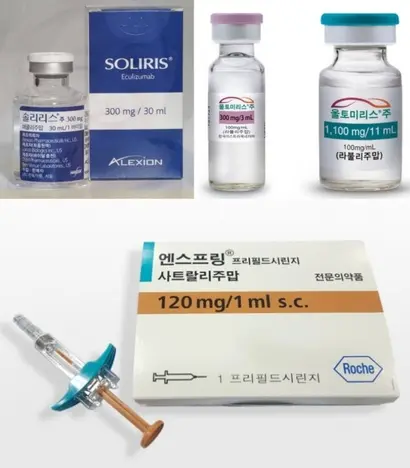
Given the nature of the disease, using an innovative new drug specialized in relapse prevention from the early stages is the best treatment. Currently, four targeted therapies—'Soliris,' 'Enspryng,' 'Ultomiris,' and 'Uplizna'—are officially approved in Korea. All except Uplizna are listed for coverage.
NMOSD patients, estimated at 1,500-2,000 in Korea, have a relatively wider range of treatment options compared to other rare diseases. However, they must cross the stepped treatment barriers set by HIRA. Using a new drug from the start means paying over 100 million won annually out-of-pocket because they do not qualify for insurance benefits.
To receive coverage, patients must first use inexpensive oral immunosuppressants. If that fails, they are required to take a 'rituximab' drug—typically used for blood cancers or rheumatoid arthritis—for at least three months. Rituximab is not officially approved for NMOSD. This has led to criticism that HIRA is forcing off-label prescriptions for NMOSD treatment to save on health insurance costs.
Only after failing first- and second-line treatments can NMOSD patients receive coverage for the three innovative new drugs. However, the coverage conditions are strict. Enspryng requires one symptomatic relapse within the last year, while Soliris and Ultomiris require at least two relapses in the last year or at least three in the last two years. The purpose of using the drug is to prevent deterioration and irreversible disability, but to get it, one must endure a catastrophic relapse that could lead to blindness or paralysis of the lower body.
These are expensive drugs that must be administered every two weeks for Soliris, every four weeks for Enspryng, and every eight weeks for Ultomiris. The coverage caps per vial are 3.6 million won for Soliris, 7.5 million won for Enspryng, and 5.04 million to 17.15 million won for Ultomiris. Without coverage, the annual cost exceeds 100 million won. Even with the release of the Soliris biosimilar Episclere, costs still exceed 65 million won per year. This is why patients accuse HIRA of pushing them into the terror of blindness and wheelchairs in the name of protecting health insurance finances.

“The Government Always Says It’s Difficult…” Urgent Need for a Patient-Centered System
Rare disease patient groups are raising their voices in criticism of the government. Jung Jin-hyang, Secretary General of the Korean Organization for Rare Diseases, which consists of 89 rare disease associations, said, “I believe it is the duty of the state to prepare alternatives for patients with severe diseases, but they always just say it’s difficult. It seems like there is no consideration for them.” She added, “In the case of the hypophosphatasia treatment where coverage is restricted for adults, we filed a complaint with the Human Rights Commission regarding age discrimination, but we only received a response that they were ‘trying.’”
However, she positively evaluated the government's recent plans to alleviate the financial burden of rare disease treatments. Last January, the Ministry of Health and Welfare announced plans to further reduce the out-of-pocket patient contribution for high-cost medical expenses for rare and severe intractable diseases, and to shorten the period from drug approval to insurance listing from 330 days to 150 days. Secretary General Jung emphasized, “We know the government is trying, such as by attempting to streamline the rapid listing process for rare disease drugs. It’s a matter of how long it will take, but patients want to feel the effects quickly.”
Between pharmaceutical companies demanding high prices and a government trying to maintain fiscal health, the life clocks of rare disease patients standing on the edge of a cliff are ticking away helplessly. It is time for an urgent reform of the tailored coverage review system that fully reflects the unique characteristics of rare diseases so that the right to life of the few is not trampled by numerical logic called ‘economic feasibility.’”
![[Ultra-Rare Disease Report] ① “Just because I’m an adult…” The cruel reality for patients with hypophosphatasia](https://s.bizhankook.com/attachments_thumb/2026/05/97846_thumb.webp)
![[Ultra-Rare Disease Report] ② Drugs are 'Pie in the Sky'... Patients Suffer as Care is Delayed by Economic Criteria](https://s.bizhankook.com/attachments_thumb/2026/05/97942_thumb.webp)
![[Ultra-Rare Disease Report] ③ "Do we really have to pay billions for these drugs?" The cold 'logic' that wounds patients twice](https://s.bizhankook.com/attachments_thumb/2026/05/97991_thumb.webp)
![[Ultra-Rare Disease Report] ④ ‘The illness is there, but I can’t prove it’: The final barrier blocking PFIC patients](https://s.bizhankook.com/attachments_webp_no_wm/2026/08/135079_no_wm_9cc07564.webp)
![[Ultra-Rare Disease Report] ⑤ “Even if I can’t see, it’s for the next generation”: Why a patient diagnosed with blindness is creating his own cure](https://s.bizhankook.com/attachments_webp_no_wm/2026/09/135657_no_wm_8c2e80e7.webp)