

[비즈한국] The ‘CES Foundry,’ which opened its doors at this year’s CES for the first time, was different from traditional component supply chain exhibitions. The goal of the foundry event, which kicked off on the 7th (local time) at the Fontainebleau Hotel in Las Vegas, Nevada, on the second day of ‘CES 2026,’ was clear: to demonstrate how artificial intelligence (AI) and quantum technology are being applied to real-world industries to create business value.
Adjacent to the space hosting panel discussions and other events, Nvidia’s exhibition is underway. Nvidia is showcasing its technological prowess alongside partners that make up its ecosystem, ranging from premium automaker Mercedes-Benz to Agibot, China’s top mass-producer of humanoid robots. Going beyond the role of a chip manufacturer, Nvidia is positioning itself as an operating system (OS) platform for the entire industry, specifically outlining how its technology is being integrated into actual industrial processes and business operations.

Foundry: From Semiconductor Factory to 'Innovation Acceleration Hub'
At 9:20 a.m. on the 7th, the first opening ceremony for the foundry division was held separately at the Fontainebleau Hotel, adjacent to the Las Vegas Convention Center (LVCC). The foundry event and exhibition are designed to facilitate intense interaction between deep-tech companies and investors. Unlike general exhibitions focused on flashy attractions, the atmosphere here was noticeably calmer and bustling with business professionals.
Nvidia’s exhibition is taking place here simultaneously. While physical products such as Mercedes-Benz vehicles equipped with the AI autonomous driving system ‘AlphaMayo Stack,’ the world’s first personal robo-car ‘Tensor,’ and Agibot were unveiled, a significant portion was dedicated to displaying simulations of each technology on screens.
Nvidia’s exhibition focused on proving that its technology is fundamentally transforming traditional manufacturing processes and consumer experiences. Leveraging its manufacturing capabilities, Nvidia is strengthening its position as a software platform provider that grants intelligence to hardware systems such as robots and mobility. The slogan ‘Physical AI’ was displayed throughout the exhibition hall, highlighting collaborations with global conglomerates and startups.
From Autonomous Mercedes to Robo-car ‘Tensor’ and China’s ‘Agibot’
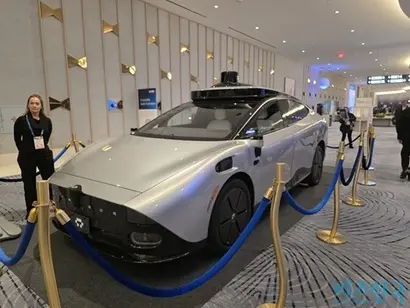
‘Tensor’ is an autonomous vehicle based on Nvidia’s Drive platform. It aims to be an ‘agentic mobility’ solution capable of conversing with users and assessing situations. A representative for Tensor at the venue explained, “It’s not just simple autonomous driving. It’s Level 4 (L4) autonomy that understands pedestrians and unexpected situations like a human, and features a steering wheel that retracts into the dashboard.”
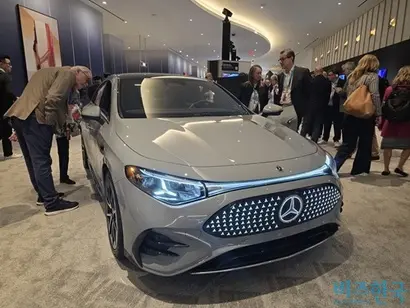
In addition to Tensor, other mobility products were on display at the site. The most notable was a Mercedes-Benz vehicle incorporating AlphaMayo Stack, Nvidia’s next-generation autonomous driving AI model. AlphaMayo is an inference-based system learned by combining camera data with human driving data.
Nvidia CEO Jensen Huang unveiled this during a special CES keynote on the 6th, stating, “The ChatGPT moment has arrived for physical AI, including robotics.” Nvidia aims to launch Mercedes vehicles equipped with AlphaMayo in the U.S. market in the first quarter of this year. It plans to expand the application of the AlphaMayo system to Europe and Asia thereafter.
The robotics zone provided answers to ‘how robots become intelligent’ through demonstrations. ‘A2 Ultra,’ a product from Chinese humanoid robot mass-producer Agibot, demonstrated its ability to understand and reason through physical laws using the Cosmos model.
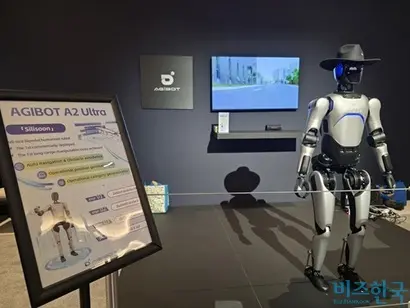
On screens placed around the venue, the process of robots simulating tens of thousands of movements within the virtual world, ‘Omniverse,’ instead of experiencing trial and error in reality, was revealed. Rather than supplying hardware directly to robot manufacturers, Nvidia’s strategy is to capture the industrial ecosystem by providing the foundation of intelligence that acts as the robot's brain in a foundry format.
At the BMW booth, virtual simulations based on Nvidia’s latest ‘Blackwell’ GPU are being demonstrated. This is a solution that dramatically reduces the time and cost of new car design by implementing the vehicle in a virtual environment before actual production.
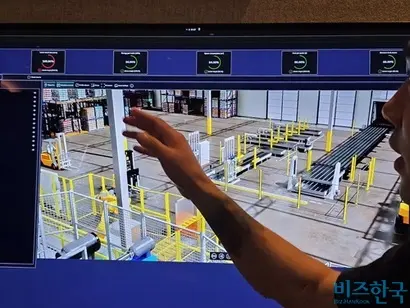
Through a simulation that implemented an entire factory as a digital twin in collaboration with the German multinational manufacturing technology firm Siemens, they showcased practical use cases of an industrial metaverse. This is also a way to maximize productivity by resolving bottlenecks that might occur before actual factory operation within the virtual world.
The establishment of the CES Foundry division is seen as demonstrating that leadership in the semiconductor market is shifting from singular hardware performance to value creation through AI infrastructure. The specific metric mentioned by CEO Jensen Huang—generating $75 million in revenue from a $5 million investment—suggests that semiconductor companies are evolving beyond component suppliers into ‘strategic foundries’ that design business profit models for their clients.
The foundry event will be held for two days until the 8th, the third day of the main event. The Los Angeles Times noted, “CES Foundry is the center of foundational technology that will lead future innovation beyond the large language models (LLMs) currently focused on research.”
![[CES 2026] "AI Prescribes Sleep" - Focus on 'SleepTech' in the Era of Home Healthcare](https://s.bizhankook.com/attachments_thumb/2026/05/96880_thumb.webp)
![[CES 2026] "Hyundai, LG, and Qualcomm All Go into Robotics": Acceleration of the Shift to 'Physical AI'](https://s.bizhankook.com/attachments_thumb/2026/05/96872_thumb.webp)
![[CES 2026] Lenovo Paints the Sphere Red: A Look at Chairman Yang Yuanqing's Keynote](https://s.bizhankook.com/attachments_thumb/2026/05/96953_thumb.webp)
![[CES 2026] 'CES Foundry' Debuts, Unfolding Nvidia's 'Physical AI' Ecosystem](https://s.bizhankook.com/attachments_thumb/2026/05/96974_thumb.webp)
![[CES 2026] "Listen to music with candy, read a dog's mind..." 5 unique innovative products](https://s.bizhankook.com/attachments_thumb/2026/05/96962_thumb.webp)
![[CES 2026] 'The Counterattack of Chinese Robots': Beyond Showcasing, They Now Have Price Tags](https://s.bizhankook.com/attachments_thumb/2026/05/96918_thumb.webp)