

[비즈한국] CES, the world's largest consumer electronics and IT exhibition, is a battlefield for innovative technologies that change human life every year. At 'CES 2026,' which has been held in Las Vegas since the 6th (local time), the digital healthcare industry is making its presence felt alongside traditional tech sectors like AI (Artificial Intelligence) and mobility.
The most notable change at this year's event is the location of the booths for healthcare companies. Carlos Nunez, Chief Medical Officer (CMO) of global sleep solution company ResMed, said in an interview ahead of the opening of CES 2026, "It is symbolic that the digital health exhibition hall is located right next to the smart home exhibition hall." The industry views the future home as transitioning beyond a simple residential space into a 'Healthy Home' that monitors the residents' health in real-time.
Along with this, the necessity for a good night's sleep to improve quality of life is growing. This is because more people are experiencing sleep difficulties, such as increasing stress from psychological and social factors and a rise in patients with sleep apnea. According to ResMed, the number of adult sleep apnea patients in the U.S. is projected to reach 77 million by 2050.
If sleep deprivation or sleep disorders persist, it leads to short-term declines in concentration and memory, and in the long term, concerns about cardiovascular risks, obesity, and metabolic problems such as diabetes increase. Anxiety and depression can also occur, turning on red lights for mental health. CMO Nunez warned, "Sleep deprivation can increase the risk of cardiovascular disease, stroke, and dementia, leading to an explosion in medical problems," adding, "While 77 million is a large number, all 8 billion people worldwide should prioritize sleep."
To achieve the goal of sleep improvement, the boundaries between home appliances and medicine are rapidly blurring. In this flow, Dr. Nunez emphasized the convergence with consumer technology companies such as Samsung and Apple. He evaluated, "The fact that big tech companies have received FDA approval for sleep apnea detection functions over the past year and a half is a huge turning point," adding, "Consumer electronics can now be seen as having evolved into clinically significant medical tools." Samsung Electronics005930 received De Novo approval from the FDA for its Galaxy Watch-based sleep apnea detection function in February 2024. De Novo refers to the FDA's first-time approval after assessing the safety and effectiveness of new healthcare technology. Apple received 510(k) clearance, the FDA's premarket notification process, for the same function in September of the same year.
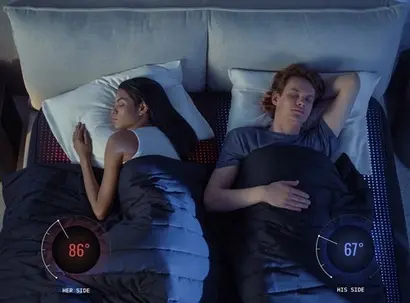
At CES 2026, ResMed showcased an 'AI Sleep Assistant' that combines data from tens of millions of patients with generative AI to provide personalized sleep coaching, such as "Reduce caffeine after lunch for a good night's sleep today." U.S. wellness tech company Eight Sleep introduced the 'Pod 5 Ultra,' a smart mattress cover equipped with AI technology that automatically adjusts bed temperature, alleviates snoring with micro-vibrations, and adjusts the mattress angle according to sleep stages. French healthcare company Withings also presented a blueprint for home healthcare that can even take care of cardiovascular health through more advanced smart scales and sleep mats.
However, there are also voices wary of technocentrism. John Lopos, CEO of the National Sleep Foundation (NSF), advised in an interview with CMO Nunez, "We must be careful of 'Orthosomnia,' where people lose sleep because they are overly obsessed and worried about their sleep data."
He evaluated, "Technology itself is not the solution, but a tool that should help users take the right actions, such as getting sunlight during the day and relaxing at night," adding, "The technologies at CES 2026 have now matured beyond simply throwing data at users to specifically guiding them on what to do."
![[CES 2026] "Giving Robots a Google Brain": Hyundai Motor Announces Alliance with DeepMind](https://s.bizhankook.com/attachments_thumb/2026/05/96907_thumb.webp)
![[CES 2026] Doosan Bobcat Overcomes 'Language and Skill Barriers' at Construction Sites with AI](https://s.bizhankook.com/attachments_thumb/2026/05/96902_thumb.webp)
![[CES 2026] AMD CEO Lisa Su: 'The Real Deal Hasn't Even Started… Let's Move Into the Era of the Yotta'](https://s.bizhankook.com/attachments_thumb/2026/05/96928_thumb.webp)
![[CES 2026] "AI Prescribes Sleep" - Focus on 'SleepTech' in the Era of Home Healthcare](https://s.bizhankook.com/attachments_thumb/2026/05/96880_thumb.webp)
![[CES 2026] "Hyundai, LG, and Qualcomm All Go into Robotics": Acceleration of the Shift to 'Physical AI'](https://s.bizhankook.com/attachments_thumb/2026/05/96872_thumb.webp)
![[CES 2026] Lenovo Paints the Sphere Red: A Look at Chairman Yang Yuanqing's Keynote](https://s.bizhankook.com/attachments_thumb/2026/05/96953_thumb.webp)