

[비즈한국] The key theme of 'CES 2026', which kicked off on the 6th (local time), was 'Physical AI'—technology that has moved beyond the screen to expand into the actual physical world. Over the past several years, AI technology that has been utilized in cloud and mobile environments is now clearly transitioning into the physical realm by integrating with tangible hardware such as robots, manufacturing processes, and logistics.
On the first day of the event, at the Las Vegas Convention Center (LVCC), global tech companies vied to showcase a wide array of practical solutions through the integration of hardware and AI. Hyundai Motor Company005380 and LG Electronics066570 presented concrete examples of physical AI implementation through large-scale exhibition spaces, while major global firms like Amazon, Qualcomm, and Siemens also showcased their physical AI capabilities built on their respective ecosystems.
How is Physical AI Implemented in Industrial Sites?
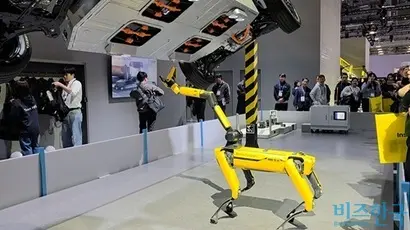
Hyundai Motor Company, which set up a large booth in the West Hall of the LVCC, focused its exhibition more on innovation in "manufacturing and processes" rather than just the final "automobile" product. In the front of the booth, a lineup of robots designed to support the automation and efficiency of industrial processes was placed at the forefront, rather than finished cars.
In a demonstration area designed to mimic an actual smart factory or logistics site, various industrial robots moved in perfect coordination. A logistics robot system equipped with a proprietary intelligent path-finding algorithm transported goods along optimal routes in a simulated warehouse environment. The quadruped robot 'Spot AI Keeper' showcased automated solutions, such as finishing an inspection task on a vehicle assembly line and then autonomously moving to a charging zone to dock. The unmanned parking robot 'H-Motion' drew attention by demonstrating efficient space utilization simulations, precisely controlling vehicles even in tight spaces.
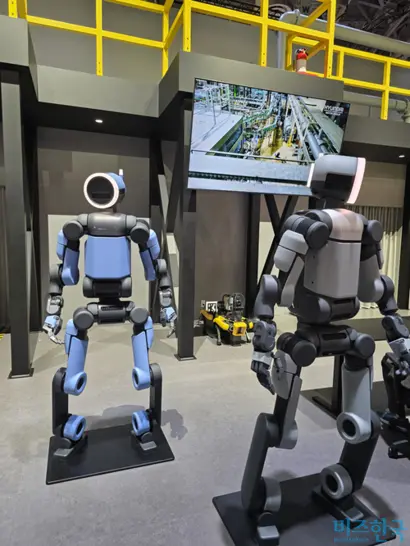
Of particular note were the electric model of the next-generation humanoid robot 'Atlas' from the robotics subsidiary Boston Dynamics, and the 'MobED' robot platform, which won the CES Best of Innovation Award. Following its initial unveiling the previous day, the next-generation Atlas was displayed in the exhibition hall, drawing significant attention.
MobED is a mobile platform designed to explore complex outdoor and industrial environments freely. Its four wheels move independently, allowing it to spin 360 degrees in place. During turns in its high-speed 'gliding mode,' it performs a tilting motion that angles the body inward—much like a skier taking a corner—enabling movements that are both dynamic and stable.
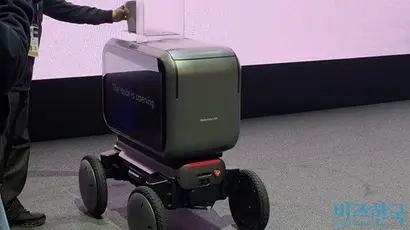
An on-site representative added, "We collect and analyze data in real-time through multiple LiDAR sensors, cameras, and radar. Through AI algorithms, the various sensor data independently evaluate complex terrains such as curves, slopes, and obstacles, allowing the robot to secure its own driving stability.”
What Does a 'Labor-Free Home' Look Like with 'Cloi-d'?
LG Electronics, which occupied the main area of the LVCC Central Hall, also made a bold move with robotics technology that goes beyond home appliances. In a virtual residential space prepared in the center of the booth, the home robot 'Cloi-d,' which was unveiled at the media conference on the 5th, was placed to demonstrate performing household chores.
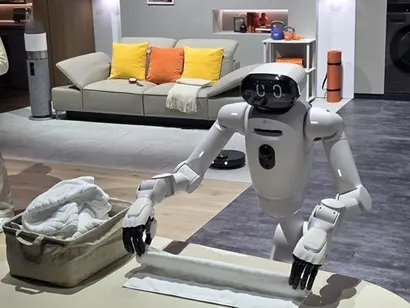
Cloi-d, which performed live demonstrations rather than simple displays, showcased home assistance functions. In a space set up like a kitchen and laundry room, it worked in tandem with a demonstrator to put laundry into the washing machine or fold dried clothes. Cloi-d is equipped with two arms and five fingers. Its base includes a drive unit that allows it to move freely indoors. According to the company, it achieves precise movements through actuators packed with motion technology, and perceives and responds to its surroundings in real-time using visual intelligence.
While there are no immediate plans for commercialization, this exhibition is significant in that it signals that AI has evolved beyond the virtual realm of controlling appliances into a physical entity capable of replacing actual labor. Ryu Jae-chul, CEO of LG Electronics, had previously mentioned 'Intelligence in Action' and a 'Labor-Free Home' as the core of his future vision. The plan is to return free time to customers as a partner that actively shares household labor.
Connecting the Physical World with Global 'Platforms'
Overseas big tech and global tech companies also put forward physical AI as a key strategy.
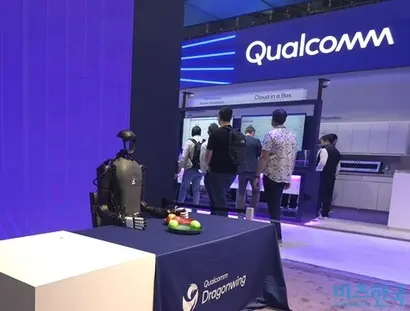
Qualcomm used this CES to formalize its transition into a 'Physical AI Platform Company.' Based on high-performance edge computing, Qualcomm has integrated its automotive 'Snapdragon Digital Chassis' and Industrial IoT portfolio. In particular, it demonstrated a fleet of humanoid robot technologies powered by the DragonWing IQ series, concretizing a physical AI strategy that allows robots to judge and move autonomously without cloud connectivity.
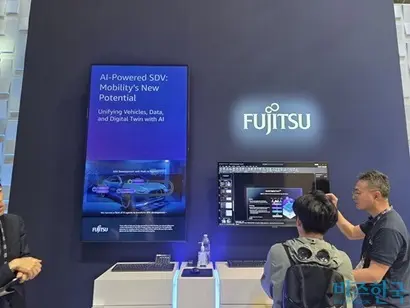
Amazon showed the expansion of physical AI through its partner ecosystem at its West Hall booth rather than a direct product exhibition, with its collaboration with Japan's Fujitsu being a prime example. At one side of the Amazon booth, Fujitsu showcased 'Spatial World Model' technology that helps robots predict and react to human behavior. It is characterized by mapping camera data into 3D scene graphs to implement an intelligent space where robots and humans can safely collaborate.
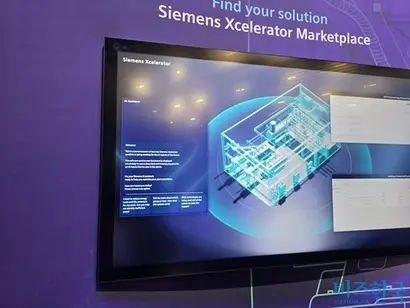
Siemens, the German manufacturing tech firm known as a 'manufacturing giant,' put its open digital business platform, 'Xcelerator,' at the forefront. It introduced 'Digital Twin'-based smart solutions that perfectly replicate and test all facilities and processes in a virtual world before a factory is even built.
An on-site official explained, "It's a technology that allows us to run a virtual factory on a computer to identify bottlenecks or check for robot collisions before putting machines into an actual factory. We provide an environment where companies can adopt complex digital process solutions as easily as downloading an app from an app store.”
NVIDIA CEO Jensen Huang, who made a surprise appearance at the Siemens keynote address that morning, added weight to manufacturing innovation in the era of physical AI, stating, "The reason we are collaborating is to perfectly implement our next-generation GPU, 'Vera Rubin,' as a digital twin in the future.”
As this year is evaluated to be a technological inflection point where AI permeates into physical reality beyond the screen, the competition for leadership in hardware intelligence among global companies is expected to become even more intense.
![[CES 2026] Doosan Bobcat Overcomes 'Language and Skill Barriers' at Construction Sites with AI](https://s.bizhankook.com/attachments_thumb/2026/05/96902_thumb.webp)
![[CES 2026] AMD CEO Lisa Su: 'The Real Deal Hasn't Even Started… Let's Move Into the Era of the Yotta'](https://s.bizhankook.com/attachments_thumb/2026/05/96928_thumb.webp)
![[CES 2026] "AI Prescribes Sleep" - Focus on 'SleepTech' in the Era of Home Healthcare](https://s.bizhankook.com/attachments_thumb/2026/05/96880_thumb.webp)
![[CES 2026] "Hyundai, LG, and Qualcomm All Go into Robotics": Acceleration of the Shift to 'Physical AI'](https://s.bizhankook.com/attachments_thumb/2026/05/96872_thumb.webp)
![[CES 2026] Lenovo Paints the Sphere Red: A Look at Chairman Yang Yuanqing's Keynote](https://s.bizhankook.com/attachments_thumb/2026/05/96953_thumb.webp)
![[CES 2026] 'CES Foundry' Debuts, Unfolding Nvidia's 'Physical AI' Ecosystem](https://s.bizhankook.com/attachments_thumb/2026/05/96974_thumb.webp)