

[비즈한국] Artificial Intelligence (AI), once confined to screens, has finally gained a physical form and poured into the real world. At this year's CES, an army of humanoids (human-like robots) equipped with human-like joints and sophisticated robotic arms have made inroads into manufacturing, logistics, and daily life.
According to the Consumer Technology Association (CTA), the organizer of CES, the number of robot-related entries this year jumped by 32% compared to the previous year. The AI and drone sectors also recorded growth rates of 29% and 32%, respectively, proving the full-scale arrival of the 'Physical AI' era. Above all, China's rapid progress was remarkable. Across the exhibition halls, it was evident that China's robotics rise has moved beyond 'technological showboating' and has entered the commercialization phase.
'Enterprise AI' Occupied by Chinese Robots
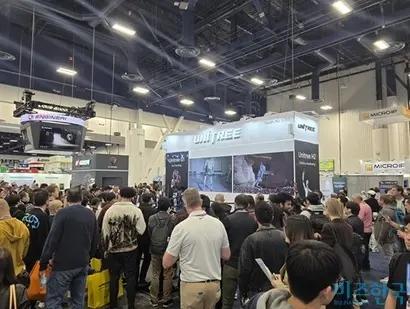
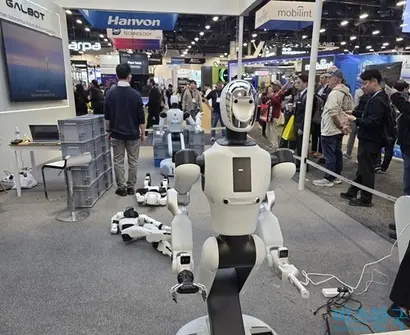
The Las Vegas Convention Center (LVCC) North Hall, where exhibitions for enterprise AI, smart cities, and the Internet of Things (IoT) were set up, was a playing field for Chinese robot companies. It was no exaggeration to say that every booth nearby was occupied by a Chinese robotics firm. They offered a wide variety of forms and purposes, ranging from logistics robots and drink-making robotic arms to full-bodied humanoids.
A total of 942 Chinese companies participated in this year's CES, ranking second in the number of participating companies by country after the United States (1,476). More than half (21) of the 38 companies exhibiting humanoid robots were from China. Unitree Robotics, AgiBot, Galbot, Engine AI, Noetix Robotics, and the government-backed 'X-Humanoid' were at the forefront.
A 70-Million-Won Boxing Robot… "Just Throwing It into the Market"
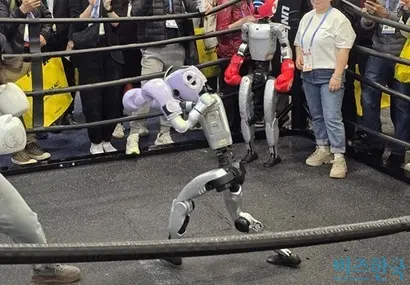
The place that drew the biggest crowd was the Unitree booth. Unitree, which grabbed attention last year with real-time interaction, presented a 'boxing robot' that competes in a ring this year. A price tag of '$49,000 (approximately 70 million won)' was attached to the model. A Unitree representative at the scene explained, "The boxing robot is to attract public attention," and added, "In reality, we are expanding verification in manufacturing and industrial sites through the G1 and H1 humanoid models." The company plans to release an enhanced H1 model with a 15kg load capacity this year.
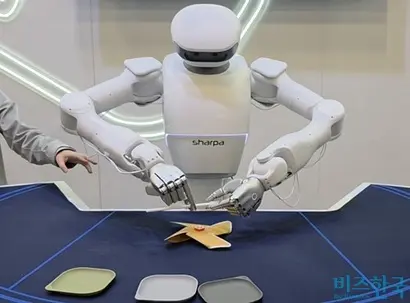
Across from them, the Singaporean company Sharper is operating a booth. Sharper is a company that keeps its global headquarters in Singapore while conducting manufacturing and R&D operations in Shanghai, China. They focus on developing high-performance robots and core components. Robotic hands like 'SharperWave' were on display, and a demonstration was held where a thin stick handle was assembled onto a pinwheel blade.
The differentiating factor of Chinese companies is evaluated as their 'end-to-end' executive capability, which includes the integration between hardware and software, and a rapid iteration cycle of converting new components into consumer products.
However, some suggest that the key to survival is whether they can exert capabilities beyond those of humans in actual production lines, rather than just imitating human movements. Aaron Jackowski, Head of Atlas Development at Boston Dynamics, who is leading the development of Hyundai Motor Group's next-generation electric humanoid 'Atlas', pointed out in a media interview that day, "Price is important, but the key is what tasks the robot can actually perform in an industrial site," adding, "If they just walk around or show off kung fu without doing any actual work at the site, they cannot provide economic utility."
Nvidia Partner AgiBot Launches Offensive with Mass Production Records
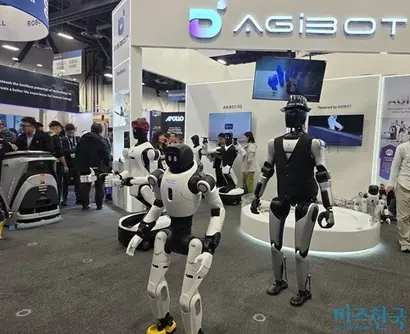
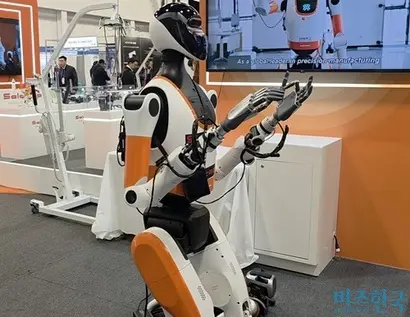
'AgiBot', which caught the eye of Nvidia CEO Jensen Huang, showcased the 'A2' model, suitable for hospitality, and the 'X2' model for education and research at this exhibition. In particular, the X2 showed off its ability to autonomously understand its surroundings through large feet designed for agile walking and built-in sensors.
AgiBot has a track record of shipping a total of 5,000 robots so far and is set for an official launch in the U.S. market this year. Full-scale support from global private equity firms, including BYD and Hillhouse Capital, has been the fuel for its growth.
Lesser-known Chinese companies also poured out various robot lineups. LY iTech, a precision component manufacturer that owns some 20 robot products, including 'Pansi' and 'Linglong', also showcased intelligent robots. However, the products of some companies appeared somewhat crude, or their movements were unnatural.
'Field Utility' Will Determine the 94-Trillion-Won Robot Market
Major Korean companies are also putting effort into building a humanoid robot ecosystem by conducting aggressive investments and mergers and acquisitions (M&A).
Samsung Electronics is accelerating the securing of industrial and humanoid robot technology through Rainbow Robotics, which was incorporated as a subsidiary in 2024. Hyundai Motor Group has secured world-class technical prowess in bipedal and quadrupedal walking robots by bringing in the robot subsidiary Boston Dynamics. The company is focusing on actual productivity improvements linked to smart factories with the goal of establishing a mass production system for the 'Atlas' of 30,000 units per year by 2028.
LG Electronics, which incorporated Bear Robotics as a subsidiary last year, is expanding its industrial, autonomous driving, and wearable robot sectors through cooperation with companies such as Robostar, Robotis, and Angel Robotics. Ryu Jae-chul, CEO of LG Electronics, stated at a media conference on the 7th, "We are cooperating with Robostar for industrial robots, which have the largest scale among our robot businesses, and with Bear Robotics for commercial robots."
![[CES 2026] "Hyundai, LG, and Qualcomm All Go into Robotics": Acceleration of the Shift to 'Physical AI'](https://s.bizhankook.com/attachments_thumb/2026/05/96872_thumb.webp)
![[CES 2026] Lenovo Paints the Sphere Red: A Look at Chairman Yang Yuanqing's Keynote](https://s.bizhankook.com/attachments_thumb/2026/05/96953_thumb.webp)
![[CES 2026] 'CES Foundry' Debuts, Unfolding Nvidia's 'Physical AI' Ecosystem](https://s.bizhankook.com/attachments_thumb/2026/05/96974_thumb.webp)
![[CES 2026] "Listen to music with candy, read a dog's mind..." 5 unique innovative products](https://s.bizhankook.com/attachments_thumb/2026/05/96962_thumb.webp)
![[CES 2026] 'The Counterattack of Chinese Robots': Beyond Showcasing, They Now Have Price Tags](https://s.bizhankook.com/attachments_thumb/2026/05/96918_thumb.webp)
![[CES 2026] 'Musk's Imagination Almost Became Reality': A Ride on the High-Speed 'Vegas Loop'](https://s.bizhankook.com/attachments_thumb/2026/05/96990_thumb.webp)