

[비즈한국] On the 4th (local time), two days before the official opening of 'CES 2026', the world's largest consumer electronics and IT exhibition, the Shoreline Exhibition Hall at the Mandalay Bay Convention Center in Las Vegas, Nevada, was bustling with reporters from all over the world. They had gathered to cover 'CES Unveiled', often referred to as the 'preview' of the main event. This year, in particular, reality-based technology where Artificial Intelligence (AI) assists human physical labor and sensory experiences filled the exhibition hall, making a strong impression.

At 4:00 PM on the 4th, before the event even began, hundreds of reporters were lined up at the entrance of the exhibition hall. CES Unveiled is a showcase where innovative companies from around the world unveil their 'killer products' to the media before the main event. It holds significant meaning as it serves as a technical compass for the global IT and electronics market for that year, transcending a simple exhibition.
The keyword that defined this year's Unveiled event was undoubtedly the 'physicalization' of AI. While last year was a software war based on Large Language Models (LLMs), 2026 is proving to be the inaugural year where AI takes on a physical form, evolving into a solution that solves real-world challenges in our lives. We identified this year's technology trends through the major innovative products that captured the attention of the press at the site.
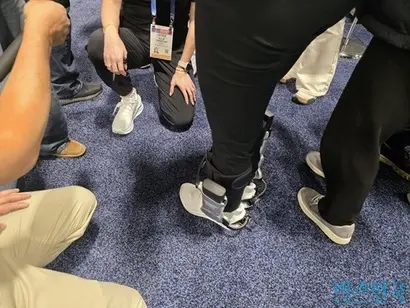
"My legs feel lighter": A fierce competition for 'wearable robots' that overcome physical limits
The area that drew the most visitors looking to try out products was 'wearable technology' that amplifies physical capabilities. The robotic exoskeleton 'Sidekick' by Dephy, which adds propulsion while walking, garnered interest from foreign media, while the ultra-lightweight walking assistance robot 'WIM S' presented by domestic startup WIRobotics also drew attention for its technology that maximizes daily walking convenience.
I personally tried on Ascentiz's exoskeleton suit. When walking with small strides like walking on flat ground, it felt like an ordinary device, but when I lifted my legs high as if climbing steep stairs or rocky terrain, I could feel the device on the waist descend and provide firm support. This technology, which instantly reduces muscle fatigue, is aimed at potential applications in industrial settings as well as walking assistance devices for an aging society.
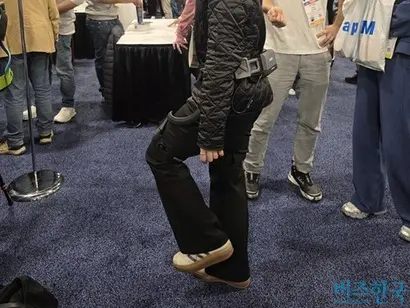
An official from Ascentiz stated, "Unlike existing methods that add a constant amount of force, the key is that sensors calculate the user's intention and muscle load in real-time, intervening intelligently only when force is urgently needed, such as on stairs or slopes."
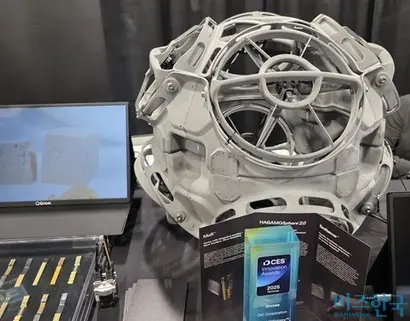
DIC, a Japanese material company and the world's largest printing ink manufacturer, showcased a product line aimed at the aerospace and industrial sectors. The ball-shaped spherical multicopter 'Hagamosphere 2.0' is a drone with eight propellers arranged diagonally at the corners of a cube. Applying a carbon fiber shield, this drone can maintain its level during flight while also rolling along the ground. A DIC representative explained, "It is a design optimized for high-difficulty missions such as disaster relief or defense reconnaissance."
A haptic assistance device that attaches to the finger was also unveiled. Even when wearing thick gloves, subtle surface textures were amplified and transmitted through the small device as if felt with a bare hand. Applications in industrial robotics or precision medical fields are highly anticipated.
From work efficiency to health management: 'Pragmatic' technology shines
Some companies competed with effectiveness rather than flashy demonstrations. The 'PLAUD NOTE PRO' and the ultra-compact 'NOTE PIN S' from AI recording device developer PLAUD are prime examples. PLAUD NOTE is an AI note-taker that supports all scenarios, including face-to-face conversations as well as phone calls and online meetings. It features an intuitive operation method where pressing the button in the center of the device starts recording instantly, and it provides real-time summaries and conversation analysis results in connection with a dedicated app.
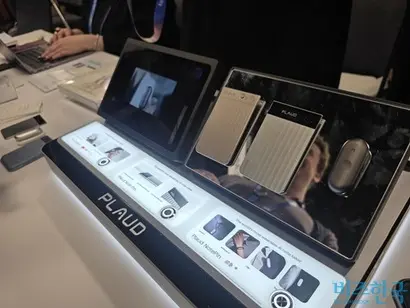
Media representatives stayed relatively long at the PLAUD booth, continuing with Q&A sessions about the product. Beyond mere curiosity in an interesting technology, it appeared that the interest stemmed from its potential for real-world business application and productivity improvement as a product already verified in the market.
A PLAUD representative emphasized, "It saves each user 260 hours per year, which is equivalent to an economic value of approximately $8,845 (about 12 million won)."
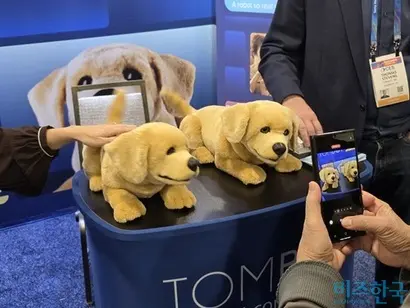
Among the booths at the event, the healthcare sector occupied a large portion, showcasing various innovative and idea-driven products. Practical attempts to resolve daily discomforts and improve quality of life appear to be particularly active in the healthcare sector. This is because the change felt by users is that much greater when advanced technology moves beyond complex theories and is implemented as services that directly touch our bodies.
Representative examples include 'TOMBOT', a robotic dog that helps provide emotional stability for patients with PTSD; 'Wheel Move', which attaches to manual wheelchairs to enhance mobility; and 'Y-BRUSH Halo', which analyzes breath using AI and gas sensors to detect early-stage diabetes and liver disease without drawing blood.

CES 2026, which opened with the Unveiled event, will feature presentations from major companies such as NVIDIA, Intel, LG, Qualcomm, and Hyundai Motor005380 Group, as well as a keynote address by AMD CEO Lisa Su during the media day period through tomorrow. The main exhibition will then welcome visitors from around the world for four days.
![[CES 2026] "No Driver's Seat, No Front or Back": A Test Ride of Amazon's Robotaxi 'Zoox'](https://s.bizhankook.com/attachments_thumb/2026/05/96861_thumb.webp)
![[CES 2026] "The Rise of Physical AI": Inside the 'CES Unveiled' Event That Stunned Global Reporters](https://s.bizhankook.com/attachments_thumb/2026/05/96832_thumb.webp)
![[CES 2026] Home Appliances Meet AI to Become Your Companion: 'One Samsung' Vision Unveiled](https://s.bizhankook.com/attachments_thumb/2026/05/96892_thumb.webp)
![[CES 2026] "A Living Room of the Future, Crafted by AI": A Preview of Samsung Electronics' 1,400-pyeong Exclusive Exhibition Hall](https://s.bizhankook.com/attachments_thumb/2026/05/96886_thumb.webp)
![[CES 2026] LG Home Robot 'CLOiD', Powered by Affectionate Intelligence, Declares Freedom from Housework](https://s.bizhankook.com/attachments_thumb/2026/05/96898_thumb.webp)
![[CES 2026] NVIDIA CEO Jensen Huang: "We Are No Longer Just a Chip Company"](https://s.bizhankook.com/attachments_thumb/2026/05/96841_thumb.webp)