

[비즈한국] “We are known as a company that makes chips, but now NVIDIA builds entire systems. And AI has become a structure that encompasses the full stack, rather than just a single function.”
On January 5 (local time), at the NVIDIA conference during CES 2026 held at the Fontainebleau Hotel in Las Vegas, CEO Jensen Huang defined the current state of NVIDIA and the future of AI in these terms. The stage that day was a testament to the kind of company NVIDIA is transforming into in an era where AI has become a platform. CEO Huang made it clear that the competition in the AI era is not about who can make the faster chip, but about who designs the entire structure upon which AI operates.
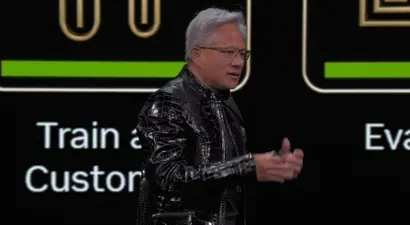
The Computing Industry Stands at the Threshold of Another 'Platform Shift'
CEO Jensen Huang began his speech by explaining the changes in the computing industry using the keyword 'platform shift.' He diagnosed that just as there were shifts from mainframes to PCs, from PCs to the internet, and from the internet to cloud and mobile, we have now reached yet another turning point.
What he emphasized was the nature of this transition. He highlighted that it is not merely about performance improvement, but that the very way applications are created and executed is changing. First, future applications will be built on top of AI. Consequently, AI is no longer just a feature but the foundation of all services. Second, the method of software development has also changed. We have moved from an era of creating programs by writing code to an era of creating software by training data, and the focus has shifted from the CPU to the GPU.
CEO Huang explained that due to these changes, the massive computing infrastructure built over the past decade and corporate R&D budgets are being reorganized around AI. He opened by stating that AI is no longer a technology for specific industries, but is becoming a key investment target for almost every industry.
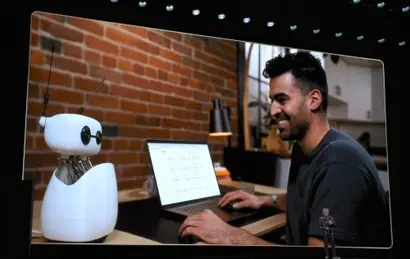
AI Evolves from a 'Responding Entity' to a 'Working Entity'
In the middle of his speech, CEO Huang identified 'reasoning' and 'agentic AI' as the cores of recent AI evolution. He explained that AI is no longer just a tool that provides immediate answers to questions, but is transforming into an entity that searches for information, uses tools, makes plans, and executes them.
This change has greatly expanded the scope of AI's utility. In software development, document analysis, and data exploration, AI is moving beyond a support tool to becoming a subject that performs actual work. The proliferation of open-source AI models is further accelerating this trend.
At this point, CEO Huang’s presentation naturally shifted to 'Physical AI.' He explained that the next stage for AI is not conversation on a screen, but the real world. Autonomous vehicles, robots, and factory automation are prime examples. The problem is that the real world is excessively complex. Even physical laws that are common sense to humans, such as gravity, friction, and inertia, are areas that have not been learned by AI.
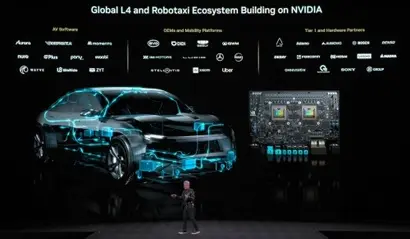
The solution proposed by CEO Huang is simulation. It is a method of training AI by first creating the countless situations that could occur in reality within a virtual space. He explained that three types of computers are needed for this: a computer that trains the AI, a computer that performs inference in the field, and a simulation computer that recreates reality.
NVIDIA's digital twin platform 'Omniverse' and world foundation model 'Cosmos' take on these simulation roles. Through a structure that turns computations into data, the strategy is to have AI pre-learn numerous exceptional situations that are difficult to encounter in reality.
In this flow, autonomous driving was presented as the first mass market for Physical AI. The autonomous driving AI 'Alpamayo' unveiled by NVIDIA is not just a model that controls a vehicle; it aims to be an AI that can explain why it made certain decisions. The approach is that while one cannot experience every driving situation in advance, one can respond by breaking down the situation into small units of common sense and reasoning through them. Based on an end-to-end structure that learns everything from camera input to steering, acceleration, and braking in a single model, Alpamayo was trained by combining human driving data with vast amounts of synthetic driving data generated by Cosmos.
The key is that it aims for 'reasoning-capable autonomous driving' that can not only control the vehicle but also explain what actions it chose, the reasons behind them, and its driving trajectory. CEO Huang announced that safety was secured by running the Alpamayo-based autonomous driving stack in parallel with existing traditional AV stacks, and that Mercedes-Benz vehicles applying this system have obtained top-tier safety certification and are scheduled to be mass-produced and released by region starting in 2026. This is particularly significant as it represents the first instance where NVIDIA, moving beyond a chip supplier, is putting a complete autonomous driving AI structure—encompassing models, software, and systems—onto actual roads.
The Solution to Exploding AI Compute: Beyond 'Chips' to the 'Full Stack'
In the latter part of his speech, CEO Huang returned to the fundamental problem of computing. AI models are getting larger every year, and the number of tokens generated during the inference process is increasing exponentially. Conversely, the price of tokens is falling rapidly. This means it is difficult to survive in the competition without dramatically increasing computational efficiency. At this point, he emphasized, “We can no longer cross the limits by improving the performance of a single chip alone.”
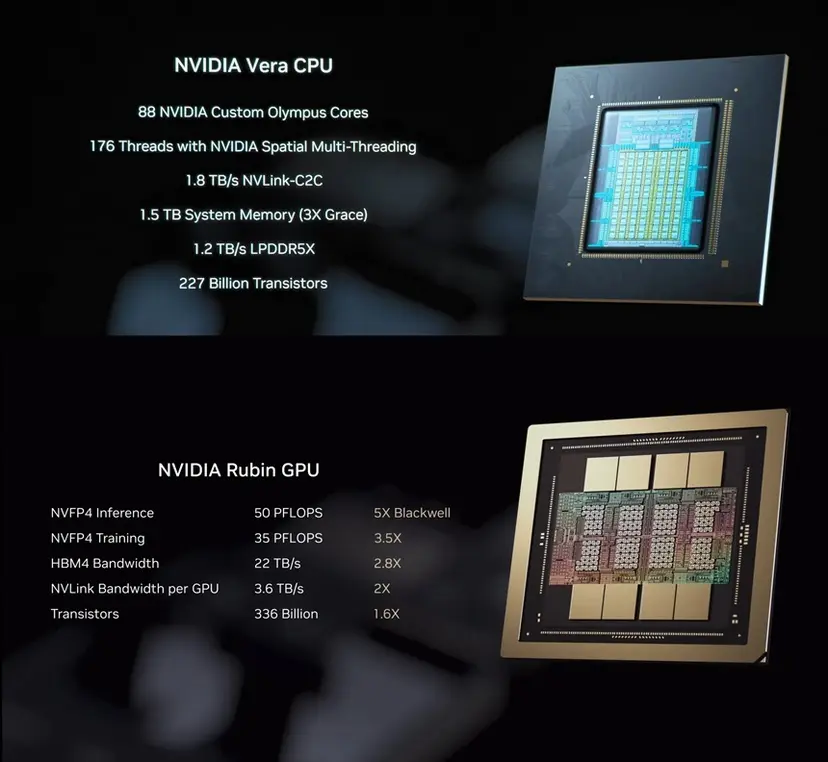
NVIDIA’s next-generation AI architecture, 'Vera Rubin,' started from this critical thinking. Vera (CPU) and Rubin (GPU) form an integrated AI system architecture that goes beyond single-GPU performance improvements to redesign the CPU, GPU, network, memory, storage, and security as a single structure. CEO Huang described this as 'design for an AI factory.' It is the first AI architecture to feature a full-stack structure beyond just a single chip.
Performance indicators clearly demonstrate this change. The Vera Rubin architecture provides approximately 3.5 times better AI model learning performance and up to 5 times better inference performance compared to the previous generation, Blackwell. Meanwhile, the cost of token generation has decreased to about one-tenth the level. CEO Huang explained that this performance improvement is not just an increase in computational power, but the result of dramatically improving throughput per watt.
The message he emphasized throughout the speech was consistent. The essence of AI competition is shifting from a fight over who can release a faster chip first to a problem of who can design the entire structure that makes AI work in the real world. AI has now become a platform, extending beyond on-screen conversations into roads, factories, robots, and industrial sites. Amidst this change, NVIDIA has redefined itself from a chip supplier into a 'full-stack AI company' that encompasses systems, infrastructure, simulation, and models.
![[CES 2026] Home Appliances Meet AI to Become Your Companion: 'One Samsung' Vision Unveiled](https://s.bizhankook.com/attachments_thumb/2026/05/96892_thumb.webp)
![[CES 2026] "A Living Room of the Future, Crafted by AI": A Preview of Samsung Electronics' 1,400-pyeong Exclusive Exhibition Hall](https://s.bizhankook.com/attachments_thumb/2026/05/96886_thumb.webp)
![[CES 2026] LG Home Robot 'CLOiD', Powered by Affectionate Intelligence, Declares Freedom from Housework](https://s.bizhankook.com/attachments_thumb/2026/05/96898_thumb.webp)
![[CES 2026] NVIDIA CEO Jensen Huang: "We Are No Longer Just a Chip Company"](https://s.bizhankook.com/attachments_thumb/2026/05/96841_thumb.webp)
![[CES 2026] "Giving Robots a Google Brain": Hyundai Motor Announces Alliance with DeepMind](https://s.bizhankook.com/attachments_thumb/2026/05/96907_thumb.webp)
![[CES 2026] Doosan Bobcat Overcomes 'Language and Skill Barriers' at Construction Sites with AI](https://s.bizhankook.com/attachments_thumb/2026/05/96902_thumb.webp)