

[비즈한국] Jeonbuk State is currently pursuing a bid to host the 2036 Jeonju Olympics. Jeonbuk Governor Kim Kwan-young is also promoting the Olympics on a daily basis. However, politicians are pointing out a lack of communication from Governor Kim. Critics argue that there is insufficient explanation regarding concerns over decentralized hosting and the postponement of the preliminary feasibility study, and that he is being overly tight-lipped about his bidding strategy. Cooperation from the political sphere is essential to secure the Jeonju Olympics, but it is difficult to expect such support without smooth communication.
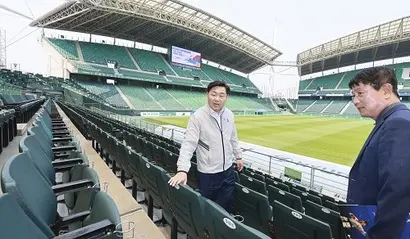
Jeonbuk State announced on the 13th that it has completed initial consultations with the Seoul Metropolitan Government regarding the use of 9 sports facilities for 8 events for the Jeonju Olympics. Out of 51 stadiums, Jeonbuk State plans to utilize 32 within the state and 19 in other regions. They explained that there will be no separate construction of new stadiums, as they plan to rely mostly on upgrading existing facilities, using temporary structures, or utilizing facilities already scheduled for construction.
This policy of Jeonbuk State is viewed positively in that it prevents excessive spending and ensures a certain degree of responsibility for post-event facility management. However, since the Olympics is an event hosted by a city rather than a country, there are voices of concern regarding holding competitions in other cities.
Democratic Party lawmaker Yoon Joon-byeong claimed on social media (SNS) in September that "the 'plan to host the Summer Olympics by forming an alliance of 10 local governments across the country centered on Jeonju, Jeonbuk,' which was finalized and submitted by the Korean Sport & Olympic Committee and Jeonbuk State, has already been deemed ineligible by the International Olympic Committee (IOC)" (Related article [Jeonju Olympics: Hopes and Concerns] Is it a 'Jeonju' Olympics?… Why decentralized hosting is causing a stir).
Lee Kee-heung, President of the Korean Sport & Olympic Committee, stated during the National Assembly's Culture, Sports and Tourism Committee audit in October, "The (IOC) provided advice after reviewing the proposal; they did not issue an ineligibility ruling." Nevertheless, the controversy has yet to subside among regional politicians in Jeonbuk State.
Jeonbuk State Council member Jung Jong-bok pointed out at a plenary session in October, "The issue of hosting the 2036 Summer Olympics, which has recently been at the center of controversy, has invited unnecessary debate due to a lack of communication between Jeonbuk State, the political sphere, and the government." He added, "As the political center's questions and Jeonbuk State's explanations clash, the reality—that we have yet to even submit a hosting plan to the Ministry of Culture, Sports and Tourism or meet crucial IOC requirements—has been pushed to the sidelines."
On the same day, Jeonbuk State Council member Park Yong-geun also said, "There has been criticism that Jeonbuk State did not provide prior notice, communicate, or consult with the Jeonbuk State Council while pursuing a large-scale financial project like an Olympic bid." He stated, "For a successful Olympic bid, all plans must be disclosed transparently, and a smooth communication channel and cooperation system are absolutely necessary."
In response, Governor Kim Kwan-young explained, "There are circumstances where I cannot disclose everything one by one," adding, "If Jeonbuk State's bidding and response strategies are exposed externally, there is a high possibility they will work against us." However, regarding the most controversial issue of decentralized hosting, he explained, "I think the remarks regarding the (IOC's) ineligibility ruling are highly inappropriate. It is certainly not the case that a final decision on ineligibility has been made, and we are currently in a stage of continuous dialogue with the IOC, just like other competing countries."
If Governor Kim's explanation is correct, Jeonbuk State's decentralized hosting policy has not been officially deemed ineligible by the IOC. However, as the state and the IOC are still in the dialogue phase, it does not mean there is no possibility of receiving an ineligibility ruling. From Jeonbuk State's perspective, it must successfully negotiate with the IOC, and it may need help from politicians in this process. Yet, the political sphere is pointing out the state's lack of communication. It is difficult to expect full-scale support in a situation where communication is not functioning properly.
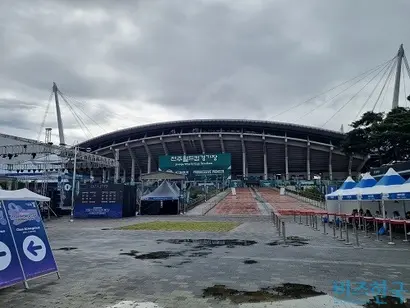
Jeonbuk State initially planned to complete the preliminary feasibility study for the Jeonju Olympics by September, but this was postponed to December. The state explained that this was to improve the completeness of the Olympic hosting plan by revising the financial scale and reinforcing the bidding strategy. Jeonbuk State plans to supplement the hosting plan based on the results of the preliminary feasibility study.
Politicians point out that there has been no sufficient explanation regarding the postponement of the study. The Jeonbuk Provincial Chapter of the Rebuilding Korea Party stated, "The fact that the feasibility study was pushed back by three months to the end of December clearly shows how sloppy the preparation process for the Olympic bid has been," and added, "The executive branch, led by the Governor, must coldly face the realistic problems through transparent and sincere communication with the assembly, politicians, and the people of Jeonbuk State." Jeonbuk State Council member Park Jung-gyu even said during an administrative audit on the 14th, "Whenever I ask something, they refuse to answer, calling it confidential."
There are also criticisms that communication with the media is not smooth. BizHankook requested an interview with Governor Kim Kwan-young in September to hear his stance on hosting the Jeonju Olympics. However, a public relations official from Jeonbuk State refused, citing that the Governor was busy with current issues and that it was difficult to report to superiors because it was uncertain whether the interview would be published. Instead, they merely sent materials and photos related to the Olympic bid. BizHankook then asked to hear from the official in charge of the Olympic bid if the Governor was unavailable, but Jeonbuk State refused that request as well.
In the past, when pursuing the 1988 Seoul Olympics, the 2002 Korea-Japan World Cup, and the 2018 PyeongChang Winter Olympics, not only politicians but also the public took the lead in running bidding campaigns. However, it is assessed that public interest in the Jeonju Olympics is not very high. There are even voices questioning if there is any real need to host the Olympics.
Jeonbuk State Council member Lee Byung-chul said at a plenary session in October, "I cannot help but ask if an administration that spends lavishly on promotional costs to host a global festival while being stingy in supporting foreign children residing in Jeonbuk State is truly conducting policies in line with the Olympic spirit." On the same day, Jeonbuk State Council member Lee Soo-jin also said, "There is no guarantee that the Olympics 10 years from now will solve immediate population and economic problems," adding, "Jeonbuk State's push for the Olympics is not a vision, but a 'hope torture'."
![[Expectations and Concerns for the Jeonju Olympics] Is it really the 'Jeonju' Olympics?… Why the debate over hosting across multiple cities is noisy](https://s.bizhankook.com/attachments_thumb/2026/05/95837_thumb.webp)
![[Jeonju Olympics: Hopes and Concerns] How Prepared is the City to Welcome Tourists? A Check on Transportation and Accommodations](https://s.bizhankook.com/attachments_thumb/2026/05/95855_thumb.webp)
![[Jeonju Olympics: Hopes and Concerns] Saemangeum International Airport Faces Cancellation Crisis: "There Is No Other Way"](https://s.bizhankook.com/attachments_thumb/2026/05/95953_thumb.webp)
![[Jeonju Olympics: Hopes and Concerns] Why Jeonbuk Governor Kim Kwan-young is Labeled as Lacking Communication](https://s.bizhankook.com/attachments_thumb/2026/05/96211_thumb.webp)
![[Jeonju Olympics: Hopes and Concerns] Lee Won-taek is Cautious, Kim Kwan-young is Proactive... Local Elections are the 'Variable'](https://s.bizhankook.com/attachments_thumb/2026/05/98575_thumb.webp)