

[비즈한국] The Korean Sport & Olympic Committee announced last February that Jeonju, Jeonbuk State, has been selected as the final domestic candidate city to host the 2036 Summer Olympics. Jeonbuk State and the City of Jeonju, led by Governor Kim Kwan-young, are putting all their efforts into winning the bid.
One of Jeonju's weaknesses is its lacking transportation infrastructure. Above all, there is no airport near Jeonju, requiring visitors to rely on trains or buses to enter the city. This stands in contrast to competing cities such as Doha, Qatar; New Delhi, India; and Istanbul, Türkiye (Related article: [Jeonju Olympics: Hopes and Concerns] How Prepared Are We to Welcome Tourists? A Review of Transport and Accommodation).
Governor Kim Kwan-young and Jeonbuk State had high expectations for the Saemangeum International Airport. The Saemangeum International Airport, planned in Gunsan, Jeonbuk State, was originally scheduled for completion in 2028. The airport's planned runway is 2,500m, and the passenger terminal is 15,010㎡ (approx. 4,540 pyeong), which is not particularly large compared to other domestic airports. Nevertheless, if opened, the airport could partially offset Jeonju's disadvantage regarding accessibility.
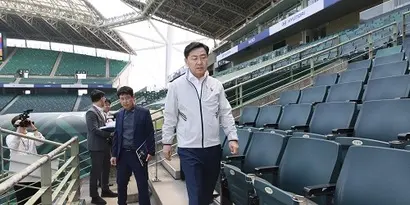
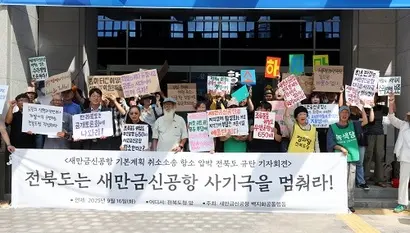
However, the court recently hit the brakes on the construction of the Saemangeum International Airport. Citizens from the "Joint Action to Scrap the Saemangeum New Airport" filed a lawsuit in 2022 to cancel the project. On September 11, the Seoul Administrative Court accepted the plaintiffs' arguments and ruled that the basic plan for the Saemangeum International Airport should be canceled. The court explained, "The basic plan for the Saemangeum International Airport is illegal and must be canceled because it deviated from planning discretion by failing to provide justification and objectivity in its cost-benefit analysis."
With the court siding with the civic group, the future of the Saemangeum International Airport has become uncertain. Although the Ministry of Land, Infrastructure and Transport (MOLIT) has filed an appeal, the originally planned 2028 completion date is now realistically difficult to meet considering the time required for legal proceedings. If MOLIT loses the appeal as well, the entire plan for the Saemangeum International Airport could be scrapped.
If the Saemangeum International Airport plan is aborted, it will also pose a setback to Jeonbuk State's bid for the 2036 Jeonju Olympics. A major weakness of the Jeonju Olympics is its relatively fragile transport infrastructure. Competitors like Doha, New Delhi, and Istanbul all have large international airports nearby. The only airport in Jeonbuk State is Gunsan Airport. Gunsan Airport is not an international airport, and its small scale limits the possibility of a conversion; currently, the only regular route from Gunsan Airport is the Gunsan-Jeju line.
That said, it is difficult to build an international airport blindly just to host the Jeonju Olympics. While it is true that the airport would help the Olympic bid if construction proceeds as planned, the Saemangeum International Airport is expected to incur massive operating costs even after the Olympics. Critics point out that if the airport continues to run at a deficit, the burden will fall on the state, and it is too heavy a price to pay for hosting a single Olympics.
Among the 15 domestic airports that handle passengers, only four recorded an operating profit last year: Incheon, Gimpo, Gimhae, and Jeju International Airports. The remaining 11 airports all ran deficits. The profitable airports are located near large cities such as Seoul, Incheon, and Busan. In the case of Jeju International Airport, it has the unique characteristic of being on an island. Considering the population of Jeonbuk State, there is no guarantee that Saemangeum International Airport would be as competitive as those four profitable airports.
The Jeonbuk Federation for Environmental Movement criticized the project in a statement, saying, "Even after receiving a report from the Korea Airports Corporation that the airport is expected to incur losses totaling approximately 355.3 billion KRW and an annual deficit of 20 billion KRW, MOLIT failed to verify that procedures were in place to secure financial viability." They added, "Spending 807.7 billion KRW in taxes to build another loss-making airport is not a path to development for Jeonbuk State, but a way to increase the burden on the public and the province."
Even if the Jeonju Olympics are held, there is no guarantee that the Saemangeum International Airport will be successful. For instance, there were expectations that passenger numbers at Yangyang International Airport would increase during the 2018 PyeongChang Winter Olympics. According to the MOLIT Aviation Information Portal System, passenger numbers at Yangyang International Airport did increase by over 20,000, from 15,757 in 2017 to 37,620 in 2018. However, considering that the total number of domestic airport passengers increased by over 7.35 million from 141,768,229 in 2017 to 149,126,508 in 2018, it is difficult to view Yangyang International Airport's performance as a special success.
Environmental concerns also cannot be ignored. Once destroyed, the environment is difficult to restore. In its ruling on the Saemangeum International Airport lawsuit, the Seoul Administrative Court stated, "The site has a rich ecosystem where various populations, including endangered species, are found," and "It is acknowledged by various expert investigations that the construction of the airport could damage the ecosystem, and the Ministry of Land, Infrastructure and Transport does not entirely deny this."
Nevertheless, Jeonbuk State is staked its survival on the Saemangeum International Airport. For Governor Kim Kwan-young, who has made the 2036 Jeonju Olympics his top priority, it is difficult to easily abandon the project. During a joint executive meeting on September 19, Governor Kim emphasized, "The Saemangeum International Airport is a key infrastructure project linked to core regional development issues such as attracting businesses and successfully hosting the Olympics. We will actively support administrative procedures such as environmental impact assessments to maintain momentum, refine our legal arguments, and race toward the completion of the airport."
On September 29, Jeonbuk State also released a press statement saying, "The airport is a core element in building the 'Saemangeum Tri-Port,' where airports, ports, and railways are integrated. It is expected to play an essential role as transportation infrastructure for hosting the 2036 Summer Olympics and boosting the economy of Jeonbuk State."
The Lee Jae-myung administration also appears to be in favor of the Saemangeum International Airport. In its appeal against the cancellation lawsuit, the Ministry of Land, Infrastructure and Transport explained, "We made this decision considering that it is a national agenda for balanced national development and that it contributes to local investment and economic revitalization as core infrastructure for the Saemangeum development project." The Lee Jae-myung administration's national agenda also explicitly includes "timely construction of infrastructure, including the Saemangeum International Airport."
Jeonbuk State expects the host city for the 2036 Summer Olympics to be finalized between 2026 and 2027. If a conclusion regarding the Saemangeum International Airport is not reached by then, difficulties are expected for the Jeonju Olympic bid. Conversely, if MOLIT wins the appeal, Jeonbuk State could find an opportunity for a turnaround.
MOLIT stated, "We will provide more specific supplementary measures regarding issues such as environmental damage raised in the first trial and once again emphasize the public interest of the project. We plan to form a consultative body with experts from related agencies, including Jeonbuk State, to jointly respond to the lawsuit during the appeal process."
![[Expectations and Concerns for the Jeonju Olympics] Is it really the 'Jeonju' Olympics?… Why the debate over hosting across multiple cities is noisy](https://s.bizhankook.com/attachments_thumb/2026/05/95837_thumb.webp)
![[Jeonju Olympics: Hopes and Concerns] How Prepared is the City to Welcome Tourists? A Check on Transportation and Accommodations](https://s.bizhankook.com/attachments_thumb/2026/05/95855_thumb.webp)
![[Jeonju Olympics: Hopes and Concerns] Saemangeum International Airport Faces Cancellation Crisis: "There Is No Other Way"](https://s.bizhankook.com/attachments_thumb/2026/05/95953_thumb.webp)
![[Jeonju Olympics: Hopes and Concerns] Why Jeonbuk Governor Kim Kwan-young is Labeled as Lacking Communication](https://s.bizhankook.com/attachments_thumb/2026/05/96211_thumb.webp)
![[Jeonju Olympics: Hopes and Concerns] Lee Won-taek is Cautious, Kim Kwan-young is Proactive... Local Elections are the 'Variable'](https://s.bizhankook.com/attachments_thumb/2026/05/98575_thumb.webp)