

[비즈한국] The Korean Sport & Olympic Committee announced last February that Jeonju, Jeonbuk State, was selected as the final domestic candidate city to host the 2036 Summer Olympics. Jeonbuk State and Jeonju City, led by Governor Kim Kwan-young, are putting all their efforts into securing the bid. Building sports and transportation infrastructure is considered the main challenge for hosting the Jeonju Olympics. As a large influx of tourists is expected once the Olympics are held, improving the local environment in Jeonju is also necessary. BizHankook visited Jeonju on September 25 to examine these issues firsthand.
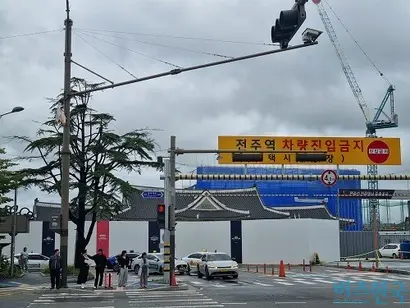
A Look Around Jeonju Station
Jeonju City began its Jeonju Station improvement project in 2023. The main focus of the project is to expand the station and build a complex transfer center for city and intercity buses on a nearby site. Currently, to travel to Jeonju via public transportation, one must use the train or an express bus. In this sense, Jeonju Station serves as the first point of contact for tourists visiting the city.
Upon exiting Jeonju Station, visitors are greeted by "Cheot-ma-jung-gil" (First Greeting Street). This street is a plaza-style path spanning 850 meters from the station to Myeongjugol Intersection. At first glance, the harmony of zelkova trees and small ponds creates an eco-friendly landscape.
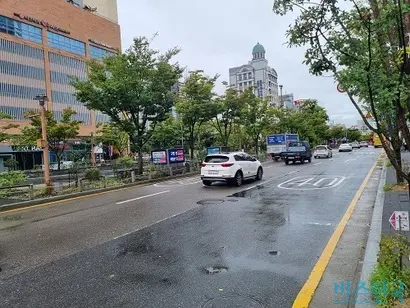
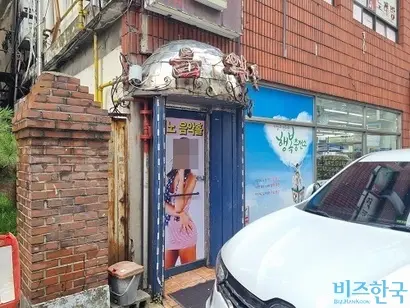
However, once you leave the main street and enter the alleys, it becomes difficult to find such a clean environment. The area is lined with various adult entertainment establishments and motels, and the boundaries between sidewalks and roads are not clearly defined. Some entertainment businesses even displayed pictures or illustrations that seemed to imply prostitution. This is a point that could make tourists uncomfortable.
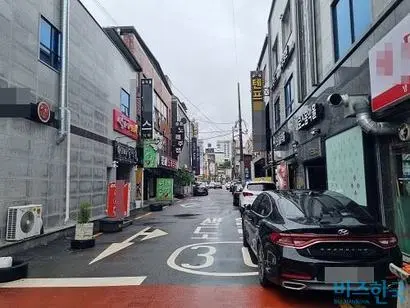
While there are many accommodations near Cheot-ma-jung-gil, there is only one hotel of significant size among them. The rest are ordinary motels, which seem insufficient to meet the demand for high-end lodging. Furthermore, since most of these motels are located right next to adult entertainment venues, it is difficult to consider the lodging environment pleasant.
What About Transportation Issues?
Governor Kim Kwan-young plans to use the Jeonju World Cup Stadium as the main Olympic stadium. Since Jeonju has no urban rail system, one must use a car or take a city bus to get from Jeonju Station to the stadium. However, during the creation of Cheot-ma-jung-gil, the city changed the existing 8-lane straight road into a 6-lane curved road. Complaints from residents suggest that traffic congestion has increased since then. Traffic jams could intensify significantly during the Olympic period.
BizHankook took a city bus from Jeonju Station to the Jeonju World Cup Stadium. We chose the route that involved taking bus 337, getting off at Jeonbuk National University, and transferring to bus 101. This was the shortest route suggested by Naver Maps. The interval between city buses in Jeonju ranges from 10 to 30 minutes. If a large number of tourists flock to the city, there could be an outcry of complaints.
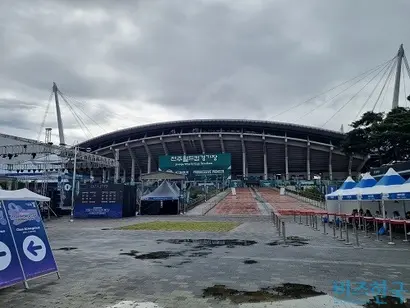
We departed from Jeonju Station at 2:01 PM and arrived at the Jeonju World Cup Stadium at 2:59 PM. It took about an hour. Fortunately, the wait time for the bus that day did not exceed 10 minutes, but depending on the circumstances, if wait times increase, it could take more than an hour to get from the station to the stadium by city bus.
It seems necessary to deploy special buses to key areas in Jeonju during the Olympics. For rail travel, it might be worth considering the temporary use of minor stations closer to the stadium, such as Bukjeonju Station or Dongsan Station, or Ajung Station (currently closed), which is near the Jeonju Hanok Village. This is because most of Jeonju's main accommodations are concentrated in the Hanok Village. The distance from the Hanok Village to the Jeonju World Cup Stadium is similar to the distance from Jeonju Station to the stadium.
Will the Bid for Consolidation with Wanju County Work?
Currently, Jeonju is pushing for consolidation with Wanju County. On September 30, Jeonju City announced, "We will strengthen our role as an Olympic host city by building infrastructure such as an Olympic village and training grounds in the Wanju area." If Jeonju and Wanju are consolidated, Iseo-myeon in Wanju County is being mentioned as a candidate site for the athletes' village. First, Iseo-myeon is close to the Jeonju World Cup Stadium, and the standard of living has improved significantly since the creation of the Jeonbuk Innovation City. In June, Jeonju City Councilor Kim Jeong-myeong (Democratic Party) officially proposed utilizing the wide-area landfill in Iseo-myeon as a sports cluster.
However, transportation is expected to be a problem for Wanju County as well. Currently, no trains pass through Iseo-myeon in Wanju County. It is also not included in the Jeonbuk-area metropolitan railway plan currently being pushed by Jeonbuk State. Although there is an intercity bus stop in Wanju Innovation City located in Iseo-myeon, its scale is not large. Even looking at Wanju County as a whole, the only currently operating station is Samnye Station. Samnye Station is not served by KTX, and its average daily ridership is around 300. It is difficult to see it as competitive as a railway station.
Jeonju City stated that it would expand public transportation infrastructure after the consolidation with Wanju County. If this happens, the transportation issues might be resolved to some extent. However, specific plans regarding the scale and methods of this expansion have not yet been disclosed.
![[Expectations and Concerns for the Jeonju Olympics] Is it really the 'Jeonju' Olympics?… Why the debate over hosting across multiple cities is noisy](https://s.bizhankook.com/attachments_thumb/2026/05/95837_thumb.webp)
![[Jeonju Olympics: Hopes and Concerns] How Prepared is the City to Welcome Tourists? A Check on Transportation and Accommodations](https://s.bizhankook.com/attachments_thumb/2026/05/95855_thumb.webp)
![[Jeonju Olympics: Hopes and Concerns] Saemangeum International Airport Faces Cancellation Crisis: "There Is No Other Way"](https://s.bizhankook.com/attachments_thumb/2026/05/95953_thumb.webp)
![[Jeonju Olympics: Hopes and Concerns] Why Jeonbuk Governor Kim Kwan-young is Labeled as Lacking Communication](https://s.bizhankook.com/attachments_thumb/2026/05/96211_thumb.webp)
![[Jeonju Olympics: Hopes and Concerns] Lee Won-taek is Cautious, Kim Kwan-young is Proactive... Local Elections are the 'Variable'](https://s.bizhankook.com/attachments_thumb/2026/05/98575_thumb.webp)