

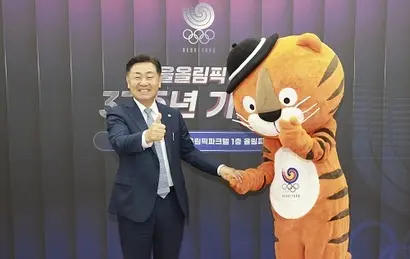
[비즈한국] The Korean Sport & Olympic Committee announced last February that Jeonju, Jeonbuk State, had been finally selected as the domestic applicant city for the 2036 Summer Olympics. Jeonbuk State and Jeonju City are putting all their efforts into hosting the Olympics, led by Jeonbuk Governor Kim Kwan-young. However, given Jeonju's current sports infrastructure, hosting the Olympics alone is not an easy task. Consequently, Governor Kim has proposed 'distributed hosting,' which involves holding some events in other cities. The problem is that if the games are spread out, the name 'Jeonju Olympics' could become meaningless.
Problems with Expanding the Jeonju World Cup Stadium
In the past, when hosting large sports events like the Olympics or the World Cup, 'post-event facility utilization' has been a major issue. For instance, the Incheon Asiad Main Stadium, built for the 2014 Incheon Asian Games, has no proper use, resulting in annual deficits that have negatively impacted Incheon Metropolitan City's finances. The PyeongChang Olympic Stadium, used as the main stadium for the 2018 PyeongChang Winter Olympics, also faced a lack of clear utility and was eventually demolished after the Games. The demolition of the PyeongChang Olympic Stadium cost 30.5 billion won.
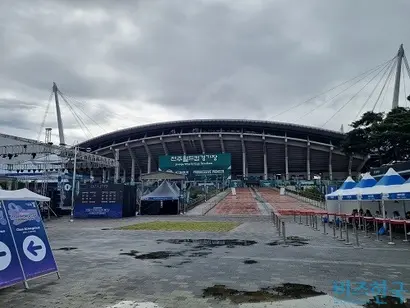
Jeonbuk State plans to use the Jeonju World Cup Stadium as the main Olympic stadium. The current capacity of the Jeonju World Cup Stadium is around 35,000, and the plan is to expand it to over 50,000 seats.
The Jeonju World Cup Stadium is currently the home ground for the professional football team 'Jeonbuk Hyundai Motors.' Expanding the stadium will inevitably increase management costs. The Jeonju Facilities Management Corporation, which oversees sports facilities in Jeonju, is already struggling with constant annual deficits. Jeonbuk Hyundai Motors pays a usage fee to Jeonju City, and if management costs rise, those fees could also increase.
The average attendance for Jeonbuk Hyundai Motors home games is less than 20,000. It is realistically difficult for Jeonbuk Hyundai Motors to fill a 50,000-seat stadium per game. From the perspective of Jeonbuk Hyundai Motors, the expansion of the Jeonju World Cup Stadium and the subsequent increase in usage fees are not welcome developments.
Using the Jeonju World Cup Stadium as a national team stadium is also problematic. According to Asian Football Confederation (AFC) regulations, international 'A' matches must be held at stadiums within 150km of an international airport. However, the distance between Incheon International Airport and the Jeonju World Cup Stadium exceeds 150km. Jeonbuk State has not provided a concrete stance regarding the expansion and utilization plan of the Jeonju World Cup Stadium.
Concerns are relatively lower for other stadiums, excluding the Jeonju World Cup Stadium. Jeonbuk State has set a goal of 'zero new stadium construction.' The plan is to utilize existing stadiums as much as possible and cooperate with other cities for missing facilities. For example, it is reported that holding sports like volleyball and handball in Seoul is under consideration. If stadiums are not newly built according to Jeonbuk State's plan, investment costs will decrease, and concerns about post-event utilization can be lessened.
Is Distributed Hosting Possible?
The problem is that if games are held in multiple cities, the name 'Jeonju Olympics' loses its meaning. The Olympics is an event held by a city, not a country. While it is true that some sports are occasionally held in other cities during an Olympic Games, the 1988 Seoul Olympics saw rowing and canoeing held at the Misa-ri Regatta Course in Gwangju-gun, Gyeonggi-do (currently Hanam, Gyeonggi-do), and sailing in Busan (currently Busan Metropolitan City).
However, this was limited to a few sports that were difficult to host in Seoul, and the vast majority of events were held in Seoul. Jeonbuk State has not officially stated which sports will be held in which cities. Some speculate that more than half of the events will take place outside of Jeonbuk State because the current stadiums within the state are insufficient without new construction. This has led to criticism that Governor Kim is making reckless choices for the sake of claiming the achievement of hosting the Olympics.
On September 28, Representative Yoon Joon-byeong of the Democratic Party of Korea criticized on social media, "The 'plan to host the Summer Olympics by forming a coalition of 10 local governments across the country centered on Jeonju, Jeonbuk,' submitted by the Korean Sport & Olympic Committee and Jeonbuk State, has already been deemed unqualified by the International Olympic Committee (IOC)." He added, "Unless there is an intention to use the Olympic bid solely for political purposes, one must first clarify or confirm how to reorganize candidate cities to meet IOC requirements, whether the selection of Jeonju by the Korean Sport & Olympic Committee remains valid, and whether the Jeonbuk Provincial Council has agreed to the obligation of local funding where local governments must bear over 40% of the total project cost."
The Jeonbuk Provincial Committee of the Rebuilding Korea Party also commented, "The Olympics are not a politician's dream, but the future of the residents." They pointed out, "A successful bid only becomes a source of pride for residents when all suspicions are transparently resolved and public accountability is secured." Voices of criticism are also emerging from civil society. Lee Jung-hyun, co-representative of the Jeonbuk Federation for Environmental Movement, stated on social media, "Local media, the Provincial Council, and civil society must re-examine the basic concepts, feasibility, procedures, and budget plans of the Jeonju Olympics." He added, "Won't people only join forces once concerns about hasty implementation and prioritizing political achievements are cleared?"
There is the option of co-hosting with other cities. Competitor India has already taken the stance of co-hosting the 2036 Olympics in Ahmedabad and New Delhi. However, since the Korean Sport & Olympic Committee has already set Jeonju as the candidate, time is running out to return to square one. There is also no guarantee that alliances with other cities will be successful. Hosting the Jeonju Olympics was not included in the Lee Jae-myung administration's national agenda, making it difficult to expect active support at the national level.
Even for athletes participating in the Olympics, having the opening ceremony in Jeonju and games in other cities will inevitably lead to accumulated fatigue. In terms of safety and efficiency, having the stadium and the athletes' village in one place is preferred.
Ultimately, Jeonbuk State must overcome the disadvantages of distributed hosting to increase its chances of selection. If, as Rep. Yoon Joon-byeong claimed, distributed hosting has already been rejected by the IOC, they will eventually have to build new stadiums in Jeonju. However, looking at the current situation in Jeonju, it seems very difficult to find post-event utilization plans if new stadiums are built. The only professional sports team based in Jeonju is Jeonbuk Hyundai Motors. The former pro-basketball team 'Jeonju KCC Egis' (now Busan KCC Egis) relocated to Busan in 2023.
Even amidst this, Jeonbuk State has failed to present a clear solution. Bizhankook inquired about the stance of Jeonbuk State but did not receive a response. On September 29, Governor Kim explained, "At the request of the IOC, the meeting details are confidential," and added, "We are in the process of talking and adjusting with each other." However, as he did not reveal more concrete details, the skeptical view regarding the Olympic bid remains.
![[Expectations and Concerns for the Jeonju Olympics] Is it really the 'Jeonju' Olympics?… Why the debate over hosting across multiple cities is noisy](https://s.bizhankook.com/attachments_thumb/2026/05/95837_thumb.webp)
![[Jeonju Olympics: Hopes and Concerns] How Prepared is the City to Welcome Tourists? A Check on Transportation and Accommodations](https://s.bizhankook.com/attachments_thumb/2026/05/95855_thumb.webp)
![[Jeonju Olympics: Hopes and Concerns] Saemangeum International Airport Faces Cancellation Crisis: "There Is No Other Way"](https://s.bizhankook.com/attachments_thumb/2026/05/95953_thumb.webp)
![[Jeonju Olympics: Hopes and Concerns] Why Jeonbuk Governor Kim Kwan-young is Labeled as Lacking Communication](https://s.bizhankook.com/attachments_thumb/2026/05/96211_thumb.webp)
![[Jeonju Olympics: Hopes and Concerns] Lee Won-taek is Cautious, Kim Kwan-young is Proactive... Local Elections are the 'Variable'](https://s.bizhankook.com/attachments_thumb/2026/05/98575_thumb.webp)