

[비즈한국] AI is now a matter of survival, not a choice. Amidst the dominance of U.S. Big Tech, China is shaking up the landscape based on massive support and human resources. South Korea, the world's leading "IT powerhouse" in digital infrastructure, has long been pushed to the "second tier" in the field of AI technology. As leading nations compete with massive capital and data, domestic AI startups are looking for niche markets to secure global competitiveness. Major IT companies are busy finding unique business models utilizing AI. Where does South Korea's path to survival lie in the global AI war? We explore the potential of our companies standing at the forefront of innovation.
The new government launched with the goal of leaping into the ranks of the "AI Top 3" amidst a global environment that is being reorganized into an advanced artificial intelligence (AI) industrial ecosystem. Compared to the U.S. and China, which are attracting investments in the trillions one after another, South Korea is evaluated as lagging behind in both the "war of money" and absolute technological competition. In the field of AI, where financial power determines success or failure, a lack of investment leads to difficulties in technology development and securing talent, revealing structural limitations.
The government plans to speed up the preparation of specific policies by viewing AI as a national strategy to lead the transformation of the industrial structure and innovation of the overall social system. Just two days after taking office, President Lee Jae-myung carried out an organizational reshuffle that included placing a Senior Secretary for AI in the Presidential Office, elevating AI to a key national task. Within the industry, there are voices calling for the creation of an ecosystem, including not only increased investment but also the construction of related infrastructure and the fostering of professional talent.
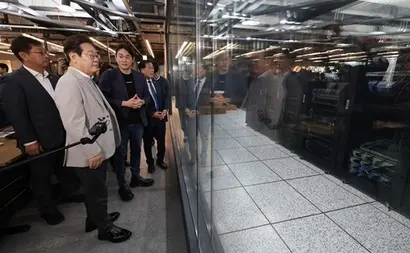
Both First Pledge and First Step are ‘AI’
AI was at the beginning of everything for President Lee Jae-myung. Following his declaration to run for president, his first official external schedule was a visit to the AI semiconductor startup FuriosaAI, where he held a policy meeting with CEO Paik Jun-ho and others. The first measure taken immediately after his inauguration was the establishment of the "Office of the Senior Secretary for AI Future Planning." According to the reorganization plan unveiled on the 6th, a separate senior secretary office will be installed in the Presidential Office to promote the task of becoming one of the top 3 AI powers, following the U.S. and China.
The AI Senior Secretary’s office will go beyond a simple advisory function to act as a policy hub that oversees national strategies related to AI, including policy coordination and implementation, and coordinates contact points with the private sector. There are also expectations that, as the lead for growth strategy under the Policy Office, it will drive the government's core national tasks.
With a paradigm shift in the AI field expected based on government-led, all-out support, attention is focused on specific implementation plans. The biggest task is how to secure South Korea's competitiveness in a flow where global Big Tech leads AI development and agendas. What President Lee put forward as an implementation plan during the presidential campaign was a "100 trillion won investment." The plan is to create a 100 trillion won foundation for private and public investment to expand AI infrastructure and advance the industrial ecosystem over the next five years. To this end, a "National Fund" in which all economic entities—citizens, companies, the government, and pension funds—participate has been mentioned.
AI is ‘Urgent’ for the Korean Industry
The domestic industry, which has been calling for the improvement of the investment environment such as deregulation and tax support, is generally welcoming the move. The domestic AI industry, including startups, has been experiencing limitations in growth due to a lack of high-performance computing infrastructure and large-scale investment.
There is also an analysis that AI capabilities and the success of industrial structural transformation will act as key variables determining future export competitiveness. Although South Korea possesses vast data as a manufacturing powerhouse, it has limitations due to a lack of refined data and linkage infrastructure that can be used for industrial AI. Kang Sung-eun, a senior researcher at the Korea International Trade Association (KITA), stated, "AI is fundamentally changing the competitive structure of the export industry," and added, "In particular, the public and private sectors must cooperate to build a 'Sovereign AI' system so that small and medium-sized enterprises can effectively internalize industrial AI based on manufacturing data."

Data shows that South Korea's disadvantage compared to major countries is prominent. According to the AI investment trend report by the National Information Society Agency (NIA) last year, the top 6 countries leading AI investment are the U.S., EU, China, the U.K., Japan, and Canada, with South Korea ranking only in the top 10 overall. The investment amount is around $2 billion to $3 billion, which is below that of Japan and Canada.
In the case of the U.S., the total AI investment in 2023 was $87.5 billion (118 trillion won), including government ($2.8 billion) and private ($84.7 billion) funding, accounting for about 62% of the global total. The EU ($13.5 billion) and the U.K. ($7.2 billion) had private investment ratios of over 90%, and China ($11.3 billion) had the highest government investment ratio among the major 6 countries at 19%. If South Korea enters the top 3, its competitors, such as Canada and the U.K., are also seeing their investment scale grow through public support to expand their own infrastructure.
Kim So-mi, a senior researcher at the NIA, analyzed, "AI is the core technology of the 4th Industrial Revolution, and governments and private companies around the world are making massive investments to secure a lead in AI technology. As business models and services incorporating AI technology are the driving force for new value creation, it is important for both the government and companies to understand these changes and respond preemptively."
Experts: "Strategies with Execution Capability are Needed"
As it is a promise to invest massive financial resources, there are concerns that it may become a policy pledge that falls short of its goal, but there is also a view that the number "100 trillion won" is more meaningful for its symbolism. 100 trillion won accounts for more than one-sixth of this year's government budget (673 trillion won). In the campaign pledge book, it was suggested that it be covered by adjusting the government's fiscal expenditure structure and using the annual total revenue increase over the next five years.
"It is difficult to materialize funding and investment targets at the pledge stage. Since the AI industry encompasses various layers ranging from chips to cloud, foundations, app stores, and applications, it is more important to decide which areas of AI to invest in," pointed out Jeon Sung-min, a professor of business administration at Gachon University. "The strategy should be 'selection and concentration.' However, it would be desirable to focus on foundational areas like infrastructure and cloud, which the private sector cannot easily handle alone."
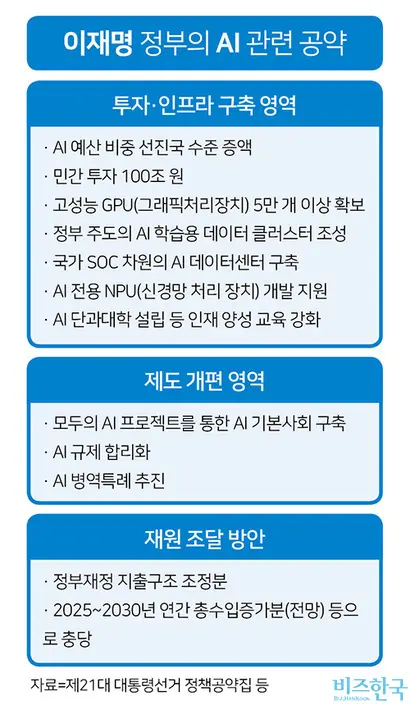
As for specific promotion tasks, the following were promised: △Securing over 50,000 high-performance GPUs (Graphics Processing Units) △Creating government AI data cluster complexes △Building AI data centers as part of securing national SOC (Social Overhead Capital) △Support for R&D and commercialization of Large Language Models (LLM) and Small Language Models △Internalization of AI semiconductor technology △Providing incentives to attract overseas talent.
The "Everyone's AI Project," which aims to allow all citizens to use basic AI services regardless of economic conditions, was also a pledge that attracted attention. The idea is to develop a Korean-style ChatGPT above the level of existing paid services and provide it to all citizens for free, with the intention of guaranteeing digital accessibility for vulnerable groups and narrowing the information gap.
Regarding the fostering of AI talent, educational reforms across the board, such as the establishment of AI colleges by region, strengthening of STEM education in elementary, middle, and high schools, and mandatory basic AI education, appear to be promoted. At the same time, the government plans to support the industry by revising regulations that limit the demonstration and commercialization of AI technology.
However, the limitation is that only abstract slogans were presented in the area of data utilization. Although President Lee has stated that he would actively open and expand public data to the private sector, it is pointed out that it lacks specificity compared to its importance.
Data utilization is essential for the development of AI. In particular, it is pointed out that it is important to create an environment where the private sector, such as startups, can utilize the vast data held by public institutions, going beyond the existing restrictive data use.
Kim Seung-joo, a professor of information security at Korea University, pointed out, "Pledges regarding hardware such as GPUs, software like 'Korean-style AI,' and talent fostering were relatively concrete, but data policy is absent. Since there are no detailed plans, there is nothing to comment on. One must realize that without data to learn from, AI cannot exist. We need to think about why previous governments' public data utilization policies failed to be properly realized, what the problems were, and how we are going to do it differently."
![[Finding Survival Strategies for AI] The 'War of Money' for Korean AI Has Begun](https://s.bizhankook.com/attachments_thumb/2026/05/94071_thumb.webp)
![[Finding an AI Survival Strategy] Companies Have Already Started Hiring 'AI Employees'](https://s.bizhankook.com/attachments_thumb/2026/05/94111_thumb.webp)
![[Finding AI Survival Strategies] Aiming for Opportunities with Full-Stack LLMs Amidst 'General-Purpose' Big Tech](https://s.bizhankook.com/attachments_thumb/2026/05/94269_thumb.webp)
![[Finding an AI Survival Strategy] Can AI Become the Secret Weapon for 'K-Content'?](https://s.bizhankook.com/attachments_thumb/2026/05/94498_thumb.webp)
![[Finding a Survival Strategy for AI] The Lee Jae-myung Administration's Goal of Becoming a 'Top 3 AI Powerhouse': What Matters More Than '100 Trillion Won in Investment'](https://s.bizhankook.com/attachments_thumb/2026/05/94747_thumb.webp)