

[비즈한국] AI is no longer a matter of choice, but one of survival. Amidst the dominance of U.S. Big Tech, China is shaking up the landscape with massive support and human resources. South Korea, an "IT powerhouse" that ranked first in digital infrastructure, was pushed to the "second tier" in the AI technology field early on. With leading countries engaged in a race fueled by massive capital and data, domestic AI startups are targeting niche markets to secure global competitiveness. Major IT companies are busy finding independent business models that utilize AI. Where does the path to survival lie for South Korea in the global AI war? We explore the potential of our companies standing at the forefront of innovation.
The emergence of ChatGPT led to the popularization of artificial intelligence (AI). Once perceived as something distant, AI has now established itself as a popular tool easily used by the general public. As generative AI suddenly became a buzzword in the industry, companies began to ponder what AI means for their business.
While many companies intend to adopt AI, the pace is still sluggish. Integration with existing IT systems is difficult, and concerns regarding cybersecurity and organizational limitations are prominent. The recent AI market is targeting these specific needs. While services targeting general consumers, such as chatbots, have been the mainstay, competition is heating up for enterprise solutions that integrate into overall corporate activities to generate revenue.
The 'Spring and Autumn Period' of AI Solutions Helping Businesses Begins
"For a general company, 'cost-effectiveness' is just as important as achieving tangible results from AI adoption. The core of an enterprise AI solution is to reduce uncertainty and allow companies to achieve maximum results at minimal cost." (AI solution industry insider)
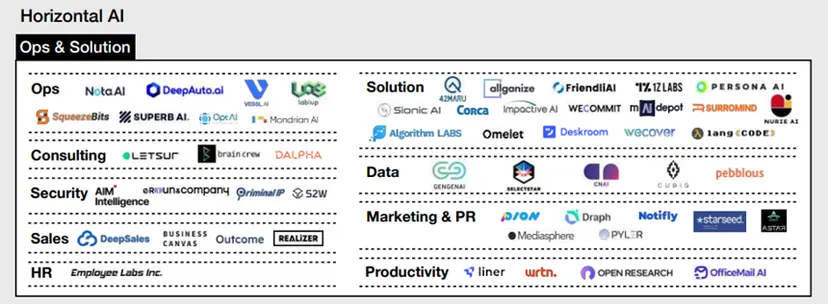
Beyond major conglomerates, small and medium-sized enterprises are also pushing for "digital transformation" to embed AI technology into their company-wide systems, bringing attention to the AI B2B optimization service market. Currently, there are over 60 services in the operations management and solution sector from domestic startups alone. Global leaders in the business customer and resource management software market, such as Salesforce and SAP, as well as Big Tech firms like Microsoft (MS) and major domestic conglomerates like LG003550 and SK Telecom017670, have also entered the related market. This means it could be a difficult competition against companies with a different scale.
VESSL AI operates 'VESSL', an integrated AI platform for companies and AI developers. VESSL AI emphasizes that if an optimized, customized infrastructure supports a company's AI operations, companies can realize AI transformation regardless of their industrial sector.
VESSL AI provides an MLOps (Machine Learning Operations) platform that supports the construction and operation of efficient AI infrastructure so that companies can respond to the rapid surge in computing demand. In particular, it puts forward a hybrid solution that manages internal server (on-premise) environments and cloud resources in an integrated manner. It is explained that this can shorten data processing and model training times for clients and reduce computing costs by up to 80%.
Domestic and international cooperation and investment attraction are also proceeding smoothly. As of October last year, the company had raised approximately 15.8 billion won in Series A funding, bringing its cumulative investment to 22 billion won. Ahn Jae-man, CEO of VESSL AI, noted, "Within the next five years, corporate culture will see AI-driven automated operations and decision-making become universal. Building the infrastructure to make this possible will be the market's top priority." VESSL has formed partnerships with Big Tech firms like Google Cloud, Oracle, and Amazon Web Services (AWS), and is collaborating domestically with Hyundai Motor Company005380, LG Electronics066570, and TMAP Mobility.
Nota is one of the startups that has secured the most investment in this field. Nota provides lightweight AI models to corporate clients in the form of B2B licenses. The basic idea is that because larger AI models carry a heavier burden of operating costs, it reduces the amount of computation, thereby lowering GPU usage. Its flagship product is the AI model optimization platform 'NetsPresso'. It is a tool that supports AI models to function in the most appropriate form on various hardware with just a few clicks.
Nota introduced, "NetsPresso is a powerful platform that reduces costs by up to 85%, improves inference speed by up to 40 times, and optimizes real-time AI model processing with high accuracy on various hardware, from edge devices to enterprise systems."
Edge AI, used for smart devices, autonomous vehicles, robots, and drones, is another key service. Nota has also established partnerships with global semiconductor and hardware manufacturers such as smart device firms, NVIDIA, Arm, and Qualcomm. It is currently in the process of a stock market listing with the goal of an IPO in the first half of this year, and it appears that the funding will be used to advance its business model and expand overseas.
Profitability Potential Visible, 'Advantageous' Data Utilization
In addition, AimIntelligence, which develops AI safety and security solutions, and LetSr, which bills itself as an all-in-one AI consultant for everything from AI development to operations and education, are expanding their influence by collaborating with domestic and international companies.
The B2B AI solution market is considered a field where continuous growth is expected. While actual corporate demand for AI—such as work automation, customer support, and data analysis—is clear, the costs of high-performance GPUs and cloud services act as a burden. For companies that faced difficulty in monetizing B2C, where they had to open the wallets of individual users, corporate clients are actually business partners to whom expensive subscription-based models can be sold.
Industry insiders explain that it is also advantageous in terms of data utilization. An IT industry official said, "B2C services often learn from public data or limited user data, making it difficult to build differentiated models, but companies differ in that they possess their own unique internal data."
In its trend report, Startup Alliance analyzed, "With the accumulation of research and development experience in generative AI services previously conducted in the B2C sector, the B2B market, which can secure the monetization and sustainability of AI technology, is in the spotlight as the demand for professional solutions to solve actual corporate problems and improve operational efficiency grows."
According to market research firm Precedence Research, the enterprise AI market is expected to grow at an average annual rate of 25.4%, reaching $102.9 billion (approximately 149.2668 trillion won) by 2030.
![[Finding Survival Strategies for AI] The 'War of Money' for Korean AI Has Begun](https://s.bizhankook.com/attachments_thumb/2026/05/94071_thumb.webp)
![[Finding an AI Survival Strategy] Companies Have Already Started Hiring 'AI Employees'](https://s.bizhankook.com/attachments_thumb/2026/05/94111_thumb.webp)
![[Finding AI Survival Strategies] Aiming for Opportunities with Full-Stack LLMs Amidst 'General-Purpose' Big Tech](https://s.bizhankook.com/attachments_thumb/2026/05/94269_thumb.webp)
![[Finding an AI Survival Strategy] Can AI Become the Secret Weapon for 'K-Content'?](https://s.bizhankook.com/attachments_thumb/2026/05/94498_thumb.webp)
![[Finding a Survival Strategy for AI] The Lee Jae-myung Administration's Goal of Becoming a 'Top 3 AI Powerhouse': What Matters More Than '100 Trillion Won in Investment'](https://s.bizhankook.com/attachments_thumb/2026/05/94747_thumb.webp)