

[비즈한국] Another worker who headed to a construction site today did not return home. The construction industry remains the sector with the highest number of fatal accidents in the country. To prevent tragic accidents where workers lose their lives due to failure to meet safety and health obligations, our society enacted the Serious Accidents Punishment Act (SAPA), which went into effect in January 2022. However, the number of workers losing their lives at construction sites annually remains in the triple digits. What efforts should our society make to reduce fatalities at construction sites?
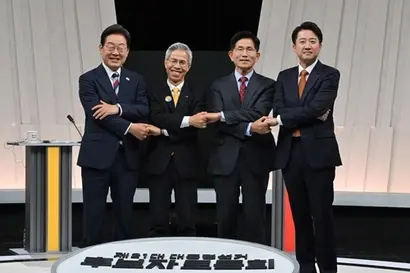
Ahead of the 21st presidential election, BizHankook reached out to the candidates invited by the National Election Broadcasting Debate Commission—Lee Jae-myung (Democratic Party), Kim Moon-soo (People Power Party), Lee Jun-seok (Reform Party), and Kwon Young-guk (Minju Labor Party)—to inquire about their positions on the Serious Accidents Punishment Act. After collecting responses between the 20th and 28th, it was found that Lee Jun-seok and Kwon Young-guk submitted their answers, while Lee Jae-myung and Kim Moon-soo did not respond to the inquiry.
What are the thoughts of the candidates running for the 21st presidential election regarding the Serious Accidents Punishment Act? BizHankook presents the responses of those who participated in the interview as provided, while the positions of candidates who did not respond were summarized based on their public statements and campaign rhetoric. As the interview response limit was set to around 300 characters, quoted remarks follow the same scale.
Lee Jun-seok: “Equity and Effectiveness Issues Must Be Addressed” vs. Kwon Young-guk: “Expand Scope and Strengthen Penalties”
Lee Jun-seok (Reform Party): I agree with the purpose of strengthening safety at industrial sites. However, I believe this law was pushed through at the time of its legislation without sufficient social discussion and coordination, and it is a law that requires rational adjustment and supplementation. Specifically, the current structure—which mandates criminal punishment even for accidents that occur due to force majeure despite business owners and management fulfilling their safety obligations—is problematic in terms of both equity and effectiveness. I believe this leads to a phenomenon of “bureaucratization of safety,” where effort is buried solely in formal paperwork. I believe we should hold people accountable, but there must also be reasonable safeguards for those who have fulfilled their responsibilities.
Kwon Young-guk (Minju Labor Party): We must strengthen the law to ensure there are no blind spots. Above all, strict punishment is necessary to ensure there are no “slap-on-the-wrist” penalties. During the three years of the Serious Accidents Punishment Act, the indictment rate has been 5%, and the conviction rate only 2%. This is not because the law is insufficient, but because of a power structure that renders existing laws useless. In particular, the complex prime-subcontractor structure of the construction industry and illegal subcontracting make the allocation of liability for industrial accidents ambiguous. In this vague accountability structure, industrial accidents have not decreased at all. The issue of unpaid safety equipment must also be examined closely. The late Moon Yu-sik, who died falling last year, passed away because he was not provided with a hard hat.
Lee Jae-myung: “Law Created Through Consensus, Has Preventive Effects” vs. Kim Moon-soo: “Punishment-Oriented Bad Law, Needs Revision”
Lee Jae-myung (Democratic Party): The fact that tragic accidents at construction sites continue unabated shows the current state of our society, which prioritizes costs over human life and safety. (Omitted) Establishing institutional mechanisms to guarantee the right to work safely and protect precious lives is not a choice, but a necessity. Strengthening the Serious Accidents Punishment Act is a task that cannot be delayed. (SNS post from October 2022, during his time as Democratic Party leader, following a fatal fall at a warehouse construction site in Anseong, Gyeonggi-do)
The Serious Accidents Punishment Act is a law created through consensus between ruling and opposition parties. Is it appropriate for a People Power Party candidate to claim it is a “bad law”? (Omitted) It is said that industrial accident fatalities have decreased because those who previously profited while neglecting safety measures are now cautious due to fears of criminal punishment. (Omitted) The essential reason for criminal punishment lies in its preventive effect. (Remarks during a campaign event in Uijeongbu, Gyeonggi-do on the 20th)
Kim Moon-soo (People Power Party): It seems quite extreme to unconditionally hold presidents or chairmen liable and arrest them if a serious accident occurs when they know nothing about it. (Omitted) The Serious Accidents Punishment Act was introduced out of concern for how to reduce fatal serious accidents; while the purpose of the law is good, it is too focused on punishment. (Omitted) What is more important than punishment in the safety sector is the use of scientific technology. (Special lecture at the Professional Construction Financial Cooperative, April, during his tenure as Minister of Employment and Labor)
The biggest problem now is whether it is right to apply the “Serious Accidents Punishment Act” to small and medium-sized enterprises like these. (Omitted) When I become a decision-maker in various capacities, I will definitely amend this bad law so that it no longer harasses you. (Congratulatory remarks at a breakfast lecture for the Association of Proud Small and Medium Entrepreneurs on the 15th)
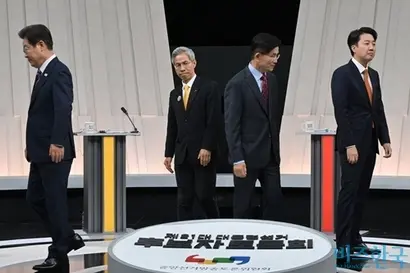
Lee Jae-myung and Kwon Young-guk Include Industrial Accident Content in Top 10 Pledges
According to BizHankook's analysis of the campaign materials submitted to the National Election Commission by the candidates invited for the debates, only Lee Jae-myung (Democratic Party) and Kwon Young-guk (Minju Labor Party) included pledges related to industrial accident prevention in their top 10 presidential campaign platforms. Such pledges could not be found in the top 10 platforms of Kim Moon-soo (People Power Party) or Lee Jun-seok (Reform Party).
Lee Jae-myung (Democratic Party) listed his 7th priority pledge as “Building a society where labor is respected and the rights of all are guaranteed.” He proposed implementing methods such as building an integrated safety and health management system between prime and subcontractors to protect subcontracted workers, transforming the labor safety and health system so people “don’t get hurt or die while working,” and introducing industrial accident insurance for self-employed individuals in high-risk occupations.
Kwon Young-guk (Minju Labor Party) listed his 2nd priority pledge as “Labor rights and social safety nets for all who work.” He proposed implementing methods such as expanding the subjects who judge and respond to hazardous situations to include workers, labor representatives, and employers, and expanding the right to stop work by granting workers or their representatives the authority to assess and verify dangerous situations, while prohibiting disadvantages for exercising such rights.
Meanwhile, Kim Moon-soo (People Power Party) stated in a policy platform on the 26th that he would “change the Serious Accidents Punishment Act to suit its preventive purpose.” He announced plans to improve the law to allow for sanctions against the neglect of pre-emptive prevention duties—not just post-facto sanctions—and to differentiate obligations by business size, such as limiting the safety and health security obligations for businesses with fewer than 50 employees (or under 5 billion KRW in budget) to risk assessment and collecting employee feedback. The plan aims to clarify regulations while relaxing punishments.
![[3 Years of the Serious Accidents Punishment Act] A Construction Worker Didn’t Come Home Again Today](https://s.bizhankook.com/attachments_thumb/2026/05/94135_thumb.webp)
![[3 Years of the Serious Accidents Punishment Act] We Asked the Two Major Construction Unions for Solutions to Prevent Serious Accidents](https://s.bizhankook.com/attachments_thumb/2026/05/94391_thumb.webp)
![[3 Years of the Serious Accidents Punishment Act] 'Strengthen vs. Relax': Where Do 21st Presidential Candidates Stand?](https://s.bizhankook.com/attachments_thumb/2026/05/94627_thumb.webp)
![[3 Years of the Serious Accidents Punishment Act] Shin Young-chul, Head of the CCEJ National Project Monitoring Center: "Prime Contractors Must Increase Direct Construction"](https://s.bizhankook.com/attachments_thumb/2026/05/94797_thumb.webp)
![[3 Years of the Serious Accidents Punishment Act] "Can It End the Outsourcing of Death?" The Construction Safety Special Act Unveiled](https://s.bizhankook.com/attachments_thumb/2026/05/95050_thumb.webp)
![[3 Years of the Serious Accidents Punishment Act] The 'Right to Stop Work' to Prevent Industrial Accidents: Status of Implementation Unknown](https://s.bizhankook.com/attachments_thumb/2026/05/95458_thumb.webp)