

[비즈한국] Once again, a construction worker who went to work today could not return home. The construction industry accounts for the highest number of fatal accidents among all industries in Korea. To prevent tragic accidents where workers lose their lives due to the failure to fulfill safety or health obligations, our society enacted the Act on Punishment, etc. of Serious Accidents (Serious Accidents Punishment Act) and implemented it in full starting January 2022. However, the number of workers losing their lives at construction sites every year remains in the triple digits. What efforts should our society make to reduce fatal accidents at construction sites?
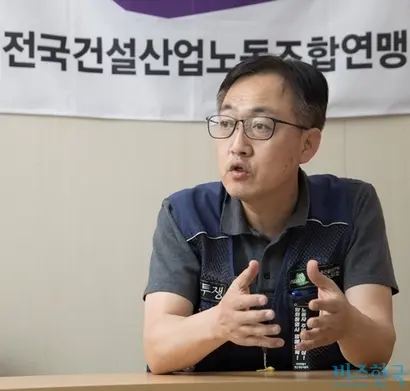
In commemoration of Labor Day, BizHankook met with Lee Dong-gi, Policy Director of the Federation of Korean Construction Industry Trade Unions (FKTU), and Kang Han-soo, Chairman of the Labor Safety and Health Committee at the Korean Construction Workers Union (KCTU), to ask about methods for preventing serious accidents at construction sites.

Q. Three years have passed since the implementation of the Serious Accidents Punishment Act. What changes have occurred at construction sites during this time?
Lee Dong-gi (Lee): The increased status of safety managers at construction sites can be cited as a positive change. Safety management departments at construction companies, which were previously on the periphery, have now become core departments. As business owners are now held responsible for serious accidents, they listen to the concerns of safety managers and departments that were previously overlooked due to cost issues. However, the current system, which focuses only on checking paperwork when an accident occurs, causes safety management tasks to become paper-centric, which is a problem. Safety managers complain that they are buried in paperwork and have no time to go out into the field. It is necessary to eliminate unnecessary documentation so they can actually monitor field safety more closely.
Kang Han-soo (Kang): It is a positive change that interest in safety at the headquarters level has increased as responsibility for serious accidents has been extended to business owners. Prime contractors at construction sites have begun to reorganize their headquarters structures and systems, establish plans to reduce disaster risks at sites, and make efforts to inspect them. However, looking at the recent patterns of punishment for business owners who caused serious accidents by violating safety duty requirements, the level of punishment stops at suspended prison sentences or fines. We must induce business owners to create safe construction sites by imposing powerful penalties on those who violate the Serious Accidents Punishment Act.

Q. The number of workers losing their lives at construction sites annually is still in the triple digits, the highest across all industries. Is there anything in the current safety system that isn't working properly?
Kang: It is the worker's "right to stop work." Even if a worker determines that there is an imminent risk of an industrial accident, they cannot exercise the right to stop work in a timely manner due to fears of disadvantage. There are cases where workers get entangled in civil or criminal litigation for obstruction of business, or face dismissal or disciplinary action, if they try to exercise the right to stop work in a situation that the company deems "not dangerous." We must increase the effectiveness of the right to stop work so that workers can use it in a timely manner without worrying about disadvantages. There also needs to be a regulation that punishes business owners who impose disadvantages on workers who legitimately exercise their right to stop work. A shift in perception is needed, recognizing that the cost of dealing with industrial accidents is greater than the cost of prevention.
Lee: Currently, many construction workers cannot use the right to stop work despite being aware of the risks due to fear of disadvantage. In large-scale construction projects, they might be somewhat cautious, but in small to medium-sized projects under 30 billion won, the atmosphere is "leave the site if you try to use the right to stop work," so they don't even dare to consider it. Construction companies worry about the abuse of the right to stop work by workers, but if the right were exercised in a way that risks identified by workers are reviewed by a supervisory group, the mutual concerns could be addressed. Workers in the field know the risks at construction sites best.
The worker's right to stop work refers to the right for a worker to stop work and evacuate when there is an imminent risk of an industrial accident. It is a worker's right guaranteed under the Occupational Safety and Health Act, and when exercising this right, the worker must report the fact to their supervisor without delay. Upon receiving this report, the supervisor must take necessary measures regarding safety and health, and the business owner must not dismiss or otherwise unfairly treat a worker who has legitimately exercised the right to stop work. However, there is currently no regulation to punish business owners who impose disadvantageous treatment on workers who have exercised this right.
Q. If there are any additional systems that need to be introduced to prevent serious accidents at construction sites, what are they?
Lee: It is necessary to appoint safety managers even for sites with a construction cost of less than 5 billion won. About 70% of workers who lost their lives at construction sites last year died at sites with construction costs under 5 billion won, and these sites do not yet have an obligation to appoint a safety manager. Furthermore, the number one cause of fatal accidents at construction sites is "falls," which are actually the easiest to prevent. If there were safety managers at the site to check basic safety equipment or devices, construction site disasters would be reduced significantly. Also, as the demand for safety managers has increased due to the enforcement of the Serious Accidents Punishment Act, the labor shortage is worsening. Government support to resolve the labor shortage of safety managers must be provided in parallel.
The obligation to appoint safety managers at construction sites is limited to workplaces with construction costs of 5 billion won or more. According to the Enforcement Decree of the Occupational Safety and Health Act, business owners at construction sites with a total construction amount of 5 billion won or more must employ a "safety manager" to assist the employer or the person in charge of safety and health management and to provide guidance and advice to supervisors. The number of safety managers required by law increases as the construction amount grows, from one person (5 billion to 12 billion won) to 11 or more (1 trillion won or more). However, there is still no obligation to appoint a safety manager for workplaces under 5 billion won. Last year, 181 workers lost their lives at sites with construction costs under 5 billion won, accounting for 66% of all construction industry deaths.
Kang: The responsibilities and obligations of project owners regarding safety must be newly defined. In fact, the fundamental variables that affect safety at construction sites are the construction period and the construction budget. There is a need for regulations that define the essential construction period and budget required to ensure safety by process, and make them mandatory during project commissioning. If a project is commissioned to be completed quickly and with low costs, the ability to focus on safety disappears as it trickles down to subcontractors. It is regrettable that the section regarding project owners was left out of the Serious Accidents Punishment Act, which defines the responsibilities of prime contractors. We must create regulations for project owners regarding safety through amendments to the Serious Accidents Punishment Act or by enacting a separate Special Act on Construction Safety.
![[3 Years of the Serious Accidents Punishment Act] A Construction Worker Didn’t Come Home Again Today](https://s.bizhankook.com/attachments_thumb/2026/05/94135_thumb.webp)
![[3 Years of the Serious Accidents Punishment Act] We Asked the Two Major Construction Unions for Solutions to Prevent Serious Accidents](https://s.bizhankook.com/attachments_thumb/2026/05/94391_thumb.webp)
![[3 Years of the Serious Accidents Punishment Act] 'Strengthen vs. Relax': Where Do 21st Presidential Candidates Stand?](https://s.bizhankook.com/attachments_thumb/2026/05/94627_thumb.webp)
![[3 Years of the Serious Accidents Punishment Act] Shin Young-chul, Head of the CCEJ National Project Monitoring Center: "Prime Contractors Must Increase Direct Construction"](https://s.bizhankook.com/attachments_thumb/2026/05/94797_thumb.webp)
![[3 Years of the Serious Accidents Punishment Act] "Can It End the Outsourcing of Death?" The Construction Safety Special Act Unveiled](https://s.bizhankook.com/attachments_thumb/2026/05/95050_thumb.webp)
![[3 Years of the Serious Accidents Punishment Act] The 'Right to Stop Work' to Prevent Industrial Accidents: Status of Implementation Unknown](https://s.bizhankook.com/attachments_thumb/2026/05/95458_thumb.webp)