

[비즈한국] K-Pop has become South Korea's top export. However, behind the glamour, there are deep shadows. Idols, the symbols of K-Pop, are scouted at a young age and endure rigorous training periods. In that process, labor rights and human rights are often ignored. What happens to the countless trainees who never get to debut? Through the 'K-Pop: Idols in Wonderland' series, BizHankook aims to highlight the problems that have been overlooked during the growth of K-Pop and explore alternatives from various angles. We believe that when those who create K-Pop become healthier, those who enjoy K-Pop can also be happier.
Last year, the "idol powerhouse" SM Entertainment041510 shook up the private education market. This was because they opened the "SM Universe Academy" in Daechi-dong, Seoul, a district packed with college entrance cram schools. Created in partnership with the modeling agency ESteem and Jongro Academy, it was a school for K-Pop idol hopefuls. A condition for admission was that students had to "drop out" of regular school. Children dreaming of becoming K-Pop stars had to attend this academy for two years instead of proceeding to high school. The tuition also exceeds 2 million KRW per month. Yet, it does not guarantee an "acceptance as a trainee." Ultimately, it faced criticism that it was profiting from children's "dreams."
However, it has been confirmed that SM Universe recently overhauled its curriculum. SM Universe no longer demands that students drop out, nor does it claim to be an alternative to "school." This comes about a year and a half after the academy opened. Why did SM jump into the private education market? I met with Jang Jae-won, the CEO of SM Universe Academy.
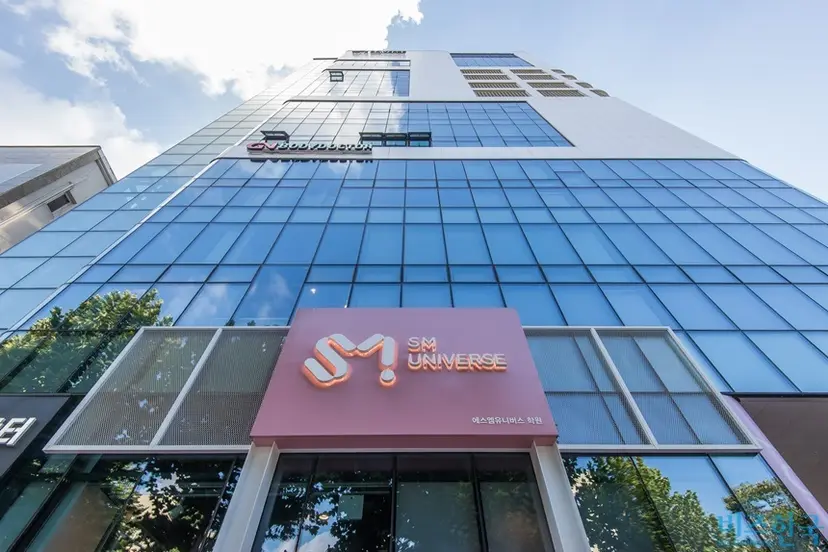
The 'Must Drop Out to Enroll' Track System Scrapped
SM Universe, which claimed to educate children like an "alternative school," recently abolished its "track system." They removed the system where students who graduated from middle school were divided into Artist and Producer tracks for two years of education. Instead, they lowered the target age range from elementary school first grade to middle school third grade and expanded their "single-subject" programs. They also created separate classes for adults. They have decided to return to the original purpose of being an "academy" rather than an "alternative school."
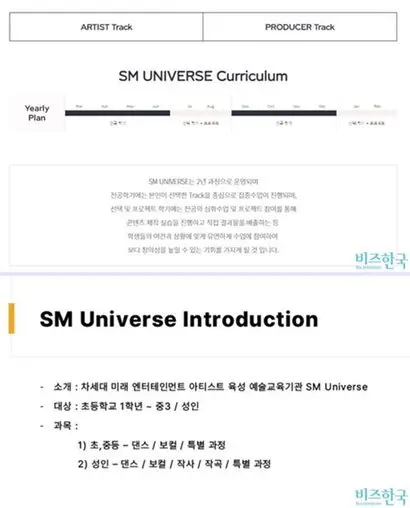
Single-subject classes have been reorganized to include dance, vocal, composition, songwriting, profile, audition, and artist business classes. Not only students who want to become "idols" but also those aspiring to be songwriters or producers can take these classes. One can even learn about the "business" side of K-Pop. Some classes were established with government support. Recently, they opened courses for entertainment content developers and engineers. You can learn about the digital technology of the K-Pop industry, such as "virtual content," with full government funding.
Why did SM Universe suddenly change course? Jang Jae-won, CEO of SM Universe, says it is "because the age at which idols are selected is becoming younger and younger." As more agencies are selecting trainees from elementary school age, the track system of the SM Universe Academy, which targeted high schoolers, became ambiguous. CEO Jang Jae-won said, "In the current situation, it is very difficult for high school or college students to prepare and debut because the selection age for trainees is getting lower. Also, we never said that you had to drop out of high school to become an idol trainee. I hope there is no such misunderstanding."
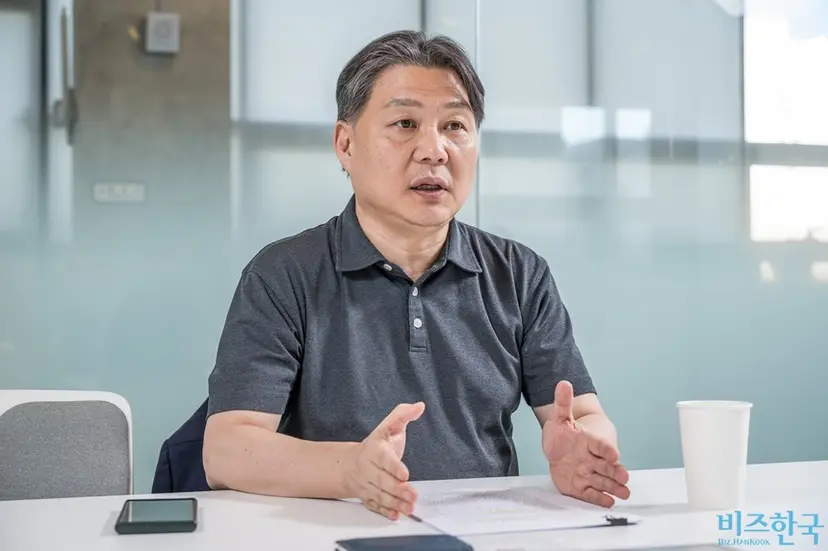
CEO Jang Jae-won says the goal of SM Universe Academy is not just to cultivate "idols." That is why he draws a line, saying it is different from an entertainment company's idol training system. "Our ultimate goal is the expansion of K-Pop infrastructure. That is why our direction is different from SM Entertainment. We want to nurture overseas students interested in K-Pop and create various curricula that can help the entire industry develop. That is why we included songwriting and producer training courses, as well as adult classes for 'career changes' or 'hobbies'."
He firmly states that it is not for SM Entertainment's "talent acquisition" purposes. "Every agency has its own ideal candidate, not just in terms of skill or appearance. We only play a role in advising children according to their talents and interests. We have even received and conducted exclusive company auditions for various agencies, not just SM, but also FNC, P NATION, and others."
Currently, SM Universe Academy's students range from first graders in elementary school to adults in their 40s. There are about 350 minor students and 150 adults. There are 45 students in government-supported projects. There are 5 full-time teachers in each field, and a total of 65 instructors.
CEO Jang Jae-won said he wants to create a system for cultivating K-Pop educators in the future. "Our goal is to broaden the scope of K-Pop and expand it overseas. We want to create subjects in various fields accordingly. We are currently preparing training programs for our own academy's instructors as well. People abroad say that even if they want to learn K-Pop, there are no teachers who know it properly. I want to produce educators who can cultivate K-Pop talent."
The Goal is 'Overseas Expansion'
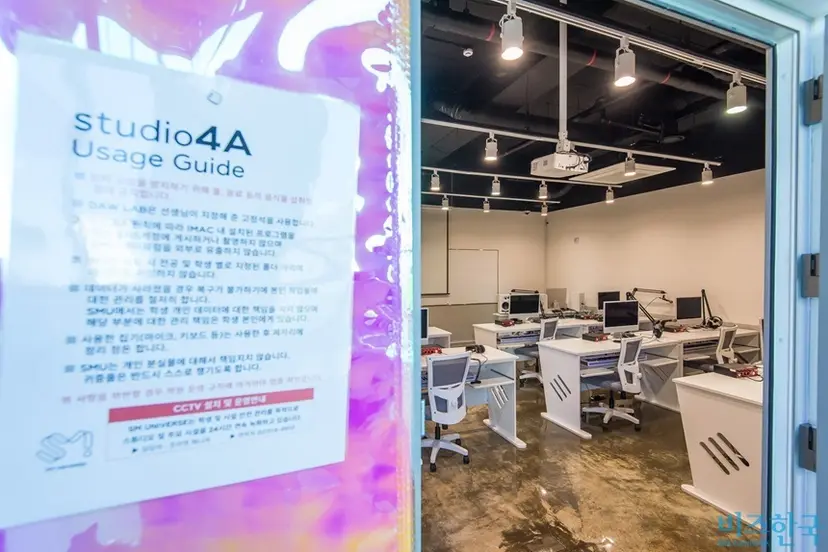
CEO Jang Jae-won, who joined SM Entertainment in 2022, was originally an expert in overseas investment consulting. Even for him, having taken office as CEO of SM Universe last April, K-Pop is still unfamiliar. However, he is feeling the influence of K-Pop. "These days, I listen to K-Pop more than my daughter. I earned my MBA in the US, and I heard the news this year that my alma mater is officially teaching 'Korean.' Unlike other subjects, they say the students requested it first, so the subject was created. Many students are showing interest in Korea as a whole through K-Pop. They say they have also opened subjects that teach not just the language, but the K-Pop industry itself."
Are there any plans to expand the idol academy nationwide like other large cram schools? SM Universe stated that, except for the building in Daechi-dong, they have no plans to increase branches in Korea. This is because SM Universe's final goal is "overseas" expansion. "Our goal is to increase the number of SM Universe academies, starting with Southeast Asia. We are currently in discussions to establish one in Singapore. In Korea, instead of increasing branches, we will choose a 'collaboration' method, such as collaborating with universities that have established K-Pop courses and visiting local schools to provide dispatched education. Since the US has Hollywood and people from all over the world gather there, I think K-Pop should become the same."
CEO Jang believes that for K-Pop to be sustainable, the industry's infrastructure must be expanded. "Right now, if you are an idol trainee and fail to debut, that's just the end of it. To prevent this from happening, we need to provide basic education such as Korean, English, and math, and also suggest directions so they can go down other paths. Even if they aren't idols, they could become composers or music video directors. It's about presenting various paths. Education should be carried out like lifestyle sports. I started this with the thought of building that infrastructure."
CEO Jang says that time is needed to define K-Pop educationally and establish theories. "There are many people interested in K-Pop, but when I go abroad, there are few opportunities to know and learn K-Pop properly. Even if you go to a K-Pop academy, they usually only teach 'cover dance.' We plan to provide educational content overseas and actively attract foreigners to Korea."
While operating SM Universe Academy for about a year and a half, CEO Jang Jae-won felt two major problems. First, it is difficult to find educators suitable for K-Pop, and second, it is difficult for foreign students who have come to Korea to enter universities. "In academies for teenagers, all teachers must have at least a junior college degree. A friend who took 1st place in 'Street Dance Girls Fighter' was in her third year of high school, and she quit school after winning. I wanted to hire such an outstanding friend, but she couldn't be an instructor at our academy. This is because, regardless of the industry's characteristics, you must have a degree. Standards should be created that fit the characteristics of K-Pop. There could be a way to have them receive other technical or educational training so they can teach teenagers even if they haven't graduated from university."
There is also the problem of not being able to guarantee the future of foreign students who came to Korea just for K-Pop. "We recently suggested the establishment of a Hallyu visa (a short-term stay visa that allows people to come to learn K-Pop and other parts of Hallyu) to the government, and it is being discussed positively. The problem is that these friends come here after giving up their own country's education. What foreign trainee parents are worried about is whether they can work in Korea or go to a Korean university if they don't debut. If they learn the ability to produce Korean content, even if they aren't idols, it's worth giving up their school days. But they say even if they pass their own country's GED, they cannot enter Korean universities. Such regulations need to be relaxed. To gather outstanding talent from around the world, we must present various career paths based on K-Pop."
CEO Jang Jae-won believes that for K-Pop not to end as a momentary popularity, K-Pop culture and content must be expanded before interest fades. He believes that this can also solve the problem of trainees who could not debut. "It is important to expand regionally in the future. K-Pop also needs to find new paths in various forms. Here, SM Universe's role is to standardize the educational curriculum for the K-Pop industry and expand it overseas."
[K-Pop: Idols in Wonderland] View the interactive article: kpop.bizhankook.com
※ The next installment will feature an article on the National Assembly discussion regarding the labor and human rights of children and adolescents hidden behind the success of K-Pop.
※ This planning project was supported by the Korea Press Foundation with funds from government advertising fees.
![[K-Pop: Idols in Wonderland] "Raising Idols Through Public Education": A Visit to a K-Pop High School](https://s.bizhankook.com/attachments_thumb/2026/05/92330_thumb.webp)
![[K-Pop: Idols in Wonderland] K-Pop Must Break Free from the Same ‘Success Formula’ to Survive](https://s.bizhankook.com/attachments_thumb/2026/05/92469_thumb.webp)
![[K-Pop: Idols in Wonderland] The Unfairness 'Ria' Experienced, and What 'Kim Jae-won' Intends to Change](https://s.bizhankook.com/attachments_thumb/2026/05/92437_thumb.webp)
![[K-Pop: Idols in Wonderland] Jang Jae-won, CEO of SM Universe: "Not an SM subcontractor, but a specialized K-Pop education institution"](https://s.bizhankook.com/attachments_thumb/2026/05/92559_thumb.webp)
![[K-Pop: Idols in Wonderland] Former Idols Visit the National Assembly: "Please Stop the Abnormal Growth of K-Pop"](https://s.bizhankook.com/attachments_thumb/2026/05/92509_thumb.webp)