

[비즈한국] K-Pop has become South Korea's top export. However, behind the glamour, there are deep shadows. Idols, the symbols of K-Pop, are scouted at a young age and put through grueling trainee periods. In that process, labor rights and human rights are often ignored. What happens to the countless trainees who never even make it to their debut? Through the ‘K-Pop: Idols in Wonderland’ series, Bizhankook aims to highlight the problems that have been overlooked during the growth of K-Pop and examine alternatives from various perspectives. We believe that when those who create K-Pop are healthy, those who enjoy K-Pop can also be happier.
“For students at a K-Pop high school, not debuting as an idol is not a failure. Because they are students, not just idol trainees who get released after a single failure. There are various opportunities open to them to pursue other paths related to K-Pop, even if they don’t become idols. They can learn diverse subjects related to the K-Pop industry—such as MIDI, music analysis, and composition—and even go to college. They don’t lose their opportunity cost over a single failure. We must be able to keep providing opportunities to these children.”
Park Byung-kyu, principal of the ‘Korea K-POP High School’, answered in this way when asked by a reporter about the differences between an agency’s idol training system and the Korea K-POP High School.
As the status of K-Pop rises, there is a fierce craze for private education to raise idol trainees. Due to overheating competition, the age of trainees is gradually getting younger, and the human rights of adolescents are being pushed into a blind spot. There is an increasing number of children who are even willing to abandon their regular education to join an agency. In such a situation, can public education truly raise idols? What are the differences compared to the private education market? In late July, Bizhankook visited the Korea K-POP High School to pose these questions.
The First Domestic K-Pop Specialized High School, Tuition-Free
Until now, education related to idol trainees has relied entirely on private corporations and private education. The process of fostering trainees has been mostly handled by management agencies, and recently, private academies (idol academies) entrusted with the role have taken on a portion of that duty. In effect, agencies that teach trainees for years under the banner of "nurturing" function as educational institutions and academic credentials. "Passing" into one of the big four agencies—HYBE352820, SM, YG, or JYP—has itself become the ultimate qualification for a trainee. The reality is that the basic rights adolescents should enjoy, such as the right to health and the right to learn, are silenced under the goal of a debut.
The number of trainees who eventually drop out of school because they cannot keep up with the regular curriculum after starting their trainee life is also increasing. Ji-yoon (pseudonym), an idol hopeful, dropped out of school because it was overwhelming to balance academics with life as an aspirant, and is now fully focused on practice in hopes of joining an agency.
The burden on parents is also increasing. It is known that the idol regular course at a K-Pop academy created by a large agency cost up to 10 million won per semester last year. Even if you pay the money, not just anyone can get in. Registration is only possible after passing a first round of document review and a second round of auditions. Most hopefuls attend two or three idol academies, taking both weekday and weekend classes. Even after spending such massive amounts of money, signing a trainee contract with an agency is as difficult as a camel passing through the eye of a needle. In this situation, the Korea K-POP High School, which advocates for idol cultivation through public education, is drawing attention.
'Korea K-POP High School' is the nation's first specialized K-Pop education institution located in Gwangcheon-eup, Hongseong-gun, South Chungcheong Province. Since opening in 2020, it has produced two graduating classes, and this year, its 5th class of freshmen has enrolled and is undergoing training.
Principal Park Byung-kyu emphasizes that public education should play the role of ensuring that adolescents can become talented individuals in various K-Pop-related industries while guaranteeing their minimal rights, such as the right to sleep and the right to learn. “Agencies have no choice but to be merchants. It is very unfortunate that if an idol doesn't make it, they are discarded like a used product. Our school’s purpose is not to make celebrities. Ultimately, education is self-realization. A school is a place that fully supports children to do the work they are interested in and want to do. We want our children to be happy. Our school is not a place where children are overworked, hurt, or frustrated because they couldn't debut.”
All tuition at Korea K-POP High School is free. Students choose and learn elective subjects related to K-Pop such as vocals, composition, and choreography, and can receive one-on-one personal lessons for one hour per week. Subjects are chosen autonomously by the students. Of course, regular curricula such as math, English, and Korean are also maintained at over 30%. There are also 15 after-school programs related to K-Pop in operation.
To this end, 5 specialized subject teachers reside at the school to teach the students. 50 industry-academic adjunct teachers and part-time instructors who teach vocals, dance, rap, MIDI, and acting are also sweating together for the children's dreams.
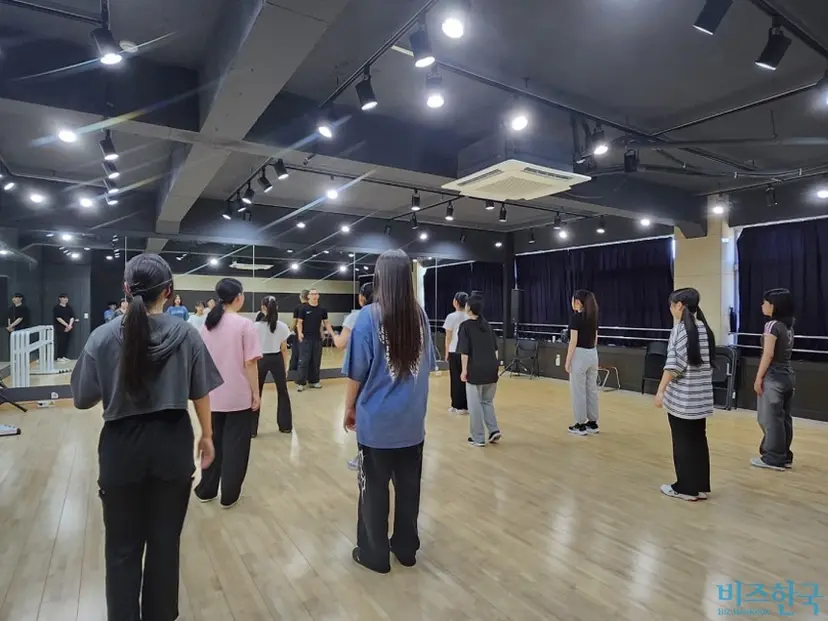
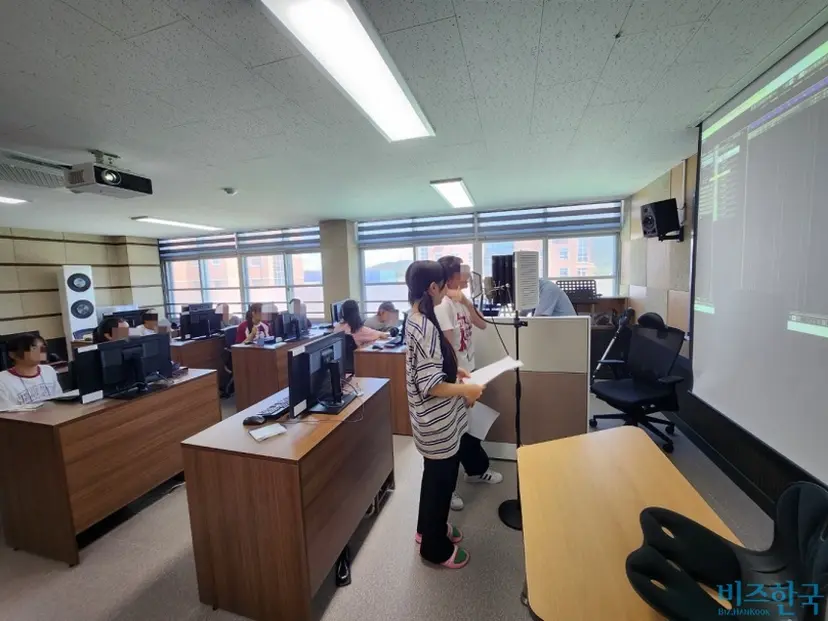
The school is equipped with various special rooms so that students can practice to their heart's content. It provides practice spaces such as personal practice rooms (50), dance studios (6), recording studios, rap rooms (2), ensemble rooms (3), music appreciation rooms, composition rooms, MIDI rooms, video studios, and performance practice rooms. Music teacher Byun Sung-hwan said, "In the past, it was difficult for students to rent personal practice rooms outside even when paying money. Now that the school is equipped with the latest facilities and can be used comfortably, students are very satisfied."
Annual Exchanges with Foreign Students, International Class Opening Next Year
The K-POP High School was explored as a way to create a source of vitality for the region, which is facing a crisis of survival. As news spreads that it is a high school that teaches K-Pop, which the whole world is paying attention to, recent interest and exchanges from various overseas schools have continued. The school also hosts a Global Youth K-Pop Contest every year in cooperation with local governments and agencies.
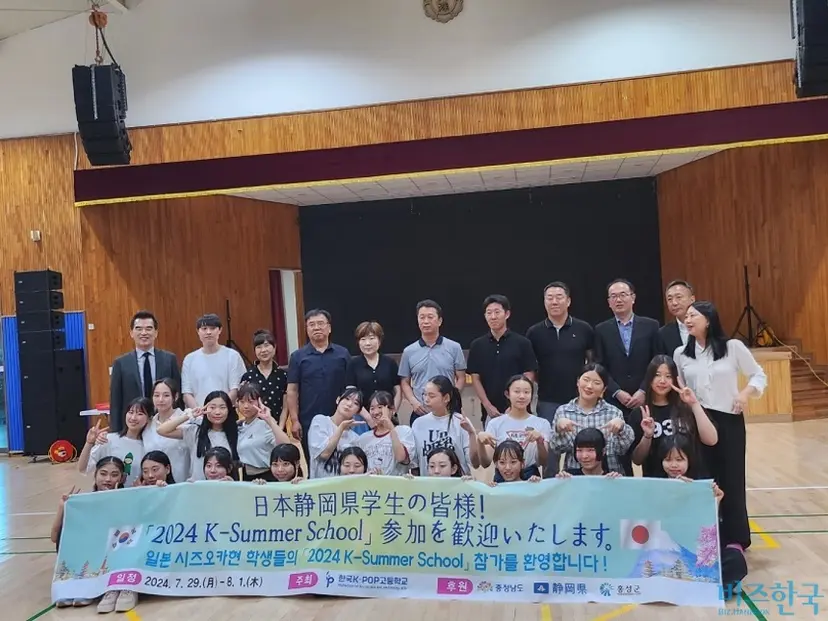
In particular, the camp held every summer vacation is popular with overseas students. Following the visit of Canadian students last year, Japanese students came this year. From July 29th to August 1st, students from Shizuoka Prefecture, Japan, stayed in the dormitory and experienced various programs together, such as learning Korean through song lyrics and K-Pop cover dance, broadening the scope of Korea-Japan cultural exchange. Miss A, a high school student from Shizuoka, Japan, said, "I became a K-Pop fan because I liked BTS, and I am so happy to have participated in this camp. I felt the 4 days and 3 nights were too short because I was dancing and building friendships with Korean friends. The process was difficult when performing the choreography we worked hard to complete together, but I felt a sense of achievement more than anything else."
As the Korea K-POP High School has established itself, school tours from various regions such as Gyeonggi-do and Ulsan have also been following. In 2026, a K-Pop high school will also open in Busan. The establishment of a K-Pop international school is also being pushed in Saemangeum, Jeollabuk-do.
Principal Park Byung-kyu emphasizes that specialized high schools like the K-Pop high school should increase in other regions as well. It means there should be more spaces where countless adolescents can foster their dreams without losing their rights. Above all, he emphasized that they must be equipped with facilities and specialized personnel to teach students properly.
The current number of students at Korea K-POP High School is about 100, and the recruitment number for freshmen in 2025 is about 60 in total, with 40 for the domestic class and 20 for the international class. According to data from the Korea Creative Content Agency, the number of trainees belonging to agencies at the end of 2022 reached 1,170, and considering this, the recruitment size of the Korea K-POP High School is relatively small. The fact that it is located in a region rather than Seoul, where idol agencies and private education facilities are concentrated, and the small number of recruits are pointed out as points of regret for the Korea K-POP High School.
There are also a small number of foreign students from Thailand, Kazakhstan, and Vietnam at Korea K-POP High School, and starting next year, an international class will be opened to select international students of various nationalities.
Currently, the biggest concern for the Korea K-POP High School is hiring professional teachers. With the revision of the Private School Act the year before last, all teachers at private schools, including specialized high schools, must pass the teacher certification exam. This is a very disadvantageous condition for the Korea K-POP High School. This is because it is not easy to find people with formal teaching qualifications in fields of special subjects such as dance, singing, songwriting, and composition.
Principal Park Byung-kyu confided, "Currently, there is no place that gives teaching licenses related to K-Pop. Even if I look for a teachers' college to bring in a dance major teacher, there are only dance teachers. It is virtually impossible to find someone with a teaching license among those who specialize in K-Pop dance." For now, instead of professional teachers, they are consistently recruiting instructors.
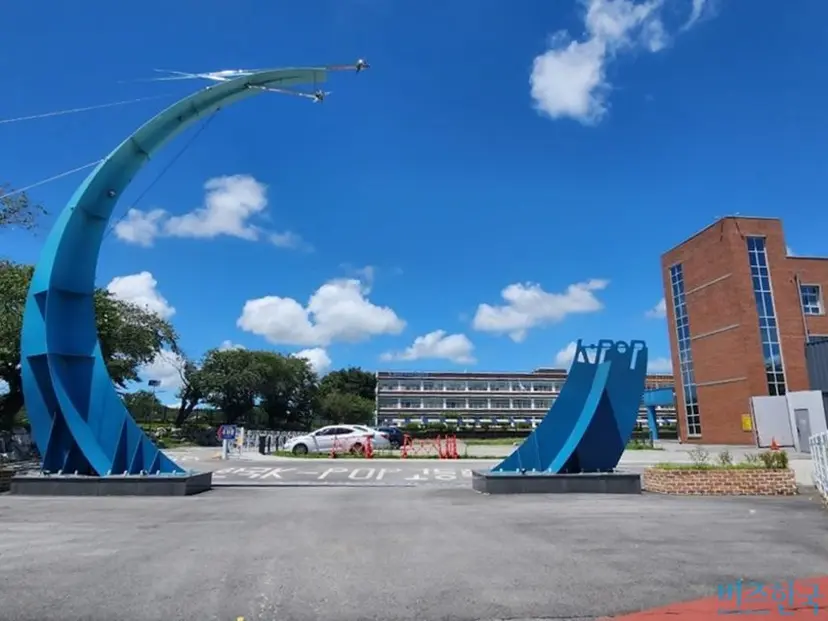
Unlike other schools, there were no gates or walls at the entrance to the Korea K-POP High School. It contains a philosophy that it should be a place where students can enter comfortably and study and play to their hearts' content, not a place they don't want to go to. In fact, students seem to regard the school that way. A student at the K-POP High School expressed pride, saying, "I come to school even during vacation to sing. We are the only school that provides a specially prepared space for challenge videos."
※ The next installment will feature an article on how small and medium-sized agencies survive.
※ This project was supported by the Press Promotion Fund created by government advertising fees.
![[K-Pop: Idols in Wonderland] Why Swedish composers from the 'Land of ABBA' are creating K-Pop](https://s.bizhankook.com/attachments_thumb/2026/05/92416_thumb.webp)
![[K-Pop: Idols in Wonderland] Asking 'What is Better K-Pop' at Sweden's 'Heavy Metal Mecca' Rock Festival](https://s.bizhankook.com/attachments_thumb/2026/05/92427_thumb.webp)
![[K-Pop: Idols in Wonderland] The Secret Behind Japan’s Endless Stream of Talented Bands Lies in Schools](https://s.bizhankook.com/attachments_thumb/2026/05/92450_thumb.webp)
![[K-Pop: Idols in Wonderland] "Raising Idols Through Public Education": A Visit to a K-Pop High School](https://s.bizhankook.com/attachments_thumb/2026/05/92330_thumb.webp)
![[K-Pop: Idols in Wonderland] K-Pop Must Break Free from the Same ‘Success Formula’ to Survive](https://s.bizhankook.com/attachments_thumb/2026/05/92469_thumb.webp)
![[K-Pop: Idols in Wonderland] The Unfairness 'Ria' Experienced, and What 'Kim Jae-won' Intends to Change](https://s.bizhankook.com/attachments_thumb/2026/05/92437_thumb.webp)