

[비즈한국] Not all bio-companies start on equal footing. Subsidiaries backed by the capital power of large conglomerates or leading companies that are already generating cash through existing products have the capacity to continue research and development (R&D) even when the capital market freezes. Conversely, small and medium-sized bio-ventures without their own cash-generating sources must secure new funds every time they reach a higher clinical stage. When the investment market shrinks, they are often forced to choose between continuing R&D or abandoning their pipelines.
In fact, in the domestic bio-industry, a polarization is becoming distinct: while conglomerate-affiliated companies—which have been able to pour funds into projects for long periods—create a virtuous cycle by succeeding in drug development and commercialization to reinvest in new R&D, small and medium-sized bio-companies struggle to shoulder massive R&D expenses that far exceed their sales, leaving them dependent on external financing. Ultimately, what determines the success or failure of new drug development is not just technology, but the ‘money’ that buys the time to endure until that technology bears fruit.
SK Group’s tenacity leads to the fruition of SK Biopharmaceuticals and SK Bioscience
Among the bio-companies that have not stopped R&D investment even during the capital market’s cooling period, SK Biopharmaceuticals is a prime example. Based on the long-term capital support of its parent conglomerate, it continued new drug development and later built a virtuous cycle of reinvesting in R&D by securing cash-generating power through its own product sales.
It took a long time for SK Biopharmaceuticals to independently develop the epilepsy treatment cenobamate (US product name: Xcopri) and achieve results in the US market. SK Biopharmaceuticals began research on cenobamate in 2001, entered clinical trials in 2005, and received approval from the US Food and Drug Administration (FDA) in 2019 after completing global Phase 3 clinical trials. It took about 18 years from the start of research to US authorization.
The capital invested was also substantial. SK Biopharmaceuticals’ consolidated R&D expenses reached 177.2 billion won in 2019, 109.1 billion won in 2020, and 114.8 billion won in 2021. After its US launch, the operating loss widened to 239.5 billion won in 2020 as costs for building local direct sales organizations were added.
Industry experts agree that SK Group’s long-term support served as a solid pillar during this process. This is the background that allowed them to continue development and commercialization while enduring large-scale deficits for several years, unlike typical bio-ventures that must recover their investments in the short term.
Currently, based on the US sales of Xcopri, SK Biopharmaceuticals has secured its own cash-generating power, building a virtuous cycle that can be poured into seeking new growth engines such as Radiopharmaceutical Therapy (RPT) and Targeted Protein Degradation (TPD).
SK Bioscience also solidified its foundation by utilizing SK Group’s capital power. Its current vaccine business began in earnest when SK Chemicals acquired Dongshin Pharmaceutical, which was engaged in the vaccine and blood product business, in 2001.
Subsequently, SK Chemicals continued to invest in R&D and production infrastructure, such as building a vaccine R&D center in 2005 and completing the Andong L-House in 2012. Based on these investments, it completed its own vaccine portfolio by sequentially launching the cell-culture trivalent influenza vaccine ‘SkyCellflu’ in 2015, the world’s first cell-culture quadrivalent influenza vaccine ‘SkyCellflu Quad’ in 2016, the shingles vaccine ‘SkyZoster’ in 2017, and the varicella vaccine ‘SkyVaricella’ in 2018.
The vaccine business accumulated in this way was spun off from SK Chemicals in 2018 and launched as SK Bioscience. It took 17 years from the acquisition of Dongshin Pharmaceutical to the launch of an independent vaccine-specialized company.
Since then, SK Bioscience has expanded its global cooperation in addition to its own vaccine development, and has also secured experience and networks in the vaccine CDMO business through the COVID-19 pandemic. Recently, it has been expanding its business scope to include next-generation pneumococcal vaccines, as well as mRNA (messenger ribonucleic acid) and CGT (cell and gene therapy).
Although their methods differ, SK Biopharmaceuticals and SK Bioscience demonstrate a characteristic of laying a business foundation through long-term funding and then connecting it to new growth engines based on that foundation.
LG and Samsung also exceed 1 trillion won in annual sales for new drugs and biosimilars through parent company capital power
It is realistically difficult for small and medium-sized bio-ventures to single-handedly raise hundreds of billions of won in capital to acquire overseas companies or expand global clinical trials. In contrast, bio-businesses affiliated with large conglomerates can utilize both the cash generated from existing businesses and the investment capacity of the parent company.
The Life Sciences Division of LG Chem is another example that utilizes the capital power of the parent company and the cash flow from existing businesses simultaneously.
LG Life Sciences was absorbed and merged into LG Chem in 2017, becoming the Life Sciences Division of LG Chem. Since then, it has been equipped with a structure that can utilize LG Chem’s capital power while growing its business scale based on stable sales of existing products, such as the diabetes treatment Zemiglo and the growth hormone Eutropin.
In particular, LG Chem acquired Aveo, a bio-company possessing the kidney cancer treatment ‘Fotivda’ approved by the US FDA, for approximately $566 million (730 billion won) in 2023, securing global commercialization capabilities in the anti-cancer drug business through this large-scale investment. Last year, the LG Chem Life Sciences business division recorded 1.3454 trillion won in sales.
Samsung Bioepis is also a representative case that secured the time needed for initial R&D and clinical trials based on the capital support of a large conglomerate, and then established its own profit foundation.
Samsung Bioepis is a biosimilar company established in 2012 as a joint venture between Samsung Biologics and Biogen of the US. However, in the beginning, it continued to record deficits until 2018 due to the burden of R&D and global clinical trial costs. Nevertheless, during this period, it received support for paid-in capital increases of approximately 1 trillion won from the Samsung Group, establishing its initial business foundation.
Samsung Group’s support did not stop there. In 2022, Samsung Biologics acquired the entirety of Biogen’s stake in Samsung Bioepis for approximately $2.3 billion (2.7655 trillion won) and incorporated it as a 100% subsidiary. Since then, it has grown into a global biosimilar company by expanding its biosimilar product line into ophthalmology, blood/kidney, and endocrine fields, in addition to autoimmune diseases and anti-cancer drugs, and last year it recorded 1.6619 trillion won in sales and 379.9 billion won in operating profit.
Bio-companies find relief through conglomerate acquisitions... Adding time to technology
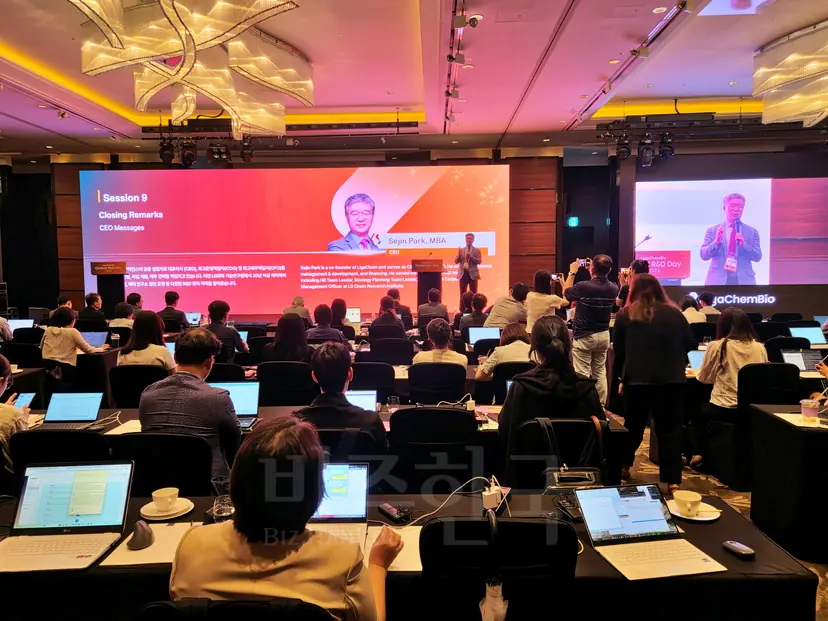
Ligachem Biosciences is cited as a representative case where integration with a large conglomerate changed a bio-company’s funding structure.
Although Ligachem Biosciences was recognized for its high technical prowess in the ADC (Antibody-Drug Conjugate) platform field, its financial capacity was limited to handle the costs of late-stage clinical trials for new drug candidates.
In this situation, Orion, which had earmarked the bio-business as a new growth engine, became the largest shareholder of Ligachem Biosciences through an investment of approximately 550 billion won. With these funds, Ligachem Biosciences laid the groundwork to develop its own ADC new drugs.
In addition, CJ Bioscience, which receives support from CJ CheilJedang; Bukwang Pharmaceutical, embraced by OCI Holdings; and SillaJen, with M2N as its largest shareholder, are focusing on R&D within the shelter of capital-rich parent companies. Unlike small and medium-sized bio-companies that worry about survival amidst the bio-investment cold wave, they are in an advantageous position to be stably supplied with R&D ammunition without being shaken by market conditions.
‘Capital polarization’ revealed in numbers… Small and medium bio-companies pouring money into R&D amidst deficits
Most small and medium-sized bio-ventures have no sales generated from new drug candidates. While R&D expenses continue to occur, there are often no cash-generating sources to offset them until a product is launched.
Up until the preclinical and Phase 1 clinical stages, which are the early stages of development, research can be continued with government subsidies or venture capital (VC) investment. However, starting from Phase 2 clinical trials, where efficacy must be proven in earnest, the scale of required funds increases significantly as the number of patients grows and the clinical period lengthens.
Phase 3 clinical trials involving a large number of patients are an even greater barrier. If it expands to global multi-country clinical trials, the necessary funding can range from tens of billions to hundreds of billions of won. However, product sales have not yet occurred, and the success of the clinical trials has not been determined.
In the bio-industry, this period, where the time when money is most needed overlaps with the time when investors become most conservative, is called the ‘Death Valley’.
The gap becomes even wider in situations like the recent one, where the capital market flowing into the bio-industry has shrunk. Even for Initial Public Offerings (IPO), a representative funding window, only around 20 companies succeed per year. This is why some companies cease development or scale down their pipelines—not because they lack technology, but because they lack the money to survive until that technology becomes a business.
This means that technology is not the only criterion that determines the survival of a bio-company. Even for companies with the same technical prowess, the clinical results and the fate of the business can vary depending on how much funding they have secured to last.
The colder the capital market, the more distinct this gap becomes. Companies with money endure the recession and invest in the next clinical trials and technology, while companies without cash-generating sources are forced into situations where they must abandon core pipelines to secure immediate operating funds.
In particular, looking at the recent financial situation of bio-companies, the funding conditions faced by small and medium-sized enterprises are revealed even more clearly. According to the ‘2026 Q1 Trend Survey of Listed Bio-Healthcare Companies’ compiled by the Korea Biotechnology Industry Organization for 82 listed companies, the polarization in performance between large/mid-sized companies and small-sized companies is clear.
Eight large pharmaceutical companies recorded 2.6701 trillion won in sales and 1.0797 trillion won in operating profit in the first quarter, while 28 mid-sized companies recorded 3.8166 trillion won in sales and 325.9 billion won in operating profit. On the other hand, the total sales of 21 small pharmaceutical companies were 209 billion won, a 0.7% decrease compared to the same period last year, and they recorded an operating loss of 65.8 billion won, turning to a deficit.
The problem is that even as the money earned is decreasing, the R&D expenses that must be poured in to maintain pipelines are increasing. R&D expenditure by small pharmaceutical companies in the first quarter was 144.6 billion won, an increase of 38.5% from the same period last year. It means that the deficit has widened by pouring about 70% of total quarterly sales into R&D.
Small and medium-sized bio-companies, which have become unable to cover R&D expenses through their own operating activities, are being driven into a position where they must receive external capital transfusions. The problem is that market funds are being concentrated in only a few companies. The ‘Money War’ of small and medium-sized bio-companies, which must prove their survival and completion of clinical trials, is beginning.
![[Bio Money Game] ② Certain Companies Attract Capital… The Rise of "Selective Investment"](https://s.bizhankook.com/attachments_webp_no_wm/2026/08/135490_no_wm_ed93574b.webp)
![[Bio Money Game] ③ Asking shareholders to "save the company," yet major shareholders only subscribe to "half"](https://s.bizhankook.com/attachments_webp_no_wm/2026/09/135587_no_wm_01be4102.webp)