

[비즈한국] Small and medium-sized venture biotech companies are at a crossroads of survival due to financial difficulties. While new drug development requires enormous, long-term R&D expenses, it is difficult to expect stable revenue until results become tangible, and in the early to mid-stages where uncertainty is high, even external investment rarely flows in.
Ultimately, some companies rely on capital increases targeting existing shareholders, but as cases where the largest shareholder subscribes to only half of their allocated shares continue to emerge, there is criticism that they are offloading the burdens and risks of new drug development onto retail shareholders.
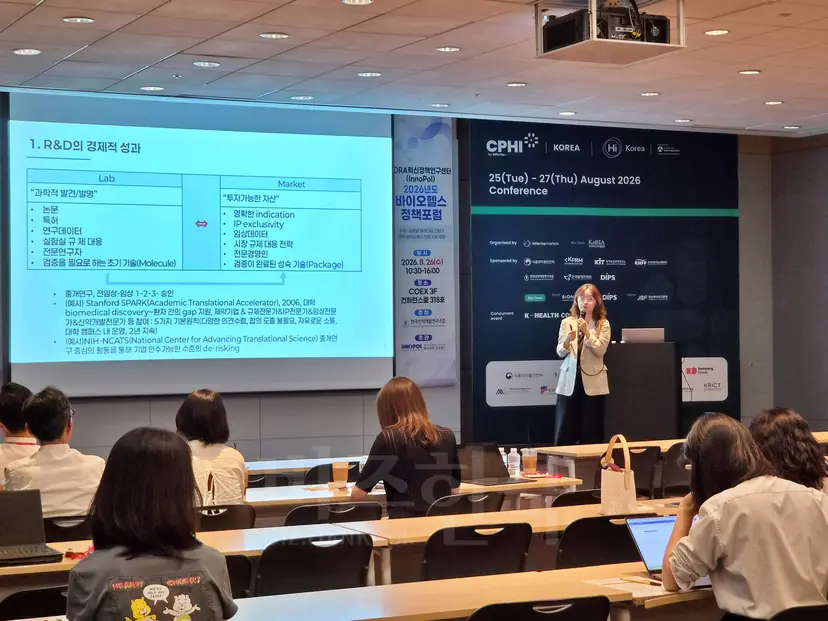
Son Soo-jung, a senior research fellow at the Science and Technology Policy Institute (STEPI), also pointed out the "capital gap" in the bio industry at the 2026 Bio-Health Policy Forum held by the KDRA (Korea Drug Research Association) Innovation Policy Research Center at COEX in Gangnam-gu, Seoul, on the 26th of last month. Fellow Son said, "Everyone acknowledges the gap where capital access is blocked, but the reality is that the actual size of capital that can enter this segment is not very large," adding, "Because even the government cannot boldly step into this capital gap, it is difficult for entities trying to start businesses with research results to cover this area themselves, resulting in a vicious cycle where market VCs (venture capitals) further avoid entering the early stages with high uncertainty."
Ultimately, biotech companies with blocked funding channels end up aiming for listing or relying on ways to raise funds again in the stock market after listing. And the final means they encounter is a capital increase targeting existing shareholders.

Biotech companies with blocked funding, left with no choice but to reach out to shareholders
The reason biotech companies pursue shareholder-allotted capital increases is simple. They need money to continue developing new drugs, but it is difficult to attract new investors. Unless they are backed by a solid conglomerate or have garnered attention for tangible technology export achievements in the global market like Alteogen, ABL Bio, Olix, or LegoChem Biosciences, it is not easy to secure the necessary funding for survival beyond R&D.
Furthermore, it is difficult for biotech companies to generate revenue or profits on their own. While funds are continuously poured in during the stages of candidate discovery, pre-clinical trials, and clinical trials, it is hard to expect stable cash flow before technology exports or new drug launches. Before entering clinical trials, it is difficult to receive investment due to a lack of technical verification, and after entering clinical trials, they find themselves in a situation where additional funding is needed due to enormous costs.
Typically, these risks are shared by various investment entities, such as VCs, strategic investors (SIs), and M&As by pharmaceutical and biotech companies. However, since there is no clear method for domestic biotech companies to recoup funds other than an IPO, participation from investors remains low.
Cho Hun-je, Executive Director of the Korea Drug Research Association, pointed out, "The government has broadly encouraged the establishment of bio-ventures, but has completely blocked the M&A channels through which large corporations or medium-sized pharmaceutical companies could acquire them due to regulations and tax blind spots."
With no new investors with strong capital power and mid-stage recovery channels blocked, the most realistic means for companies tasked with maintaining their listing and continuing clinical trials is inevitably narrowed down to shareholder-allotted capital increases, where they reach out to existing shareholders.
Asking to "save the company," yet major shareholders subscribe to only "half"
A capital increase itself is not necessarily negative. If a company with high growth potential raises necessary funds based on a clear business plan, a capital increase can be a normal means of financing for R&D, as well as a good investment opportunity for shareholders who expect growth.
The problem arises when companies repeat capital increases without fully explaining their performance, funding purposes, and the responsibilities of the largest shareholder.
New drug development inherently carries a high risk of failure. However, failing to secure new investors with clear clinical data or a promising pipeline and offloading the funding burden onto existing shareholders damages shareholder value and triggers market distrust. For existing shareholders, if they do not inject additional capital, their equity value can be diluted, but if they do participate in the subscription, they are forced to take on the risk of failure in new drug development.
In particular, whether the largest shareholder and management participate in the capital increase is a key factor that determines shareholders' trust. This is because the participation of the largest shareholder and management, who understand the company best, can serve as a signal of their commitment to future business.
If the largest shareholder actively participates in their allocated portion, it can be interpreted as a sign that management also shares the responsibility for the need for additional capital and the sustainability of the business. On the other hand, if the largest shareholder does not subscribe to or forfeits a significant portion of the new shares allotted to them, it can be strongly read as a negative signal that even the insiders who know the company best have doubts about its success.
Recently, there have been successive cases where biotech companies decided on shareholder-allotted capital increases due to financial difficulties, and the largest shareholder or related parties participated in only a portion of their allocations.
HLB Pharmaceutical, which is set to undergo a shareholder-allotted capital increase followed by a public offering of forfeited shares worth 60.8 billion won on the 15th-16th of this month, plans for its largest shareholder, HLB Life Science, and related parties to subscribe to only about half of their allocation.
According to HLB Pharmaceutical's disclosure, the largest shareholder, HLB Life Science, plans to subscribe to 869,289 shares out of the 1,738,577 shares allocated through the capital increase, or 50%. Four related parties, including Jin Yang-gon, Chairman of HLB Group, his two daughters, and Park Jae-hyung, CEO of HLB Pharmaceutical, have also decided to subscribe to 50% of their allocated shares. A related party named Lim Chul-an plans not to subscribe.
Accordingly, out of the total allocated shares of 2,253,113 for the largest shareholder and related parties, the amount actually planned for subscription is 1,124,917 shares, which is about 49.9%. The company explained that the scale of participation by the largest shareholder was decided after comprehensively considering realistic financial conditions.
L&C Bio, which is also preparing for a shareholder-allotted capital increase followed by a public offering of forfeited shares worth 140.6 billion won in October, also plans for its largest shareholder to subscribe to only about 50% of their allocation.
According to L&C Bio's disclosure, the largest shareholder plans to subscribe to 50% of the shares allocated in this capital increase. To secure funds for subscription, related taxes, and partial repayment of existing stock-collateralized loans, they plan to sell some of their common shares through block deals (off-market bulk trades) and also sell their non-subscribed stock warrants.
Partial participation in a capital increase by the largest shareholder leads to a deterioration in shareholding ratios. Following the capital increase, the shareholding ratio of the largest shareholder and related parties of HLB Pharmaceutical is expected to decrease from 20.93% to 18.35%, and that of L&C Bio's largest shareholder from 23.45% to 19.40%.
Of course, it is difficult to conclude that the largest shareholder has not fulfilled their responsibility simply because they did not subscribe to all of their allocated shares. This is because factors such as individual financial capacity, the purpose of the capital increase, and the company's financial situation must be considered.
However, the problem is that if the company fails to achieve results that can increase corporate value despite repeated fundraising, the burden on existing shareholders will continue to grow. Unless the company transforms into one where investors are willing to put money back in, capital increases only extend survival and cannot be a fundamental solution to financial difficulties.
![[Bio Money Game] ① “Clinical trials take time, but funding runs dry”: The ‘Capital Polarization’ determining the success or failure of new drugs](https://s.bizhankook.com/attachments_webp_no_wm/2026/08/135437_no_wm_1fdc0506.webp)
![[Bio Money Game] ② Certain Companies Attract Capital… The Rise of "Selective Investment"](https://s.bizhankook.com/attachments_webp_no_wm/2026/08/135490_no_wm_ed93574b.webp)