

AI glasses are being misused for activities like exam cheating and unauthorized filming, heightening concerns about daily privacy invasions. While manufacturers are implementing safety features such as LED indicator lights, methods to bypass them are already emerging. As the distribution of these devices accelerates, experts point out an urgent need to overhaul laws and regulations and establish technological defense systems at the manufacturer level.

Beyond Exam Cheating to Secret Filming… Bypassing Safety Features
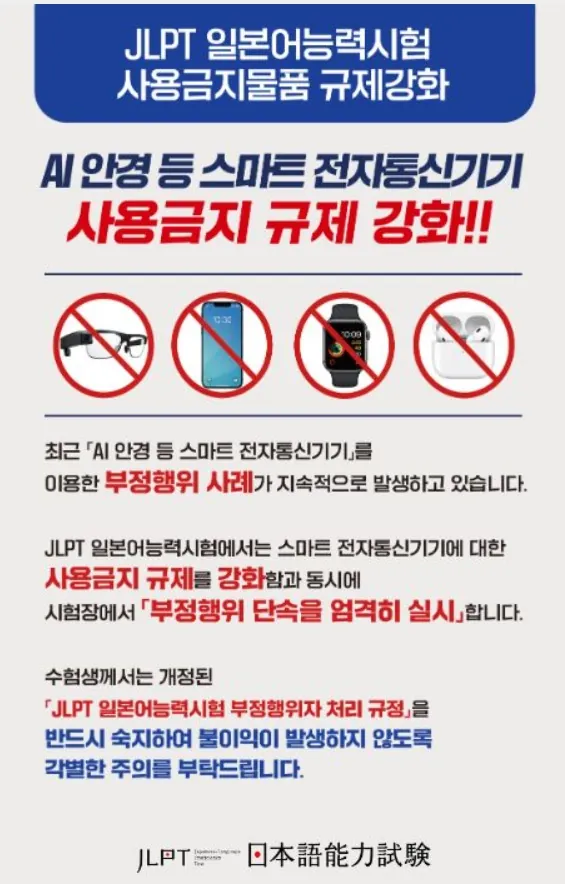
Recently, several cases of exam cheating using AI glasses have been uncovered in South Korea. In July, a candidate taking the Financial Investment Analyst qualification exam was banned from all exams organized by the Korea Financial Investment Association for five years after being caught with smart glasses equipped with a camera and AI answer-generation capabilities. Previously, in May, three individuals were caught during electrical and fire safety engineer exams, and two were caught during regular TOEIC exams.
Damage has been confirmed outside of testing environments as well. In July, a man was investigated by the police for secretly filming a woman on a date after covering the recording indicator light and distributing the footage online. There are also concerns about the possibility of leaking information by filming internal corporate documents or blueprints. The UK Cinema Association (UKCA) stated in August that many cinemas in the UK have banned or restricted the wearing of camera-equipped smart glasses due to concerns over privacy invasions and illegal movie piracy.
Manufacturers have their own defensive measures. Ray-Ban Meta glasses have a white LED on the front of the frame that flashes when recording; from the second generation onwards, the camera will not function if the LED is detected as being covered or damaged. Samsung Electronics also explained that its product is designed so that internal and external LEDs light up during recording, and the camera stops if the indicator is blocked or broken.
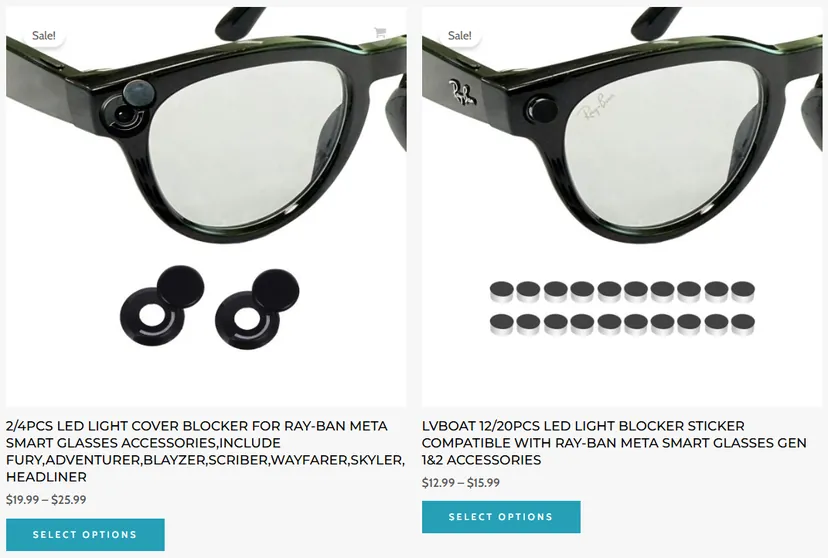
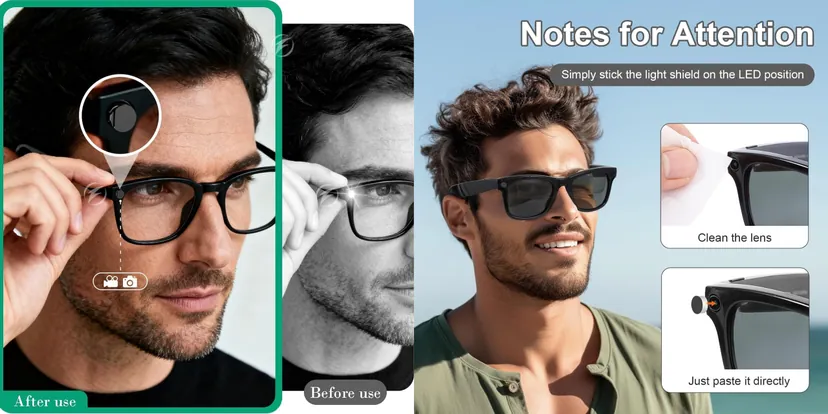
However, these are not perfect defenses. Overseas shopping platforms like Amazon sell stickers to cover the LEDs and clip-on covers for the lenses. Sticker sets are priced around 17,000 won for 20, and clip-on sets are around 8,000 won for two. Some of these products can also be purchased on domestic open markets as direct overseas purchases.
The clip-on type covers the camera and LED area to conceal the recording indicator. The LED-blocking stickers have microscopic holes over the indicator area, allowing light to reach the device's sensor while remaining nearly invisible to onlookers. Both products exploit loopholes in safety systems that only detect when an indicator is completely covered.
Domestic Protection Principles in Preliminary Stages… Growing Responsibility for Manufacturers and Regulators
South Korea is still in the phase of establishing specific standards tailored to the characteristics of AI glasses. The Personal Information Protection Act’s regulations on mobile video recording devices are limited to operators for business purposes, making it unclear whether they can regulate cases where ordinary consumers film people around them. Currently, covering or removing indicator lights is not illegal as there are no relevant laws.
Responses in educational settings are also limited. While some universities have established guidelines such as entry bans and checking eyeglass frames, it is difficult to distinguish the latest models from regular glasses. With the College Scholastic Ability Test (CSAT) and university essay exams approaching in the second half of the year, many universities have yet to prepare separate countermeasures. The Ministry of Education is considering explicitly designating AI smart glasses as prohibited items for the CSAT.
In late July, the Personal Information Protection Commission met with Samsung Electronics to discuss personal information protection measures for AI glasses scheduled for release within the year. Ideas discussed included applying recording notification devices so that people nearby can recognize when a camera or microphone is active. The commission plans to establish personal information protection principles for AI glasses and related industries in the second half of this year. However, these principles are expected to serve as guidelines providing standards for the industry rather than mandatory regulations.
Internationally, responses targeting specific spaces or situations have emerged first. The New York State Unified Court System in the U.S. has banned them from court facilities, and the state of Illinois implemented a law on July 31 specifically naming AI smart glasses as electronic communication devices to prohibit their use while driving. In China, following guidance from the Ministry of Industry and Information Technology, an "AI Glasses Voluntary Code" was announced in June, with 10 companies agreeing to strengthen data security and personal information protection.
Domestically, the Ministry of Personnel Management checked all examinees wearing glasses for smart glasses for the first time during the second round of the 5th-grade open competitive recruitment exam in July.
The prevailing view is that the task at hand is to manage the risks that arise as these products enter daily life, rather than attempting to stop the spread of AI glasses entirely.
In this context, the preemptive responsibility of manufacturers is emphasized. The Hamburg Commissioner for Data Protection and Freedom of Information in Germany previously pointed out that technical tests showed that white LEDs are only sufficiently visible under specific conditions, such as narrow viewing angles, close distances, and appropriate lighting environments.
Lee Eun-hee, a professor of consumer science at Inha University, said, "No matter how they are distributed, the primary responsibility lies with the manufacturer. They must implement technology so that even if something is inserted or attached, it is ineffective, or attempts to bypass it are inherently exposed." She emphasized, "It is also urgent to establish a legal basis to severely punish unauthorized filming without the consent of the other party."
Meta stated that it considers the use of LED-bypassing products a policy violation and removes related posts, while also preparing updates to deactivate the camera if it detects physical tampering with the indicator light.
Post-incident response technology has also emerged. Maestro Forensic introduced a forensic solution that analyzes the model, serial number, connection time, recording time, location information, and AI Q&A data of smart glasses connected to smartphones. The solution targets investigative agencies such as the police and prosecution that need to secure evidence for illegal filming or industrial espionage cases.
Kim Jong-kwang, CEO of Maestro Forensic, said, "When a user is recording, others nearby should be able to tell with the naked eye. However, we have discovered loopholes where indicator lights are not easily visible or can be easily covered by stickers, indicating that continuous technical improvements are necessary."
![[AI in My Eyes] ① Why are Big Tech companies focusing on AI devices, and why specifically glasses?](https://s.bizhankook.com/attachments_webp_no_wm/2026/08/135409_no_wm_4541d3fc.webp)
![[AI in My Eyes] ② “Lightweight, Long-lasting, and Stylish”: Packing Cutting-edge Tech into Small Glasses](https://s.bizhankook.com/attachments_webp_no_wm/2026/08/135532_no_wm_343a6f3c.webp)