

[비즈한국] The approval of the 'Daesan 1st' project has triggered a full-scale structural reorganization of the domestic petrochemical industry. The government and the industry aim to resolve oversupply issues and improve their underlying competitiveness by pivoting toward high-value, eco-friendly industries. However, there is criticism that specific industrial transition measures for carbon neutrality remain insufficient. We examine what is needed to ensure this restructuring leads to a true 'transformation' rather than just a simple reduction in production.
Decarbonization in the petrochemical sector is no longer an issue that can be explained solely by the language of environmental campaigns. The jobs in industrial cities like Yeosu, Ulsan, and Daesan, Korea's export competitiveness, and the very survival of companies all depend on it. If they cannot reduce carbon emissions, factories will have fewer places to sell their products even if they manufacture them, and if export routes are blocked, the regional economy will inevitably falter. The reason petrochemical decarbonization is so critical is not just the imperative to 'save the planet,' but because it is a practical issue that determines whether Korea's core industry can continue to survive.
The World's 4th Largest Petrochemical Industry: Why Has It Become a Burden on the Korean Economy?
The domestic petrochemical industry has grown around three major hubs: Yeosu, Ulsan, and Daesan. Following China, the U.S., and Saudi Arabia, this industry possesses the fourth-largest production capacity in the world and is a core pillar of Korean manufacturing, recording 111 trillion KRW in production in 2023 and 48 billion USD (72 trillion KRW) in exports in 2024. The problem is that while this industry supports the Korean economy, it is also a major emitter of greenhouse gases. It accounts for 18.8% of domestic industrial greenhouse gas emissions, totaling 53.6 million tons, second only to the steel industry. Without decarbonization in the petrochemical sector, reaching the 2035 National Greenhouse Gas Reduction Targets and the 2050 Carbon Neutrality goal is virtually impossible.
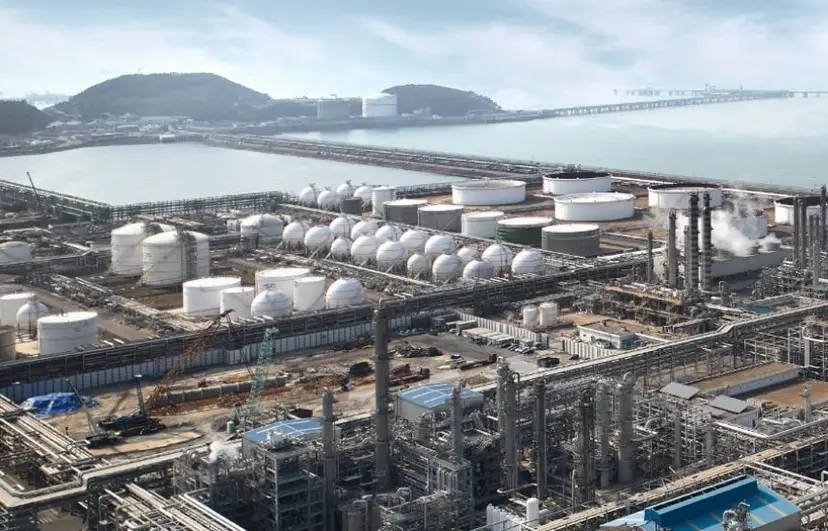
However, there is an even more urgent reason. Carbon is no longer just an environmental issue; it has become a matter of trade costs. The European Union's (EU) Carbon Border Adjustment Mechanism (CBAM) will begin mandating the purchase of carbon certificates in 2026. Currently, it targets six items, including steel, but it is highly likely that it will expand to organic chemicals and plastics. Once this happens, products with high carbon footprints will become more expensive in the European market, further reducing their competitiveness. This is why concerns are growing that if companies cannot lower their carbon intensity, they may face hundreds of billions of won in additional annual costs. With discussions on the Clean Competition Act continuing in the U.S., managing carbon emissions has become a standard for financial health and export competitiveness, rather than just corporate image.
In the past, it was enough to make good products cheaply. Now, how little carbon was used to make the product is part of the price tag. If they fail to meet these standards, Korean petrochemical companies will be pushed out of overseas markets, factory utilization rates will drop, and the impact will ripple into partner firms, local businesses, and the job market. This is why petrochemical decarbonization is a matter directly linked to the regional economy.
Two Solutions: "Bio-feedstock and ECC"
Amid this sense of crisis, a 'Debate on Decarbonization Strategy to Overcome the Petrochemical Regional Crisis' was held at the National Assembly on March 17. At the forum organized by the Climate Crisis Decarbonization Economic Forum and Solutions for Our Climate, the decarbonization solutions under industry consideration and their realistic limitations were discussed in depth. The conclusion was clear: while there is no disagreement on the need to reduce carbon, three barriers—technological gaps, cost burdens, and unstable feedstock supply—are working simultaneously in the field.
The first strategy often discussed is partially replacing existing fossil-based naphtha with other feedstocks. Utilizing bio-based or recycled feedstocks is considered a realistic alternative because the technology is relatively mature, and some existing facilities can be used as they are. In particular, bio-naphtha is gaining attention as a means to lower oil dependency because it can be produced using feedstocks like waste cooking oil. LG Chem's cooperation with Italy's ENI to build an HVO plant in Seosan, Chungnam, is an extension of this trend.
Jang Yong-hee, Team Leader of the Low Carbon Promotion Team at LG Chem, stated at the forum, "Rather than waiting for electric NCC (Naphtha Cracking Center) technology, which requires more time for development and verification, early expansion of recycling technology will be a more certain strategy." This means that instead of looking only at ultimate solutions that take a long time, we must first broaden the reduction means available today.
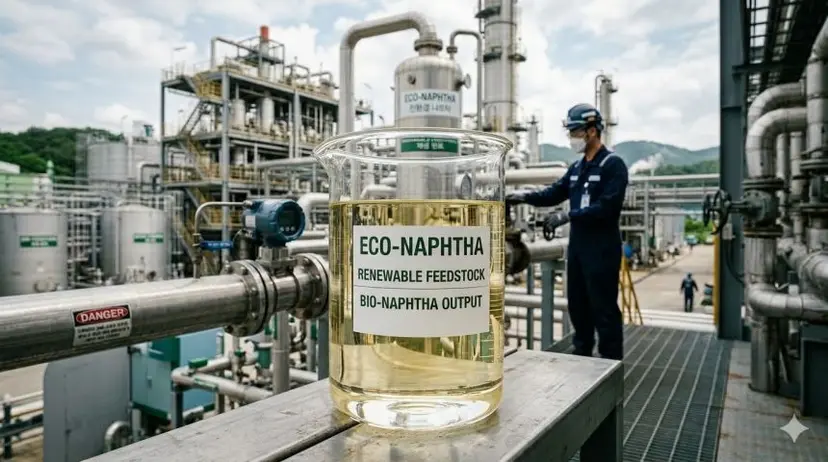
However, bio-feedstocks also have clear limitations. The biggest issue is securing a stable volume. Current domestic HVO projects and carbon neutrality policies are structured around transportation alternative fuels such as biodiesel or sustainable aviation fuel (SAF). Bio-naphtha is closer to a byproduct of this process, leading to criticisms that the petrochemical industry cannot be supplied on the large scale required. Bio-based feedstocks like waste cooking oil also lack a sufficient domestic collection system, meaning a significant portion must be imported. This means the structure is such that even if companies want to switch to eco-friendly materials, it is difficult to procure the raw materials themselves.
Team Leader Jang explained, "The domestic used cooking oil (UCO) collection system is not yet well-established, so we are requesting related policies," adding, "We are looking for additional feedstocks such as second-generation oils, excluding UCO." For companies, securing the supply chain is more urgent than developing technology.
Another alternative is transitioning to ECC (Ethane Cracking Center) by introducing North American ethane. Ethane has fewer impurities than naphtha and is evaluated as being more cost-competitive, while reducing carbon emissions by up to 50%. The fact that high ethylene yields can lower production costs is another advantage. For an industry suffering from oversupply from China and sluggish market conditions, it is a card that can lower both carbon and costs simultaneously.
However, this is not a panacea either. While ECC is efficient for ethylene production, it has the limitation of a simplified product line. The petrochemical industry is structured to extract various basic oils and derivative products together; moving toward an ethane-centered system could narrow the production portfolio. Furthermore, the price advantage of ethane is heavily dependent on U.S. shale gas policies and the international landscape. Even if it looks advantageous now, the situation can change at any time due to geopolitical variables, the weaponization of resources, or changes in U.S. energy policy.
Kim Dong-ha, a team leader at HD Hyundai Chemical, said, "Looking at the Hormuz crisis, feedstock diversification is essential for survival, and ethane could be an auxiliary feedstock," adding, "We can supplement the variety of products by producing propylene, necessary for high-value-added products, through the PDH process using propane." Ultimately, this means that a strategy to diversify feedstocks and distribute risks is more realistic than finding a single answer.
Need for Bold Government Support
More fundamental solutions for petrochemical decarbonization include the electrification of the NCC process itself and the transition to hydrogen/ammonia fuel. However, this area is still in a stage that requires significant time and money. Even if the industry sees electric NCC as the ultimate goal, it is not easy for companies with declining profitability to bear the enormous costs of demonstration. There are also many challenges to be verified technologically. The current reality of the petrochemical industry is clear: carbon must be reduced, but funds are scarce, and while future technology is necessary, there is not enough time to apply it to the field immediately.
Therefore, the necessity of government support was repeatedly emphasized at the forum. Petrochemical decarbonization cannot be solved by individual companies changing a few facilities; it must move in tandem with national infrastructure such as power, hydrogen, supply chains, and recycling systems. Park Jin-soo, CEO of Plan-it, pointed out the need to reference Germany's Carbon Contracts for Difference (CCfD). This is a method where the government compensates for the gap between the additional costs incurred when companies transition to low-carbon processes and actual carbon prices for a certain period, serving as a minimal safety net for companies to decide on large-scale investments.
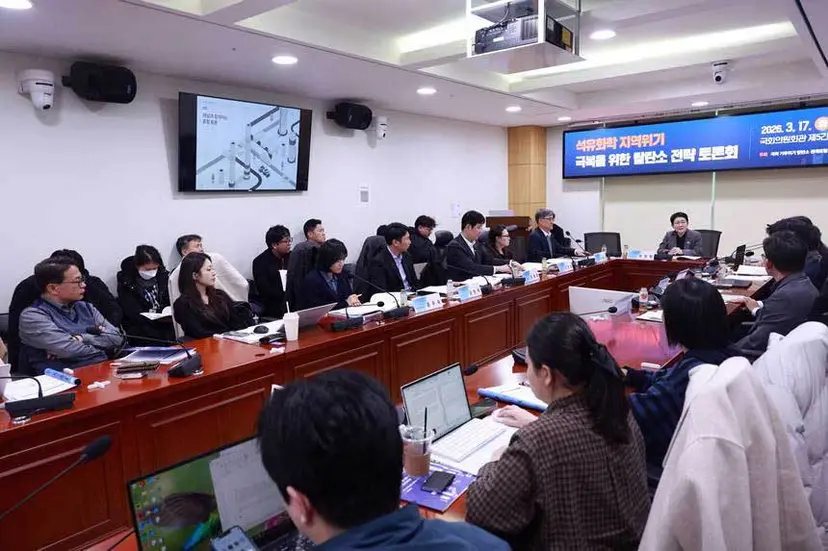
The reason such a system is necessary is that domestic carbon prices are not yet high enough to boldly induce reduction investments. Companies also know that carbon reduction is necessary in the long term. However, based on current income statements, there is a lack of incentive to put up hundreds of billions of won first. Ultimately, if the government does not use policy to reduce initial risks, the pace of the industry's overall transition will inevitably be slow.
The government has also begun to move. On March 4, the Ministry of Trade, Industry and Energy launched the 'Chemical Industry Innovation Alliance.' The purpose is to move away from supplier-centered R&D and promote technology development that reflects market demand by involving consumer companies that actually use the materials. Noh Gwi-seok, a deputy director at the Ministry of Trade, Industry and Energy's Chemical Industry Division who attended the forum, explained, "Currently, petrochemical companies have no investment capacity, so the government must take the lead in presenting a roadmap for high-value-added transformation R&D to serve as a catalyst," adding, "A pilot project for hydrogen/ammonia fuel replacement at the LG Chem NCC plant in Yeosu, Jeonnam, is scheduled until 2028, and a demonstration project for electric NCC began in 2023 and is being pushed until 2030."
For petrochemical decarbonization, the sequence and speed are more critical than the technology itself. Experts point out that we need a structure where the use of recyclable and bio-based feedstocks that can be done immediately is rapidly expanded, while large-scale technologies like electric NCC and fuel conversion are demonstrated in the mid-to-long term, with the government mitigating investment risks through systems and funding in the meantime. Any single measure alone is insufficient.
![[Petrochemical Transformation] ① Daesan Project 1: Just production cuts, but no 'climate' strategy](https://s.bizhankook.com/attachments_thumb/2026/05/97714_thumb.webp)
![[Petrochemical Transformation] ② "Protect the Earth, Protect the Region": What are the Decarbonization Solutions that will Determine Survival?](https://s.bizhankook.com/attachments_thumb/2026/05/97911_thumb.webp)
![[Petrochemical Transformation] ③ A Definite Alternative to Decarbonization: How Far Have We Come with 'NCC Electrification'?](https://s.bizhankook.com/attachments_thumb/2026/05/98098_thumb.webp)
![[Petrochemical Transformation] ④ The Limits of 'De-Naphtha' Pursued by the Government and Industry](https://s.bizhankook.com/attachments_thumb/2026/06/106592_thumb_bf493a20.webp)