

[비즈한국] The approval of the 'Daesan Project 1' has marked the beginning of full-scale restructuring in the domestic petrochemical industry. The government and the industry aim to resolve the issue of oversupply through this restructuring while improving their constitutional structure toward high-value, eco-friendly industries. However, critics argue that substantial measures for industrial transition toward carbon neutrality are lacking. We examine what is needed to ensure that this restructuring goes beyond mere production cuts and leads to a genuine 'transformation'.
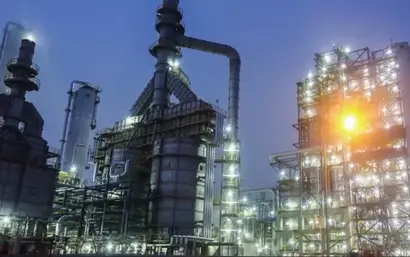
Relying on LNG will leave us behind in global regulations
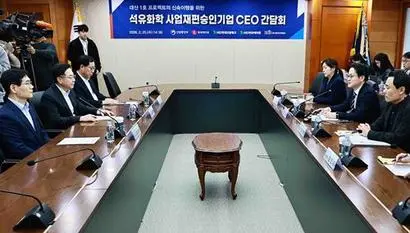
On February 25, the government announced a large-scale support package for companies participating in the Daesan Project 1. The core of this business restructuring is for Lotte Chemical011170 to spin off its Daesan operations to merge with HD Hyundai Chemical and halt the operation of its 1.1 million-ton capacity NCC (Naphtha Cracking Center). Shareholder companies HD Hyundai Oilbank and Lotte Chemical agreed to implement self-rescue efforts worth 600 billion won each, for a total of 1.2 trillion won to improve financial stability, and in return, the government decided to provide customized support worth over 2.1 trillion won, encompassing financial, tax, and cost-saving measures.
Through this restructuring, the government set a goal to increase greenhouse gas reduction from 270,000 tons in 2025 to 2.1 million tons by 2035. However, experts criticize that the transition efforts from a climate perspective are insufficient. This is because, under the current plan, there are no clear carbon reduction measures beyond the natural reduction resulting from production volume cuts.
Concerns have also been raised that the cost-saving measures included in the support package could solidify reliance on fossil fuels. The government announced plans to supply electricity at a rate 4–5% cheaper than KEPCO by utilizing the Distributed Energy Special Zone system. However, the current 'Distributed Energy Act' includes LNG combined heat and power plants as distributed energy sources. If companies choose LNG power generation instead of renewable energy PPAs (Power Purchase Agreements) to save costs, there is a high possibility that the direction will move far away from carbon reduction in the long term.
Expanding the scope of facilities for direct import of fuel-grade LNG could also be a factor that deepens dependence on fossil fuels. To ease the burden of fuel costs on companies, the government stated it would expand direct LNG imports, previously limited to existing NCC facilities, to some downstream facilities such as Mixed Xylene (MX) production units.
Since LNG supply contracts are typically long-term agreements of 10 years or more, once introduced, it can create a 'lock-in effect' where it becomes difficult to change the carbon emission structure midway. If companies settle for cheaper LNG fuel rather than investing in electrification, there is a high risk of falling behind increasingly stringent global carbon regulations.
Kim Soo-kang, a researcher at the non-profit energy and climate policy think tank 'Next', pointed out, "Relying solely on LNG without investing in facilities to electrify existing processes is a passive strategy for long-term carbon emission reduction," adding, "Looking at current geopolitical risks in the Middle East, it is difficult to forecast that LNG prices will remain stable in the long term."
Raw material substitution has its 'limits'
The eco-friendly strategy of this project is structured around raw material substitution, such as bio-naphtha, waste plastic recycling, and ethane introduction. However, this approach faces several realistic barriers.
Raw materials such as animal/vegetable fats and biomass have unstable supply and high import dependency, making them vulnerable to supply chain management. As the commercialization of technologies for developing biomass-derived raw materials and materials is expected to occur in the 2030s-2040s, it is insufficient to achieve greenhouse gas reduction targets immediately.
Chemical recycling technologies, such as waste plastic pyrolysis oil, also require considerable time before large-scale commercialization. Furthermore, as global policies restricting single-use products are expected to cause a sharp drop in plastic demand, it is unclear whether eco-friendly product production through raw material substitution will lead to stable profits and demand.
Ethane Cracking Centers (ECC), which can reduce carbon emissions by up to 50% compared to conventional naphtha, also have limitations in terms of production. ECCs have a simpler range of producible products compared to existing NCCs. While an NCC can form a broad portfolio encompassing not only various basic oil fractions but also aromatic products, aromatic chemical production is impossible with an ECC. This means that while it is advantageous in terms of carbon emission reduction, there are constraints on diversifying high-value-added products, which is a goal of this restructuring.
Process innovation needed for carbon reduction
The biggest flaw in this support plan is the lack of technical alternatives to lead to fundamental decarbonization of the process. Approximately 70% of greenhouse gas emissions in the petrochemical industry originate from NCCs. This is because massive amounts of fossil fuels must be burned to crack naphtha at high temperatures of over 800 degrees Celsius. For a true eco-friendly transition, 'NCC electrification,' which replaces the fuel for this process with electricity, is the key task. Although NCC electrification was specified as a major task in the Ministry of Climate, Energy and Environment's '2035 Nationally Determined Contributions (NDC)' plan, it was omitted from this project, which is the execution stage.
Major overseas petrochemical companies have already brought NCC electrification technology to the pilot and demonstration stages. Three companies—BASF (Germany), SABIC (Saudi Arabia), and Linde (UK)—signed a joint development and demonstration agreement in 2021, and in 2024, they completed and began operating the world's first large-scale electric furnace pilot plant. Dow (US) and Shell (Europe) have also been building and operating electric cracker experiment units (e-cracker) since 2022.
Kim A-young, a researcher at the Solution for Our Climate (SFOC) petrochemical team, said, "BASF has confirmed through demonstrations that there are no technical constraints and is now entering the stage of considering economic feasibility," adding, "On the other hand, Korea is still stuck in the experimental stage."
The lack of mention of industrial heat pumps is also a regrettable point. Industrial heat pumps are facilities that absorb waste heat and use electricity to raise the temperature to provide heat sources needed for processes; since they are already in the commercialization stage, they can be introduced to the field immediately. As such, they are attracting attention as a practical means to lead a short-term and stable decarbonization of the petrochemical industry.
Experts agree that raw material substitution is, at best, a supplementary measure. They argue that without innovation in the process sector, which accounts for the absolute majority of carbon emissions, achieving greenhouse gas reduction targets is distant. This is why it is pointed out that while this support package may contribute to resolving companies' short-term management difficulties, it is insufficient to equip them with industrial competitiveness befitting the climate crisis era.
Jeong Seok-hwan, head of the petrochemical team at Solution for Our Climate, emphasized, "Daesan Project 1 stops at burden-relief measures focused on resolving overproduction," and added, "To possess true industrial competitiveness, substantial transition for carbon reduction must follow.".
![[Petrochemical Transformation] ① Daesan Project 1: Just production cuts, but no 'climate' strategy](https://s.bizhankook.com/attachments_thumb/2026/05/97714_thumb.webp)
![[Petrochemical Transformation] ② "Protect the Earth, Protect the Region": What are the Decarbonization Solutions that will Determine Survival?](https://s.bizhankook.com/attachments_thumb/2026/05/97911_thumb.webp)
![[Petrochemical Transformation] ③ A Definite Alternative to Decarbonization: How Far Have We Come with 'NCC Electrification'?](https://s.bizhankook.com/attachments_thumb/2026/05/98098_thumb.webp)
![[Petrochemical Transformation] ④ The Limits of 'De-Naphtha' Pursued by the Government and Industry](https://s.bizhankook.com/attachments_thumb/2026/06/106592_thumb_bf493a20.webp)