

[비즈한국] The wave of artificial intelligence (AI) is sweeping across all industries. In daily life as well as nearly every sector of corporate management, integrating AI has become a necessity rather than an option. The pharmaceutical and biotech industry is no exception. With the government announcing plans to foster the 'ABCD (AI, Bio, Culture, Defence)' industry as the next-generation national growth engine, the convergence of AI and bio is no longer a distant future. We examine the changes AI brings to pharmaceutical and biotech R&D, clinical trials, and production, as well as the tasks needed to support this institutionally.

The pharmaceutical and biotech industry's use of AI is evolving. Beyond efficiently selecting promising candidates among tens of thousands of new drug substances for R&D, there are attempts to create 'AI virtual personas'—virtual customer models—for use in marketing. An AI persona refers to a virtual target that mimics the actual tendencies, interests, and behavioral patterns of customers based on vast digital behavioral data, rather than simply demographic information like 'a male in his 40s living in Seoul.'
IQVIA, a global healthcare data statistics firm, introduced specific practical examples of how AI is changing the paradigm of pharmaceutical marketing at an insight forum held in Seoul last November. The core is precision targeting through virtual personas.
According to IQVIA's analysis, 40% of healthcare professionals (HCPs) change their clinical and prescription tendencies within 6 months. Conversely, the cycle at which existing pharmaceutical companies update their target lists for marketing usually ranges from 12 to 36 months. In other words, marketing strategies are failing to keep pace with the speed of market changes.
To address this, IQVIA utilizes AI to analyze approximately 4 billion pieces of digital activity data, including social media activities, search keywords, and academic journal subscription records, to derive 'digital fingerprints'—unique online behavioral patterns and psychological traits of individuals. The rationale is that if one can identify potential customers who might be interested in a specific disease or drug and track what concerns they have and how they make decisions, their needs can be reflected immediately.
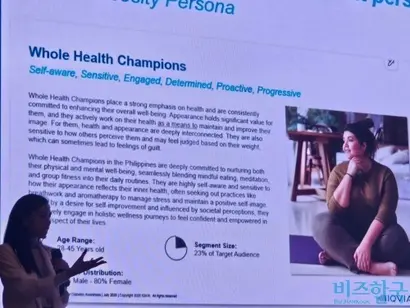
This approach provided a glimpse into the commercial potential of AI personas. Geraldine John, Head of Omnichannel Marketing at IQVIA, explained specific results using the case of the Philippines. By analyzing Philippine obesity market data with AI, IQVIA noted that obese women aged 28-45 prioritized not only disease treatment but also appearance management and mental well-being.
John explained, "This AI persona showed characteristics of being highly interested in yoga and fashion, acquiring health information through Facebook and YouTube, and using aromatherapy for stress management. Instead of a direct message about weight loss, we approached them with lifestyle content they prefer, and as a result, targeting precision increased 15-fold."
The true value of AI personas also stands out in diseases with relatively small patient populations. Even if the number of patients is small, they leave digital traces while searching for information about their condition or treatment online, allowing companies to find these hidden patients.
A program conducted for Hepatitis C patients in Australia is a case that demonstrates the effectiveness of this AI persona approach. Hepatitis C is an infectious disease transmitted through sharing or reusing syringes, blood transfusions, dialysis, sexual contact, or mother-to-child vertical transmission. Due to social stigma, patients tend to avoid or hide their diagnosis. Often, they are not even aware that they have been exposed to the risk of infection.
Through AI analysis, IQVIA discovered that Hepatitis C patients spent more time on general lifestyle websites than on hospital websites. Consequently, they launched campaigns such as posting banners on those lifestyle websites that displayed lists of locally available medical staff and linked to consultations. As a result, the number of visitors to hospital websites in the regions where the campaign was executed increased by approximately 71%.
The introduction of AI personas is also positive for cost efficiency for pharmaceutical companies. According to IQVIA, campaigns applying AI insights achieved 2-3 times higher performance compared to existing digital marketing, and one global pharmaceutical company recorded an ROAS (Return on Ad Spend) of 8 to 1, achieving 8 times the revenue efficiency relative to advertising costs.
Beyond marketing, AI personas are expected to be utilized in clinical trials, especially in patient recruitment. Usually, it costs more than 10 million won just to recruit and manage one clinical trial participant. An AI model that has learned clinical trial inclusion and exclusion criteria can analyze Electronic Medical Records (EMR) and digital behavioral data to identify candidates who meet the criteria. Furthermore, an AI persona created based on vast patient data could potentially replace the placebo group, thereby reducing the number of actual patients needed and shortening costs and time.
However, there are limitations. Outside of the United States, regulations exist where Direct-to-Consumer (DTC) advertising of prescription drugs is restricted, necessitating workarounds such as disease awareness campaigns.
John stated, "AI personas help design how to communicate and are useful in identifying which topics form a stronger consensus when supporting treatment access or treatment adoption. While they can be used alone, combining them with traditional methods will increase speed and add depth."
![[Adding AI to K-Bio] Government Supports GPUs, Association Builds Ecosystem for New Drug Development](https://s.bizhankook.com/attachments_thumb/2026/05/96137_thumb.webp)
![[Adding AI to K-Bio] Park Young-min, Head of Korea Drug Development Fund: "Intensive Support to Cross the Valley of Death"](https://s.bizhankook.com/attachments_thumb/2026/05/96354_thumb.webp)
![[Adding AI to K-Bio] The 'AI Laboratory' Where Robot Researchers Work 24 Hours a Day](https://s.bizhankook.com/attachments_thumb/2026/05/96787_thumb.webp)
![[Adding AI to K-Bio] Changing the Grammar of Marketing with 'AI Personas'](https://s.bizhankook.com/attachments_thumb/2026/05/97343_thumb.webp)