

[비즈한국] The wave of AI (Artificial Intelligence) is sweeping across all industries. Integrating AI has become a necessity, not an option, not only in daily life but in almost every aspect of corporate management. The pharmaceutical and biotechnology industry is no exception. With the government announcing its plan to foster the 'ABCD (AI, Bio, Culture, Defence)' industry as the next-generation pillar of national growth, the convergence of AI and bio is no longer a distant future. We examine the changes AI is bringing to the pharmaceutical and bio industry—from research and development to clinical trials and production—and the tasks required to support this institutionally.
The Society of Automotive Engineers (SAE International) classifies the level of autonomous driving technology for road vehicles into six levels, from 0 to 5. The highest level, Level 5, is 'Full Driving Automation,' meaning a state where the Automated Driving System (ADS) performs all driving tasks required without driver intervention. It is a level that functions without limitation under most road and environmental conditions that a human driver could handle; it is often called a 'dream technology' because it is not yet feasible on real roads.
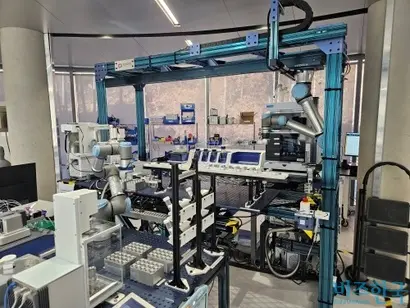
However, in the pharmaceutical and biotechnology industry, often considered the most conservative, autonomous technology is being integrated into new drug research and development (R&D), changing the landscape of laboratories. The KPBMA's AI New Drug Development Research Institute recently established an 'AI New Drug Development Autonomous Laboratory' in its newly expanded Mirae Hall and has finished preparations for full-scale operation.
The AI New Drug Development Autonomous Laboratory is responsible for synthesizing and optimizing substances under various conditions during the drug candidate synthesis or process development stages. For example, combining substances and synthesis conditions results in a vast number of possibilities. Automated equipment conducts experiments across numerous combinations within pre-defined conditions, while algorithms suggest subsequent conditions based on the results, accelerating the search for optimized synthesis conditions.
The core of this laboratory is the implementation of a 'closed-loop' experimental autonomous system that combines robotic automation with algorithm-based decision-making. Simple repetitive processes, such as sample preparation that researchers previously performed one by one using pipettes (liquid transfer tools), are now handled by robots in this laboratory.
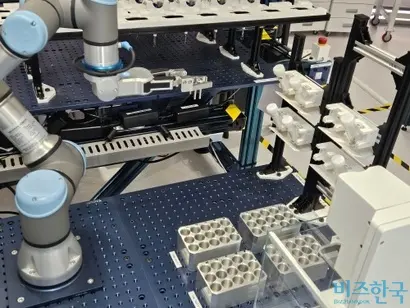
It does not merely replace physical tasks. The system analyzes experimental results, redesigns the next set of experimental conditions to reach the target synthesis yield, and repeats the process to refine the search for optimal conditions. If a desired yield is not achieved under specific conditions, it incorporates the results and proposes different conditions. In the event of equipment stoppage or abnormal situations, it typically responds according to pre-determined procedures such as safety rules and control logic, while the algorithm focuses on streamlining the exploration of experimental conditions within those parameters.
Pyo Joon-hee, head of the AI New Drug Development Research Institute, predicted, "It is like having a well-trained researcher capable of conducting repetitive experiments 24 hours a day. AI models, such as optimization algorithms, not only handle physical tasks but also make repetitive searches more efficient, which will further enhance the role of the researchers who utilize them."
The AI New Drug Development Autonomous Laboratory of the KPBMA is also raising expectations as a testbed for individual pharmaceutical and bio companies looking to build their own autonomous labs. This year alone, the lab provided theoretical training on equipment and software utilization to 260 individuals in the industry. It is creating an 'open innovation' ecosystem where companies can experience autonomous systems firsthand and explore joint research. Pyo noted, "Interest from companies considering the introduction of autonomous experimental systems is high. After building the infrastructure and providing theoretical training this year, we plan to conduct hands-on training next year."
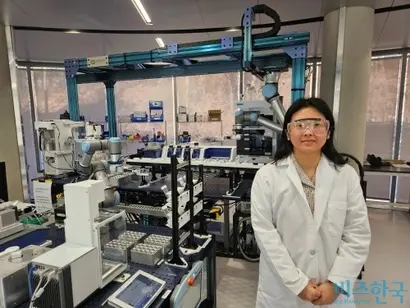
Measures have also been prepared to address data security, which is often cited as a major hurdle in industry collaboration. Since new drug development data is a core asset for pharmaceutical and bio companies, the lab was built in an offline environment isolated from external networks to prevent leakage. However, Pyo explained that they are currently building security governance that includes not just system design but also operating systems for the AI New Drug Development Autonomous Laboratory. This is because security levels can only be maintained stably when operational controls—such as the import/export of portable storage media, access rights management, log monitoring, and physical security—are in place, even in an offline environment.
Pyo expressed her expectations, saying, "Our goal is to introduce high-demand technologies into AI new drug development and build a system that domestic researchers can use and study with. This will also help in revitalizing the AI-based new drug development ecosystem."
![[Adding AI to K-Bio] Government Supports GPUs, Association Builds Ecosystem for New Drug Development](https://s.bizhankook.com/attachments_thumb/2026/05/96137_thumb.webp)
![[Adding AI to K-Bio] Park Young-min, Head of Korea Drug Development Fund: "Intensive Support to Cross the Valley of Death"](https://s.bizhankook.com/attachments_thumb/2026/05/96354_thumb.webp)
![[Adding AI to K-Bio] The 'AI Laboratory' Where Robot Researchers Work 24 Hours a Day](https://s.bizhankook.com/attachments_thumb/2026/05/96787_thumb.webp)
![[Adding AI to K-Bio] Changing the Grammar of Marketing with 'AI Personas'](https://s.bizhankook.com/attachments_thumb/2026/05/97343_thumb.webp)