

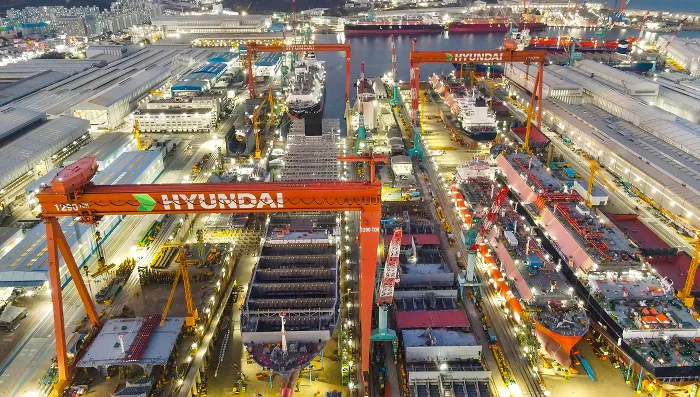
[비즈한국] When ordering a ship, the shipbuilding contract signed between the shipowner and the shipyard is accompanied by an auxiliary document called the 'Maker’s List.' This list pre-approves the manufacturers for major equipment that determines the ship's performance and safety, such as engines, propellers, generators, cranes, valves, pumps, and navigation equipment.
Looking at actual shipbuilding contracts submitted by major domestic shipbuilders to overseas public disclosure systems, the selection of parts is often fixed by this list at the time of the order. If a shipyard wishes to arbitrarily replace equipment on the list, it requires separate approval from the shipowner. In other words, which company’s parts will be used is determined by contract before welding even begins.
Being on the list is synonymous with market entry; once a company is listed, it secures stable volume for a long time, whereas companies that fail to make the list struggle to even submit a quote, no matter how high their quality may be.
Verified Parts Equal Risk Management
The reason shipowners have such conservative requirements is simple: component failure leads directly to massive financial losses. Time charter agreements include 'off-hire' clauses, meaning that if a ship cannot operate normally due to mechanical failure, the payment of charter fees stops immediately. If repair costs, the deployment of substitute vessels, and cargo claims are added to this, the losses snowball.
According to the '2026 Maritime Safety Report' released last month by the global insurance firm Allianz Commercial, mechanical damage and failure accounted for 1,505 out of 2,818 global maritime accidents last year, more than half of the total. This is nearly six times the number of collisions (260 cases), which ranked second. Even looking at the cumulative data over the past 10 years, mechanical failure is the No. 1 cause of accidents, accounting for 45% of the total—far outpacing collisions, groundings, and fire/explosions.
This trend is also being detected in the insurance industry. Statistics from the Nordic Association of Marine Insurers (Cefor) show that insurance claim costs related to hulls and machinery are over 30% higher than pre-pandemic levels, and the International Union of Marine Insurance (IUMI) predicts that related costs will continue to rise over the next five years. Ultimately, from the shipowner's perspective, choosing 'proven parts, even if slightly more expensive,' is a matter of risk management, not just cost, as it directly impacts charter fees, insurance premiums, and resale values.
A Cycle Where Track Records Beget Track Records… The 'Double Barrier' Built by Overseas Firms
The problem is that this structure acts as a 'double barrier' that is difficult for new entrants to break through. For new equipment to enter the market, it must first receive type approval from a classification society, a process that typically takes 3 to 6 months including design review, prototype testing, and factory audits. However, receiving approval is not the end. The real wall comes afterward. If there is no track record of the equipment being installed on a ship and operating without issues—the so-called 'track record'—shipowners still will not reach out.
Last March, the Ministry of Trade, Industry and Energy and the Korea Marine Equipment Research Institute (KOMERI) launched 'KOMERI No. 1,' the world's first vessel dedicated to the sea-based testing of marine equipment. This was done to overcome the structural difficulty that domestic equipment companies face in being selected by global shipowners, as they often lack proof of operation on actual vessels even after completing product development and land-based testing. This 17,000 DWT bulk carrier serves as a national-level verification platform that installs domestic equipment and operates on actual routes to build up a 'track record.'
In its report titled 'The Core of Shipbuilding Paradigm Shift: Localization of Equipment and Commercialization Strategy,' the Korea Institute for Industrial Economics & Trade (KIET) also diagnosed that "in marine equipment, the influence of the shipowner on installation decisions is absolute, and one can only enter the Maker’s List by building a track record and proving reliability."
This structure is particularly grueling for small and medium-sized enterprises (SMEs). The KIET report points out that many domestic marine equipment companies are small and face difficulties in every stage of the life cycle, from R&D investment to certification, inspection, production, marketing, and after-sales service.
Conversely, it analyzed that leading overseas equipment companies have strengthened their market dominance by filling in weaknesses at each stage through mergers and acquisitions, strategic partnerships, and joint ventures with global companies. Since obtaining just one type of approval requires significant cost and months of time, and additional time and capital are needed to build a track record afterward, capital-strained SMEs find it hard to even attempt the challenge. Ultimately, the wall of the Maker’s List is not just a matter of technical prowess, but also a matter of having the capital to survive until that technical prowess can be proven through a track record.
Without original technology, one cannot be free from royalties, and without a track record, one cannot overcome the wall of that original technology. While Korea prides itself on building the world's best ships, the major equipment inside those ships is quietly being ruled by global corporations.
![[The Quiet Rulers of Shipbuilding] ② GTT, the Company Collecting Royalties on LNG Cargo Tanks Worth ‘5% of Vessel Prices’](https://s.bizhankook.com/attachments_webp_no_wm/2026/08/135058_no_wm_2127a8e1.webp)