

[비즈한국] The financial industry has entered the massive transformative wave of Artificial Intelligence Transformation (AX). The adoption of AI in core areas of finance, such as data analysis, risk management, and asset management, has emerged not as a choice but as a prerequisite for survival. With the rapid advancement of generative AI technology and government policy support, financial companies are going beyond Digital Transformation (DX) to reshape their business processes, organizational structures, and service strategies centered on AI. We examine the current flow of AI transformation in the financial sector and explore the future direction of the financial industry led by AI through strategies and use cases by sector.
State-run banks, established with government investment and functioning as public institutions, are also changing in line with the AI transition trend. These banks are primarily applying AI technology to lending operations and are building their own AI agents and platforms while conducting training to enhance employee capabilities. Furthermore, it is noteworthy that they are promoting financial support for companies and industries in need of AI transformation, fitting for institutions performing public functions.
Industrial Bank of Korea (IBK) is pushing for a transition into an 'AI-Native Bank' under the leadership of CEO Jang Min-young. At a press conference commemorating her 100th day in office, CEO Jang stated, "We will implement hyper-personalized AI banking, build an AI-based credit review system, and establish an AI agent-centered work environment." In her inaugural address last February, CEO Jang also announced that she would turn IBK into an AI-based financial company with an AI-friendly organizational DNA. "We will transform our working methods, organizational structure, and overall work environment to fit the AI era," she said, adding, "We will secure unrivaled capabilities through AI in all areas."
Accordingly, IBK has been conducting practical AI training for its employees since April. In the first half of the year, it provided 'Vibe Coding' (work automation through natural language-based coding) training to head office staff, and starting from the second half, it is expanding this to branch staff nationwide. Furthermore, by utilizing 'IBK GenAI,' a proprietary generative AI model built specifically for the bank, it is supporting employees in work efficiency, developing customized services by department, linking API-based systems, and developing internal AI agents. IBK has set a goal to continuously upgrade IBK GenAI to expand its application areas, including small and medium-sized enterprise (SME) credit evaluation, automated loan reviews, and customized product recommendations.
IBK is also conducting 'AI ACT Consulting' to help SMEs utilize AI in their operations. AI ACT Consulting is a free service that helps SMEs struggling with a lack of manpower and funds to use general-purpose AI apps without the need for specialized personnel or large-scale investments.
The Export-Import Bank of Korea (KEXIM) concluded its 'DX/AX Strategy and Generative AI Utilization Plan Consulting' early this year and established a mid-to-long-term digital strategy roadmap for 2026-2028. As a key execution task in the first year of the roadmap, it began building its proprietary generative AI platform, 'KEXIM AI,' last April. The goal is to introduce AI-based customer services that enable shortened non-face-to-face loan and guarantee review processes, as well as customized consultation support for SMEs expanding overseas. The construction project consists of four main tasks: in-house AI system implementation, unstructured data pipeline and document repository reconstruction, AI service development, and establishment of an AI management system.
The in-house AI system aims to build AI infrastructure on the internal network instead of using external clouds, creating an AI environment that can be used continuously by establishing safety devices. The reconstruction of the unstructured data repository involves converting internal documents and unstructured data into a form that AI can utilize and reorganizing the company-wide content management system to be AI-friendly. AI service development focuses on creating AI agents that assist in practical tasks like document writing, approval, and contract review, as well as AI that provides 24/7 information on loan products and financial data. The AI management system centers on creating standards for overall AI operations, such as internal regulations, ethical standards, and risk assessment systems.
KEXIM also plans to apply AI to credit supervision, which checks whether decision-making was appropriate throughout the entire lending process, including credit evaluation, loan approval, and post-management. It is currently soliciting consulting services to upgrade its AI-based early warning model to detect abnormal signs in advance and manage risks.
KEXIM has also prepared support measures for AI-related industrial sectors. According to its AX special program, it will provide 20 trillion won in loans and guarantees and 2 trillion won in investments over the next five years across the entire AI value chain, including semiconductors, data centers, Large Language Model (LLM) development, AI solutions, and robot factory construction. Like IBK, it also provides free consulting for the AI transition of SMEs and middle-market companies.
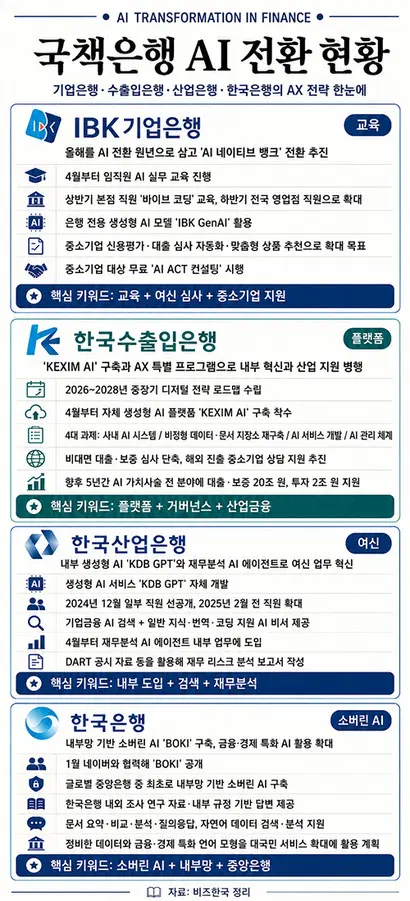
The Korea Development Bank (KDB) is quickly adopting and utilizing AI. It developed its own generative AI service, 'KDB GPT,' internally, pre-releasing it to some employees in December 2024 and launching it for all employees in February 2025. KDB GPT, which is text-based, consists of an AI search function for corporate finance and an AI assistant function that provides general knowledge, translation, and coding in a conversational format.
Starting in April of this year, it introduced AI into its bank lending operations in earnest. This was done by incorporating an in-house developed financial analysis AI agent into its internal operations. This system refines external data, such as DART disclosure materials, into usable financial data and then writes reports including the company's financial risks, review items, and investigation methods. It reflects the characteristics of a company's industry and provides customized analysis based on user requirements.
The Bank of Korea (BOK) is the first among the world's central banks to build its own AI on an internal network. 'BOKI,' a sovereign AI (AI developed independently based on national data and infrastructure) unveiled in January, was created through public-private cooperation with Naver; Naver provided the cloud infrastructure and LLM model, while the Bank of Korea developed AI apps specialized for finance. BOKI provides services such as: answers based on internal/external BOK research materials, answers based on internal regulations and guidelines, document summarization/comparison/analysis/Q&A, natural language data search/analysis, and translation of materials produced and published by the Bank of Korea.
The Bank of Korea stated, "We expect the construction of sovereign AI to serve as an opportunity to enhance trust in domestic AI technology and services and expand the potential for AI utilization across the industry," adding, "Beyond internal use, we will actively utilize the data and finance/economy-specialized language models refined during the BOKI construction process to expand services for the general public."
![[Finance is in AX] Regional Financial Triad Focuses on 'Joint Response' for AI Transformation](https://s.bizhankook.com/attachments_thumb/2026/05/97897_thumb.webp)
![[Finance in AX] The Three Internet Banks: "I Am the AI Leading Bank"](https://s.bizhankook.com/attachments_thumb/2026/05/98148_thumb.webp)
![[Finance is in AX] The Top Tier is Busy, Others are Quiet… Savings Banks Face 'Polarization'](https://s.bizhankook.com/attachments_thumb/2026/05/98318_thumb.webp)
![[Finance in the Era of AX] Securities and Insurance Firms Head Toward 'AI Financial Companies,' the Race for AX Begins](https://s.bizhankook.com/attachments_thumb/2026/05/98430_thumb.webp)
![[Finance in AX] 'AI Agent Pay' Is Coming: Shopping and Paying on Behalf of Humans](https://s.bizhankook.com/attachments_thumb/2026/05/98556_thumb.webp)
![[Finance is in AX] Bank of Korea First Among Central Banks to Build Its Own AI… State-Run Banks Take 'Rapid Strides'](https://s.bizhankook.com/attachments_thumb/2026/06/98721_thumb_bfff7934.webp)