

[비즈한국] As holidays or Family Month approach, home shopping channels become a 'battlefield without gunfire' for health functional foods promising vitality recovery. However, many premium health foods sold for hundreds of thousands of won, backed by the prestige of major pharmaceutical companies and flashy marketing, are in reality nothing more than common processed foods made with cheap ingredients. Starting with the controversy over the medical efficacy of 'edible albumin,' Bizhankook examined the reality of the pharmaceutical industry's tricks with health functional foods and the distribution structure that has created abnormal price bubbles.
The identity of health foods costing hundreds of thousands of won is surprisingly simple. It is merely a matter of slapping a pharmaceutical company's name onto common food products manufactured by small subcontractors and packaging them with confusing certification marks. In a market where 8 out of 10 consumers are deceived, the only ones laughing are the pharmaceutical companies.
According to a survey of 1,000 consumers conducted by the Korea Consumer Education Council last August, only 20.5% of respondents answered that they could clearly distinguish between 'health functional foods' and 'general health foods.' This means that 8 out of 10 people mistake ordinary processed foods for high-efficacy health functional foods due to the flashy marketing, packaging, and confusing certification marks used by pharmaceutical companies. Consumer dissatisfaction has reached a peak, with 84.9% of respondents stating that “general food products should be mandatorily labeled with a warning that they are 'not a health functional food.'”

MFDS Certification Marks Share Identical Colors and Designs
A prevalent view is that the primary cause of the decline in trust toward health functional foods lies in the complacent administration by the Ministry of Food and Drug Safety (MFDS), the governing body. This is directly due to the similar certification marks. Unless a consumer carefully scrutinizes the ingredients, the only standard for distinguishing between health functional foods and general health foods is the certification mark on the packaging.
However, in August 2014, under the pretext of increasing the reliability and uniformity of their marks, the MFDS created designs for health functional food marks, the HACCP (Hazard Analysis and Critical Control Points) mark for general food hygiene, and the GMP (Good Manufacturing Practice) mark for high-quality health functional food manufacturing that are identical. Aside from the text, the blue and green circular bands, the smiley curve at the bottom, and the MFDS logo are virtually indistinguishable.
Since the certification marks are small on the products, they are even harder to notice. This is why consumers easily mistake general health foods for health functional foods even when pharmaceutical and distribution companies attach HACCP or GMP marks to them. While the health functional food mark indicates proven efficacy, HACCP signifies food hygiene, and GMP denotes manufacturing facility certification; not many consumers accurately know these differences.
Outsourced Manufacturing, Pharmaceutical Profits… Shifting Blame When Problems Arise
The foundation for consumers paying hundreds of thousands of won for health functional foods or general health foods is the belief that pharmaceutical companies, which make medicine, would manage quality with the same meticulous care and cutting-edge equipment used for pharmaceuticals. However, checking the back of the product package reveals a different reality.
Most of these foods are produced via OEM (Original Equipment Manufacturing) or ODM (Original Design Manufacturing) methods, where production is entirely outsourced to small-to-medium-sized manufacturers. While they put forward the name of a pharmaceutical company, they are, in reality, merely lending their brand name.
In fact, according to the '2025 Food and Drug Statistical Yearbook' published by the MFDS at the end of last year, the total domestic sales of health functional foods as of 2024 amounted to 3.633 trillion won, with 41,896 types of items manufactured. Major OEM/ODM companies such as Kolmar BNH200130, Novarex194700, and Cosmax NBT222040 are firmly established in the top 10 list of health functional food manufacturers. The structure is one where external contractors handle all actual production.
When asked to take responsibility, the true face of the pharmaceutical companies becomes apparent. When recently asked for specific data or a stance regarding the efficacy of 'edible albumin' during the controversy, most pharmaceutical companies were reluctant to respond. Responses included claims like, 'I don't know much about it because it's a subsidiary's product,' or 'We only lent our name and were not involved in development.'
The irresponsible attitude of the Korea Health Supplements Association (KHSA) also cannot escape criticism. During holidays like Lunar New Year and Chuseok, the KHSA actively runs campaigns urging people to 'buy by distinguishing between health functional foods and general health foods' and to 'carefully check the MFDS mark.' However, when asked for an official stance after the edible albumin scandal broke, they remained silent. As they cannot help but be mindful of their member pharmaceutical and distribution companies, it is difficult for them to point to a specific company and raise a voice of criticism.

Civic Groups Criticize Passive Response from MFDS
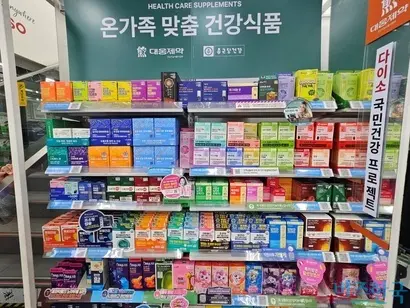
In February last year, the retailer Daiso launched health functional foods (vitamins, calcium, omega-3, milk thistle, etc.) priced between 3,000 and 5,000 won for a 30-day supply. While it received a great response from consumers for being launched at a breakthrough price compared to existing nutritional supplements, the pharmacy industry voiced concerns regarding potential quality degradation due to the lower price competitiveness.
Consumers purchase Daiso health functional foods with the lighthearted mindset that 'since a pharmaceutical company made it, it must be better than common snacks or food.' It is closer to 'placebo consumption' relying on cost-effectiveness rather than the purpose of treatment or health improvement. Originally limited to Daewoong Pharmaceutical069620, Chong Kun Dang Health, and Ilyang Pharmaceutical, Daiso's health functional food lineup has now expanded to include Yuhan Corporation, Dongkook Pharmaceutical, and Yungjin Pharmaceutical.
Conversely, the exact opposite phenomenon is occurring at home shopping channels and pharmacy counters. A contradiction is emerging where people open their wallets generously for expensive, general processed foods (health foods) costing hundreds of thousands of won that have had no functionality certified by the MFDS. This is evidence that the clear standards and trust that divide health functional foods from general foods are shaking at their roots.
Given this situation, civic groups are raising their voices. They argue that although market order is collapsing due to the deceptive marketing of pharmaceutical companies, the MFDS continues to use slap-on-the-wrist punishments and merely superficial monitoring.
The non-profit organization 'Together with Consumers' issued a statement on the 20th of last month, as the controversy over the efficacy of edible albumin was spreading, labeling this situation as a national fraud and rebuking the MFDS for its passive response. 'Together with Consumers' demanded: “Even though illegal acts of promoting general foods in connection with the treatment of specific diseases are rampant, the management and supervision by the MFDS are excessively complacent,” adding, “You must identify companies that have violated the Food Sanitation Act and the Act on Labeling and Advertising of Foods, and respond strongly with a zero-tolerance policy, including the highest level of administrative measures and criminal charges.”
There is growing support for the immediate reform of certification marks that deceive consumers, as well as the urgent introduction of a punitive damages system to claw back illegal profits gained through deceptive advertising.
![[Supplements in Name Only] ① Why 'Edible Albumin' is Just a '300,000 Won Seasoning'](https://s.bizhankook.com/attachments_thumb/2026/05/98166_thumb.webp)
![[Supplements in Name Only] ② Health food is not 'Health Functional Food'](https://s.bizhankook.com/attachments_thumb/2026/05/98159_thumb.webp)
![[Supplements in Name Only] ③ Health Foods 'Mimic' Health Functional Foods Thanks to MFDS 'Twin Marks'](https://s.bizhankook.com/attachments_thumb/2026/05/98202_thumb.webp)