

[비즈한국] Technology often crosses borders quietly, tucked inside someone’s bag on their way home. Research achievements and national strategic technologies cultivated over decades vanish into thin air, contained within a few printed pages or a USB stick. While dozens of technology leakage cases are uncovered each year, the full picture remains only partially revealed. Through this four-part series, 'Tech Spy,' BizHankook reconstructs the moment of leakage based on real-life events.
1.
When Executive Director Jeong Myeong-jung (pseudonym) first brought up the idea of resigning, the air in the conference room was calmer than expected.
“You need to give me more of a role.”
There was a time when, during his late commute home, he thought the smooth, endless highway resembled the trajectory of his career. He had started with a doctoral degree and reached the executive level within 15 years. His name was well-known in the OLED device industry, and he knew better than anyone that there weren't many steps left to climb in this organization.
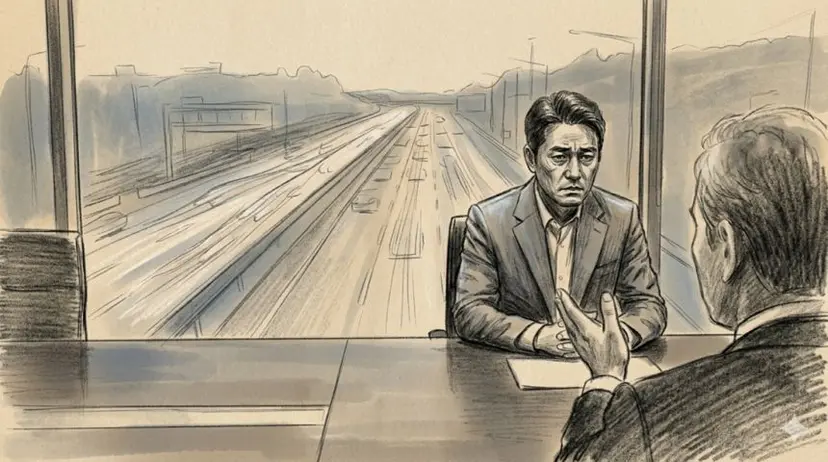
In the meeting in April 202X, he hadn't explicitly demanded a new title. Instead of saying "from Executive Director to Senior Executive Director," he chose the phrase "expansion of duties and roles." But the meaning was clear. More authority, a bigger position.
The response was a polite rejection. It was explained as difficult given the current organizational structure, followed by words of comfort that he was already in a sufficiently important role. Leaving the conference room, Jeong thought briefly:
‘Is this as far as it goes?’
That November, he brought up the same topic again. This time, the sentence was different.
“If it’s difficult this time as well… I think I’ll have to move on.”
2.
The intention to resign was formalized early the following year. The stated reason was a move to Europe. When he said he wanted to be by his children’s side while they studied abroad, the company tried to stop him.
“What about a leave of absence? Take a year off. The company will cover your living expenses.”
They could not simply let go of a core talent in device technology. The negotiation table heated up quickly.
“Even if you resign, if you stay on as an advisor, we will pay you 12 million won per month. On the condition that you do not join another company.”
They had to prevent any unfortunate incident, even if there was only a slight possibility. That’s why they offered even better terms. But Jeong shook his head.
“I don’t think there’s anything more I want to do here.”
The move to Europe was real. He had booked flight tickets, registered for language classes, and even looked into renting a house. But that wasn’t everything. Jeong Myeong-jung had a plan.
3.
Around this time, his work patterns began to change.
“I will come to the office until mid-March. I’ll work from home until early April, and then use vacation days for the rest…”
Late one night, he logged into the company’s internal network and opened a file.
‘2X0908_Mega_Project_Strategy_v0.19).pptx’
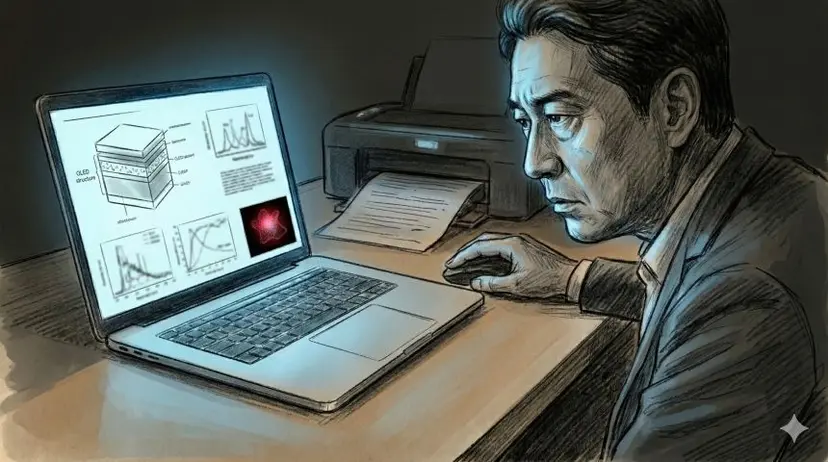
It was a long-term strategic plan containing detailed device development schedules, investment timelines, and strategies for each equipment line. As he slowly scrolled, he hovered his cursor over the print icon. He selected several slides packed with figures, graphs, and core data to print. While the printer was running, he opened new files to check OLED material combinations, evaluation results, and process conditions.
The security system was quietly recording these logs.
The company where Jeong worked held national core technology. Materials were managed by grade, and files classified higher than internal-only were accessible only to authorized personnel. The Data Loss Prevention (DLP) system monitored file viewing and print logs, and any external transfer required supervisor approval.
At the exit on his way home, security checks were conducted daily, inspecting bags, printouts, and storage devices. Company security apps ran on his smartphone, and camera functions were restricted inside the office. Employees signed a non-disclosure agreement for trade secrets and received security training every year. Executive-level researcher Jeong Myeong-jung was no exception.
After he began working from home, he started requesting materials from his team members. They sent him everything from meeting minutes regarding OLED TV devices from the past two years to Excel files with material combination data and evaluation results. The requests didn't stop once. Only after team member Lee Seong-hoon, who felt something was strange, cautiously reported it to the group leader, was an order issued to stop sending the data. Meanwhile, since first expressing his intent to resign, Jeong had also repeatedly printed his resume and the profiles of company executives for nearly a year.
4.
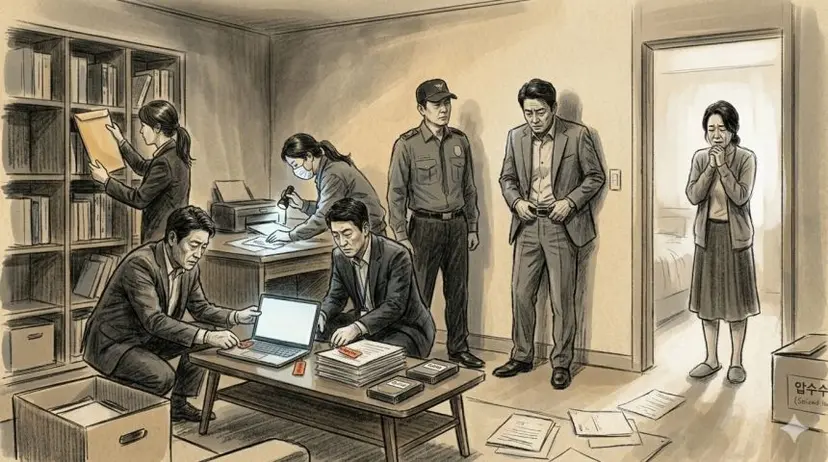
What the investigators found in his home during the search and seizure was not just printouts, laptops, and work notebooks.
An envelope tucked between books on a shelf. The top of the contract pulled from it bore a clear Chinese character.
華東光電 (Huadong Optoelectronics).
It was a Chinese display company competing with his firm. Inside the envelope, which had no sender name or address, were two copies of an employment contract in Chinese. It was hard to doubt that the recipient was anyone other than Jeong. From his rare Chinese name to his home address and phone number, everything was his.
The position was 'R&D Center Scientist.' A fixed salary of 2.08 million yuan with a performance bonus of 800,000 yuan, totaling an annual salary of 4.5 million yuan including various allowances. At the time's exchange rate, that was about 860 million won. The contract duration of three years, the start date, salary payment conditions, and even commercial insurance coverage were all meticulously listed. The only thing left blank was the signature line.
5.
One day in February 2026, at a criminal court in a regional district.
The court pointed out that while he had only printed company cloud materials 16 times the previous year, the number surged to 114 times (74 general documents, 40 confidential or higher) in 2021, when his promotion request was denied.
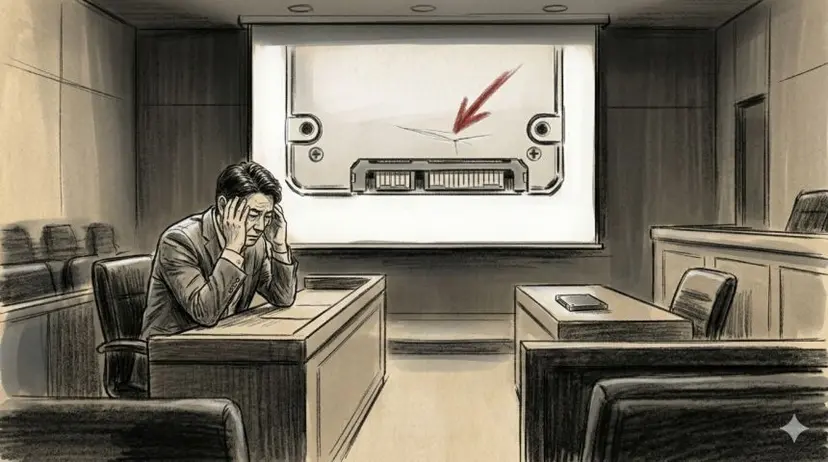
Traces of hard drive removal and reattachment found on the defendant’s work laptop were deemed strong circumstantial evidence. Digital forensic analysis revealed that the SSD of the work laptop had been removed and reattached during his work-from-home period. The next day, most of the technical data on the laptop was deleted. It was the same laptop that contained vast amounts of the victimized company’s technical data, including OLED devices and deposition line equipment specifications.
The defendant claimed he contacted an IT firm to repair the laptop, but no record of requesting repairs from the company's IT department or any external service provider could be found. The National Forensic Service, with the consent of both the prosecution and the defense, produced results identical to the forensic report. The court concluded, “It is difficult to imagine any purpose other than attempting to copy data through other means after detaching the storage device.”
Also considered were the facts that the defendant had been in contact with an acquaintance working for the Chinese competitor via KakaoTalk around the time of his resignation, and that a Chinese employment contract with specific conditions was discovered at his residence.
The court ruled, “Considering that in a typical contract, two copies are drawn up for each party to keep, the fact that there were two copies indicates that negotiations on the terms were effectively completed, and the situation had reached a stage where only the defendant’s signature was needed to return one copy.”
Regarding the defendant’s statement that he “didn’t know who left the contract there,” the court noted that it was “difficult to accept from a common-sense perspective.”
Based on these circumstances, the court concluded it was highly likely that the defendant had leaked the materials with the intent to join the competitor after his resignation and utilize the data. However, it determined that the amount of leaked material was not massive and no actual damage or financial gain had yet been realized.
“The defendant is sentenced to 2 years in prison.”
Jeong hung his head for a moment. It was impossible to know what he was thinking. 15 years of research, a denied promotion, an envelope on a bookshelf—everything converged into this short sentence.
The signature line remained unfilled. The plane to Europe never took off.
This article reconstructs a 2022 case where an executive-level researcher at LG Display034220 was indicted for unauthorized removal of the company's national core technology materials ahead of his resignation. After his promotion request was denied, the researcher's printing activity spiked, and traces of dismantling his work laptop's hard drive were discovered during his work-from-home period. A search and seizure of his residence yielded an employment contract from a Chinese competitor offering a salary of 4.5 million yuan (860 million won). This incident had not been previously reported in the media.
LG Display, which holds national core technology, strives to prevent tech leaks by building various security systems. If anomalies are detected through constant monitoring systems—such as increases in the printing of core documents or transmission of internal emails to external addresses—the team leader is immediately notified, and the individual is asked to provide an explanation. If suspicion of a security leak arises during the investigation, they immediately file for a police investigation and press charges. Additionally, when signs of resignation are detected, they collaborate with the HR department to perform security audits, and even after departure, they continue to monitor for signs of joining a competitor or leaking information, requesting investigations from authorities if necessary. In this case, the full story was revealed through the company’s investigation request.
The Suwon District Court (Judge Kim Dal-ha) handed down a prison sentence, determining that the act of a researcher handling national core technology betraying that trust and removing materials inflicts great harm on national competitiveness. However, it took into account that the leaked data was recovered through the search and seizure and that no actual damage or financial gain was confirmed. Ultimately, the researcher was sentenced to two years in prison.
![[Tech Spy] ① "114 Files Printed After Promotion Was Denied": The Full Story of the LG Display Tech Leak Case](https://s.bizhankook.com/attachments_thumb/2026/05/97960_thumb.webp)
![[Tech Espionage] ② Solvay, SKC, SK Hynix: 'CMP Slurry' Technology Stolen Whole... The Audacious Conspirators](https://s.bizhankook.com/attachments_thumb/2026/05/98043_thumb.webp)
![[Tech Espionage] ③ “Lured by a Sweet Job Offer…” How Internal Audits Saved HKMG and CIS Blueprints](https://s.bizhankook.com/attachments_thumb/2026/05/98253_thumb.webp)
![[Tech Espionage] ⑤ State secrets stacked away on a server bound for China... The downfall of a 'Samsung Man' who sold semiconductor technology](https://s.bizhankook.com/attachments_thumb/2026/05/98489_thumb.webp)
![[Tech Spy] ⑤ Even if the '23 Trillion Won' Cow Is Lost, We Must Keep Repairing the Barn...](https://s.bizhankook.com/attachments_thumb/2026/05/98605_thumb.webp)