

[비즈한국] With a subscription rate of about 70% of the total population, private medical insurance is often referred to as the "second national health insurance." However, it suffers from a distorted structure where the top 9% of subscribers receive about 80% of total insurance payouts. Medical abuse driven by private medical insurance has already disrupted the market and left irreparable scars on the healthcare system, including the avoidance of essential medical care. This series explores the history of private medical insurance, its impact when combined with non-covered services in non-critical sectors, and the direction that the upcoming 5th-generation insurance must take.

The reason private medical insurance is included in medical reforms is that it often leads to "excessive treatment" when combined with non-covered services. Patients want to receive expensive care because they have paid premiums to their insurer, and doctors encourage it because they earn money based on the treatments they perform. Their interests are mutually aligned. "Information asymmetry" also plays a role here. As non-experts, patients find it difficult to determine what medical services they truly need or how much the services provided by a doctor have contributed to their health. Consequently, patients often opt for expensive treatments based on a single question to the doctor: "Is this covered by my private medical insurance?"
Taking advantage of this, non-covered medical fees set by medical institutions vary wildly. It is rare for a patient to research prices beforehand, and the amounts paid fluctuate significantly. Although it has been over a decade since health authorities began disclosing non-covered medical fees to protect patient choice, the initially anticipated "price competition effect" has been minimal. The system has become one that patients are unaware of and medical institutions ignore. As of 2024, the government discloses prices for 623 non-covered items across all medical institutions (treatment materials (167), MRI (75), ultrasound examination fees (78), vaccinations (63), functional examination fees (46), treatment and surgical fees (44), dental treatment/surgical fees (20), dental prosthetic fees (14), medical devices (12), certification fees (31), and others (73)).
The price gap is also evident in surveys conducted by the Ministry of Health and Welfare and the Health Insurance Review and Assessment Service (HIRA). According to the "2024 Non-Covered Price (Medical Expense) Survey and Analysis Results," the minimum cost for a multifocal lens for cataract surgery at one clinic in Seoul was approximately 290,000 KRW, while another clinic in Seoul charged 6.8 million KRW. The maximum price of 6.8 million KRW was 3.1 times the median price of 2.2 million KRW. For manual therapy, one clinic in Seoul charged 100,000 KRW, while a clinic in Gyeongnam charged about 260,000 KRW. The average cost for manual therapy increased by 2.5% year-on-year, and the maximum price (280,000 KRW) was 2.8 times the median price (100,000 KRW).
Such medical practices became more pronounced following the implementation of the "transition of non-covered items to covered (national health insurance) status." This implies that medical institutions bear significant responsibility. According to the Korea Insurance Research Institute’s report on "Analysis of Non-Covered Private Medical Insurance Payouts," the average price of multifocal lenses surged after September 2020, when cataract-related tests were transitioned to coverage. Among the top 10 clinics with a high proportion of inpatient claims for cataracts, all but two raised the unit price of multifocal lenses. As the average cost of cataract-related tests dropped from 1.3 million KRW before September 2020 to around 50,000 KRW after September 2020, clinics chose to offset this by raising the unit price of multifocal lenses. The report noted an increase from an average of 2.66 million KRW to 4.2 million KRW.
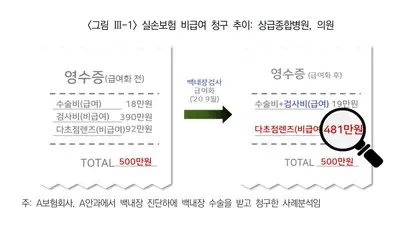
The report also pointed out that in many cases, the total claimed amount remained identical to that before the transition to coverage. Before the transition, test fees (non-covered) amounted to 3.9 million KRW; after the transition, while the test fee (covered) dropped significantly to 10,000 KRW, the cost of multifocal lenses rose from 920,000 KRW to 4.81 million KRW, resulting in the same total claim of 5 million KRW as before the transition. In short, before the transition, the total was 5 million KRW (Surgery fee (covered) 180,000 KRW + Test fee (non-covered) 3.9 million KRW + Multifocal lens (non-covered) 920,000 KRW). After the transition, the total remained 5 million KRW (Surgery fee + Test fee (covered) 190,000 KRW + Multifocal lens (non-covered) 4.81 million KRW). The report analyzed that "the transition of cataract-related test fees to insurance coverage is expected to have increased total private medical insurance payouts in 2020 by 3.42%."
Rising loss ratios for insurers ultimately threaten the sustainability of private medical insurance. Future generations may be unable to purchase private medical insurance to use "when they need it." The loss ratio for insurers remains high. Since 2009, it has never dropped below 100%. According to basic statistics from the Korea Insurance Development Institute, the combined loss ratio (incurred loss ratio + expense ratio) for private medical insurance was 113.8% in 2018, 125.5% in 2019, 123.7% in 2020, 124.6% in 2021, 111.6% in 2022, and 113.7% in 2023. Although insurers raise premiums significantly every year, the rate of increase still fails to keep pace with the loss ratio. Consequently, the supply is shrinking, with about 10 insurance companies recently discontinuing the sale of private medical insurance products.
![[Emergency Diagnosis: Private Health Insurance] ① The ‘Second National Health Insurance’ with 70% Coverage: 9% of Policyholders Take the Lion’s Share of Benefits](https://s.bizhankook.com/attachments_thumb/2026/05/93877_thumb.webp)
![[Emergency Diagnosis of Private Medical Insurance] ② Why the cost remains unchanged after the 'cataract surgery' transition to national health insurance coverage](https://s.bizhankook.com/attachments_thumb/2026/05/93928_thumb.webp)
![[Emergency Diagnosis of Private Medical Insurance] ③ Why is the 2nd Phase of Medical Reform 'Weak'?](https://s.bizhankook.com/attachments_thumb/2026/05/93998_thumb.webp)
![[Emergency Diagnosis of Private Health Insurance] ④ How has the '5th Generation Private Health Insurance' changed from the government's promises?](https://s.bizhankook.com/attachments_thumb/2026/05/94057_thumb.webp)